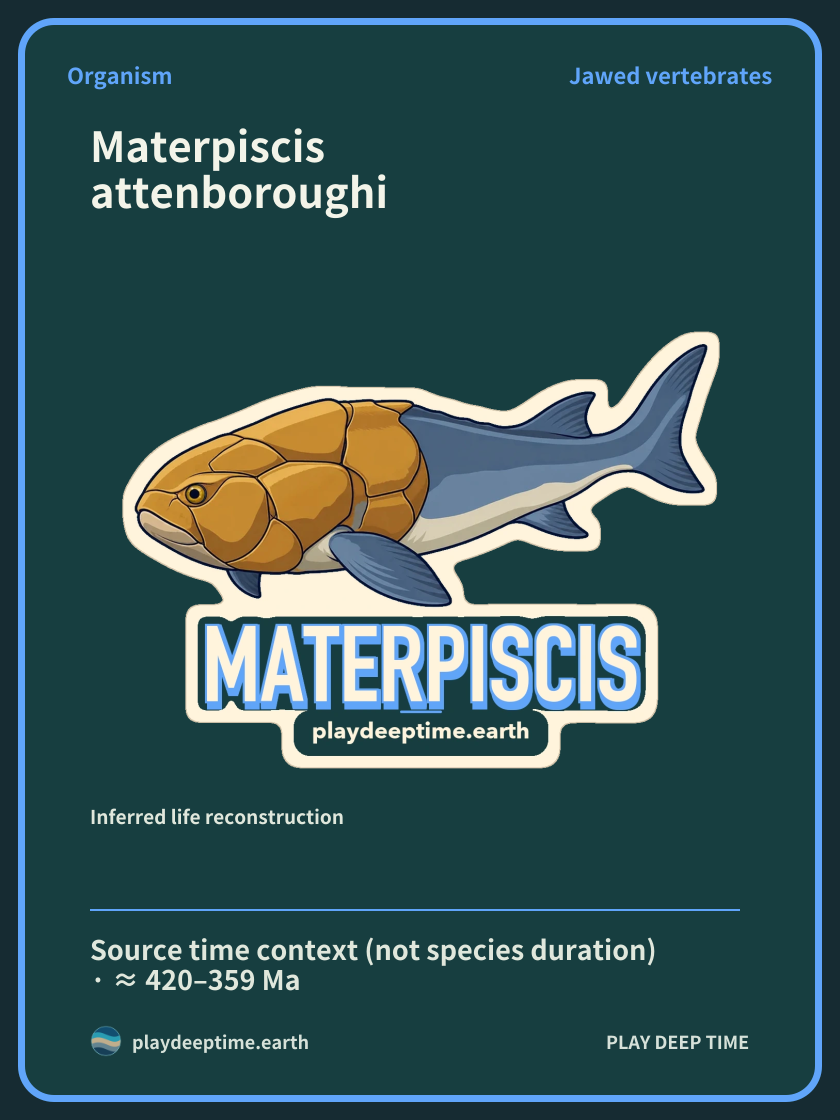
Organism · Jawed vertebrates
Materpiscis attenboroughi
Source time context (not species duration) · ≈ 420–359 Ma
Inferred life reconstruction
Materpiscis attenboroughi
Overview
Materpiscis attenboroughi is a Devonian fish reported to preserve an embryo and umbilical connection inside its body. The adult’s head and trunk are studied through their hard armor. External armor and a tiny offspring preserved inside tell an intriguing story together.[1][3]
Loading illustration…
Key facts
A single embryo remained inside the fossil fish’s abdomen. Researchers reported it together with a mineralized umbilical connection. The discovery allowed investigation not only of bones and armor but also of how offspring developed.[3]
Time and place
The type specimen came from Gogo Station near Fitzroy Crossing in present-day Western Australia. A 2008 study described it as early Frasnian material of the Late Devonian from the Gogo Formation. The Devonian as a whole spans roughly 420–360 million years ago.[1][2]
The time range describes source context, not the complete duration of this species.
Size, form and skeleton
Type specimen WAM 07.12.1 preserves adult head and trunk armor and part of the tail. The body is described as scaleless with a low median ridge. The hard armor and the body extending behind it can be examined separately.[1]
A 2015 study of vertebrate size listed an adult body length of 18.7 cm for Materpiscis. This fish measured about 19 cm from snout to tail tip and is known from a fossil preserving an offspring inside its body.[6]
Loading illustration…
Habitat and reproduction
Researchers interpreted the embryo and umbilical connection inside the adult as evidence for reproduction in which offspring developed internally before birth. Ancient fish reproduction cannot therefore be imagined solely as laying eggs externally. A tiny embryo revealed something about adult life.[3]
Fossil discovery
An embryo and connecting traces were reported in the specimen studied for its adult armor. The 2008 paper presented the material in research on Devonian live birth. A discovery about adult form expanded into offspring inside the body and reproduction.[1][3]
References
- Study of birth in the Devonian — Armour and body of Materpiscis
- International Commission on Stratigraphy (2024) — Geological time chart
- 2008 study — An embryo and traces of an umbilical cord inside an adult
- Royal Ontario Museum — Waptia fieldensis species account
- Study of birth in the Devonian — Armour and body of Materpiscis
- Sallan·Galimberti (2015) — Changes in vertebrate size before and after the end-Devonian extinction
Research questions
How can a small fossil be identified as an embryo? Researchers considered its position inside the adult, its structure, and the umbilical connection together. Where and in what form a fossil is preserved provide important evidence for inferring reproduction.[3]
Observation
First examine the hard armor covering the head and trunk. Then picture the tiny embryo and umbilical connection preserved inside, bringing outward appearance and life history together.[1][3]
Related organisms
 Waptia fieldensisArthropodsSource time context (not species duration) · ≈ 539–487 Ma
Eggs beneath a carapace, offspring inside a body
Cambrian Waptia from the Burgess Shale in present-day Canada carried eggs beneath its carapace, while an embryo and umbilical connection were reported inside a Devonian Materpiscis fossil from the Gogo Formation in present-day Western Australia. Connect an arthropod and a fish from widely separated times to compare where developing offspring were preserved in relation to the body.