Organism · Birds and early avialans
upland moa
Fossil record age bounds · ≈ 2.58–0 Ma
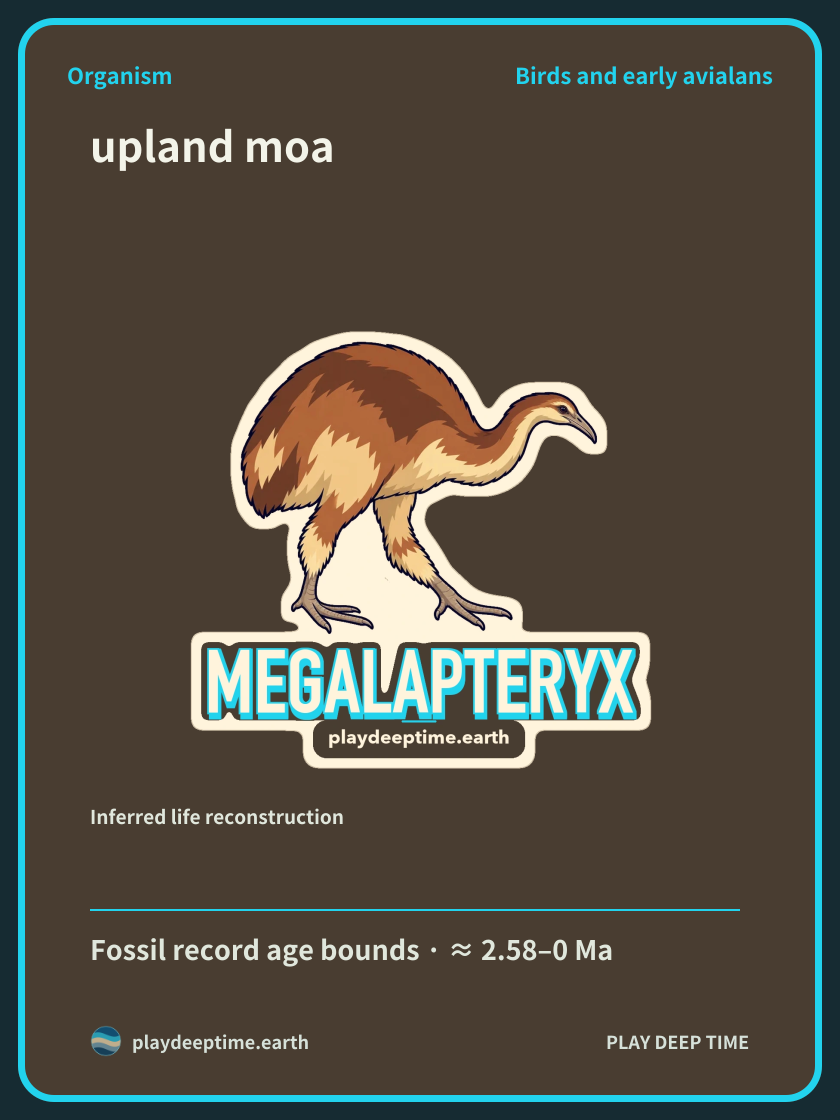
Inferred life reconstruction
Megalapteryx didinus
Overview
The upland moa was an extinct flightless bird from the South Island of New Zealand. It is described as having a relatively slender body, a small head, and feathers extending down its lower legs. Its long toes and low head posture can also be examined.[1][2]
Loading illustration…
Key facts
Mummified remains preserve clues about feathers as well as bones. Descriptions record plumage with mixed light and dark areas, alongside relatively plain or striped feathers. A single bird species offers varied feather evidence.[1]
Time and place
It is known as a moa of the South Island of New Zealand. A museum describes one skeleton as approximately 15,000 years old, while the species account discusses moa history extending into the Holocene. The Holocene began approximately 12,000 years ago.[1][2][3]
The time range describes source context, not the complete duration of this species.
Size, form and skeleton
It is described as having a less bulky body, a small head, and a slightly curved, pointed beak. The lower legs were feathered and the toes long and slender. The museum account also highlights its low head posture and lack of wing bones.[1][2]
A New Zealand bird guide gives the upland moa (Megalapteryx didinus) a body mass of approximately 28–80 kg. This size shows that not all moas were giants.[4]
Loading illustration…
Habitat and reproduction
Did all moas have the same body shape? The upland moa had a relatively slender body and feathered lower legs. Examining head height and toes separately reveals different arrangements among flightless birds.[1][2]
Fossil discovery
Researchers study this bird through mummified remains as well as surviving skeletons. Different feather types and the skeleton provide different clues. Comparisons beginning with bones extend to evidence of the body covering.[1][2]
References
Research questions
How can different feather records enrich our picture of a species? We can examine combinations of light and dark areas and stripes separately. The question explores a fossil bird through evidence from several individuals rather than a single impression.[1]
Observation
Move your gaze from the small head across the body to the feathered lower legs and long toes. Considering the low head posture together with the slender body helps reveal the upland moa’s shape.[1][2]
Related organisms
 Pachyornis elephantopusBirds and early avialansFossil record age bounds · ≈ 2.58–0 Ma
Different bodies among moas
Explore the bodies of Megalapteryx didinus and Pachyornis elephantopus together. Megalapteryx didinus: The upland moa was an extinct flightless bird from the South Island of New Zealand. Pachyornis elephantopus: The heavy-footed moa, Pachyornis elephantopus, was a moa from the South Island of New Zealand.