Organism · Placental mammals
Mesonyx obtusidens
Source time context (not species duration) · ≈ 56–33.9 Ma
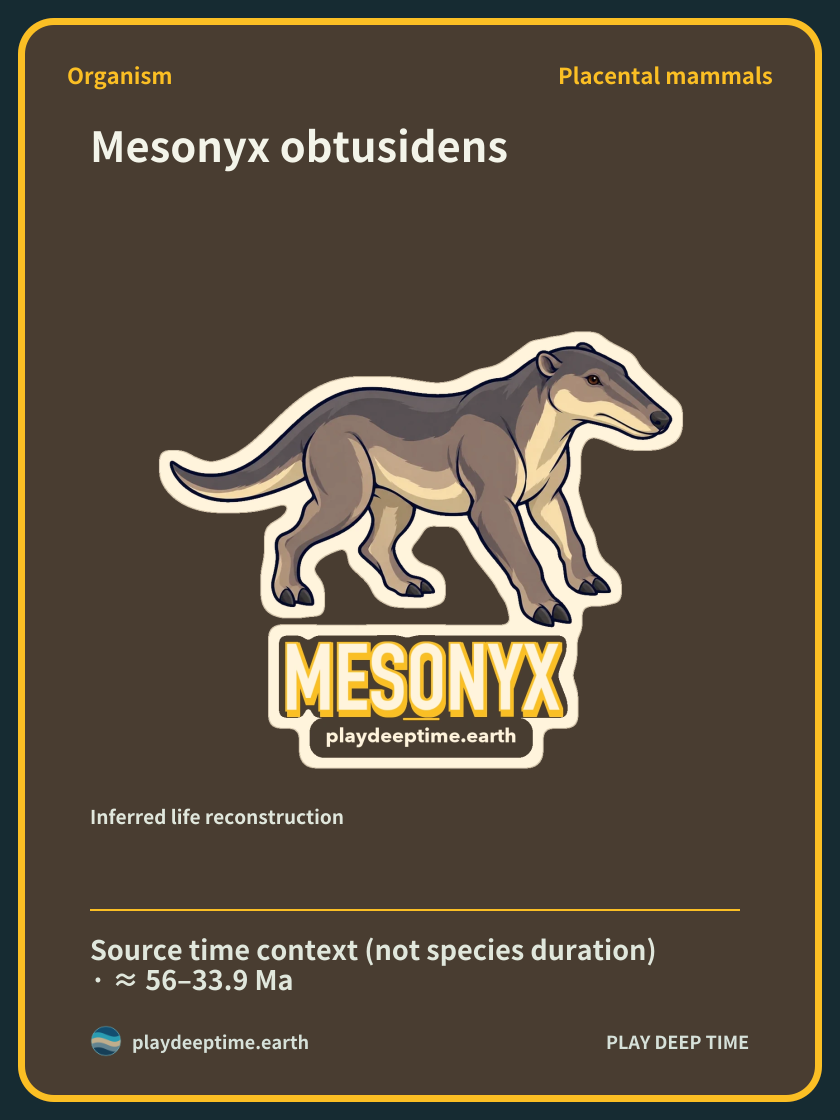
Inferred life reconstruction
Mesonyx obtusidens
Overview
Mesonyx obtusidens is an Eocene mammal from North America. Researchers study its body by comparing parts of the skull, teeth, limb bones, and vertebrae. Its story involves distinguishing similar-looking relatives bone by bone.[1][3]
Loading illustration…
Key facts
A single ankle bone can prompt a reassessment of an animal’s name. Mesonyx and Synoplotherium are so similar that some researchers proposed combining them in one genus. More recent comparisons have treated them as separate genera after examining small skeletal differences.[3]
Time and place
It is associated with Eocene material from the western USA, particularly around 50 million years ago. Fossils came from the Bridger Formation in present-day Uinta County, Wyoming. Specimens from the lower formation’s Blacks Fork Member provided a basis for comparing the two similar animals.[3][1][2]
The time range describes source context, not the complete duration of this species.
Size, form and skeleton
Museums preserve the front of the skull with teeth, limb bones, and vertebrae. AMNH FM5021 at the American Museum of Natural History is an astragalus, a bone forming part of the ankle. The neck of this bone, compared in the research, is different from the neck that supports the head.[1][3]
A comparative study of brain size gives a body mass of approximately 35–47 kg for Mesonyx obtusidens. These values use fossil-based estimates from earlier research and help convey the size of this hoofed carnivore.[7]
Loading illustration…
Habitat and reproduction
The limbs supporting the body matter alongside the head when studying this mammal’s life. Its close relative Synoplotherium is described as having more robust limbs than Mesonyx. This difference raises questions about how similar animals may have moved differently over land.[3]
Fossil discovery
Smithsonian specimen records connect different body regions with their discovery sites. A 2021 study revisited older specimens and stratigraphic records to compare occurrences of Mesonyx. Long-preserved ankle bones can contribute to new taxonomic research.[1][3]
References
- Smithsonian — Specimen catalogue for Mesonyx obtusidens
- International Commission on Stratigraphy — Geological timescale
- Tomiya et al.2021 — Diversity of carnivorous mammals in the Washakie Formation
- Tomiya et al.2021 — Diversity of carnivorous mammals in the Washakie Formation
- Tomiya et al.2021 — Diversity of carnivorous mammals in the Washakie Formation
- Smithsonian — Specimen catalogue for Mesonyx obtusidens
- Orliac et al. (2012) — Brain and body-size comparisons in early mammals
Research questions
How different must two similar animals be to warrant separate genera? Researchers consider bone shape and size alongside the layers in which the specimens were found. The close relationship between Mesonyx and Synoplotherium illustrates how such comparisons accumulate.[3]
Observation
Move your gaze from the head to the legs and ankles. After viewing the broad outline, compare small joint bones to explore relationships hidden beneath outward appearance.[1][3]
Related organisms
 Viverravus gracilisPlacental mammalsSource time context (not species duration) · ≈ 56–40 Ma
Different mammals of Eocene Wyoming
Viverravus and Mesonyx are mammals known from Eocene strata in present-day Wyoming, USA. Compare the bodies and bones of different specimens to explore a wider range of this region’s ancient mammals.