Organism · Birds and early avialans
Messelastur gratulator
Source time context (not species duration) · ≈ 56–33.9 Ma
Inferred life reconstruction
Messelastur gratulator
Overview
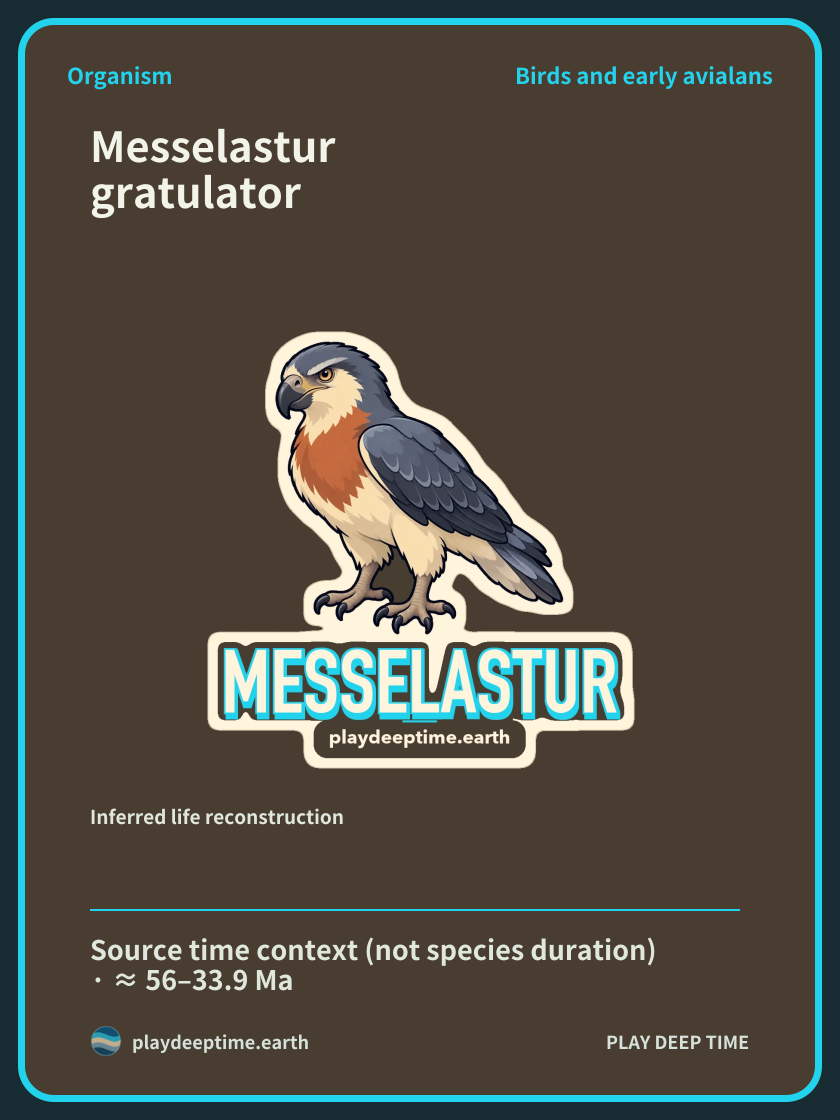
Messelastur gratulator is an unfamiliar bird that lived in Eocene Germany. Its large head, short and deeply curved bill, and robust legs draw attention. Features recalling owls, parrots, and birds of prey come together in one body.[1][2]
Loading illustration…
Key facts
How can relatives be found when similar features are scattered across several groups? The head and legs of Messelastur recall different birds. This combination made it intriguing material for studying the family tree of early birds.[1][2]
Time and place
It is associated with Messel, Germany, around the Middle Eocene, roughly 48 million years ago. Sediments of an ancient lake preserved delicate bird skeletons. Messel is a locality where a variety of birds, as well as mammals and plants, can be compared.[1][3]
The time range describes source context, not the complete duration of this species.
Size, form and skeleton
The head is large, the lower jaw deep, and the bill short and curved. The legs are short and robust. The partial skeleton SMF-ME11080 became important material for connecting features previously seen separately in the head with the postcranial skeleton.[1]
One skeletal specimen of Messelastur gratulator had a skull length of about 4.5 cm. Its short bill with a curved tip accounted for about one quarter of the skull length. The head, large relative to the body, featured a thick lower jaw and a hook-like bill tip.[7]
Loading illustration…
Habitat and reproduction
The curved bill and robust legs invite investigation of how food was handled. Researchers compare the structures of the toes and legs as well as the bill. This provides an example of examining the combinations in which food-handling features appeared in early birds.[1][2]
Fossil discovery
Comparisons expanded when a specimen connecting the postcranial skeleton with the previously known skull was added. A 2005 study analyzed the postcranial bones and relationships. In 2021, Tynskya, a relative in the same family from the London Clay of Britain, was compared again.[1][2]
References
- Mayr2005 — The skeleton of Messelastur and bird relationships
- Mayr2021 — New skeletal comparisons of Messelasturidae
- International Commission on Stratigraphy — Geological timescale
- Mayr2005 — The skeleton of Messelastur and bird relationships
- Welterbe Grube Messel — Three species of Leptictidium from Messel
- Mayr2021 — New skeletal comparisons of Messelasturidae
- Mayr (2005) — Postcranial skeleton and morphology of Messelastur
Research questions
Did similar bills and feet come from a shared ancestor, or arise through similar ways of life? Research on Messelasturidae addresses such questions through combinations of several bones. The toe structure of the close relative Tynskya added new questions to the comparison.[1][2]
Observation
Move your gaze from the large head and curved bill to the short, robust legs. It is interesting to compare whether several familiar kinds of birds come to mind at once.[1]
Related organisms
 Leptictidium auderienseTheriansSource time context (not species duration) · ≈ 56–33.9 Ma
Birds and mammals of Messel
Messelastur and Leptictidium are Eocene organisms known from Messel in present-day Germany. Examine the different skeletons of a bird and a mammal in sequence to explore the varied bodies preserved at this fossil locality.