Organism · Animals
Minitaspongia parvis
Fossil record age bounds · ≈ 359–347 Ma
Inferred life reconstruction
Minitaspongia parvis
Overview
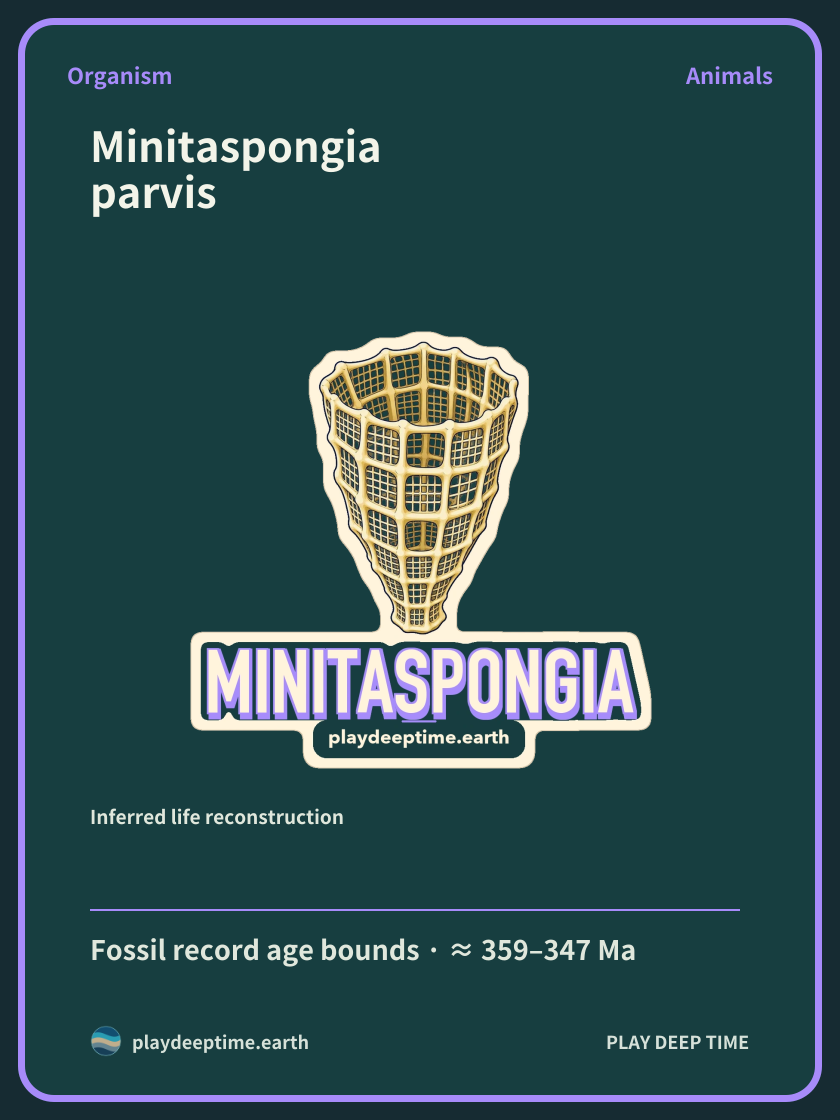
Minitaspongia parvis is an ancient marine sponge characterized by an upward-widening, cup-shaped body and a lattice skeleton. Smaller grids continue within larger square frameworks. The fossil lets us examine the broad body outline alongside its intricate skeleton.[1]
Loading illustration…
Key facts
The genus name Minitaspongia comes from Sierra de las Minitas, where the fossils were found. The species name parvis is linked to Latin words for small and young. The paper considered this small specimen probably a juvenile. Its name combines the locality with the impression of a small body.[1]
Time and place
It is known from Tournaisian strata of the Early Carboniferous. The locality is Sierra de las Minitas in present-day La Rioja Province, Argentina, and the fossils came from the Agua de Lucho Formation. They provide evidence for exploring the sea of western Gondwana.[1]
The time range describes source context, not the complete duration of this species.
Size, form and skeleton
The nearly complete type specimen PULR-I4 was described as approximately 3–4 cm tall and about 20 mm wide. Its body widens upward from a narrow base, and its lattice contains square openings of at least two sizes. The paper describes a broad, deep interior space, shown as a cup in the authors’ diagram.[1]
Loading illustration…
Habitat and reproduction
The researchers interpreted the fossil-bearing sediments as a record of an ancient marine shelf influenced by glaciers. The sponge’s environment was described as having relatively weak water movement. The strata preserving its complex lattice body offer clues to a cold ancient sea.[1]
Fossil discovery
A 2018 study described the new genus and species from the nearly complete type specimen PULR-I4 and the fragmentary paratype PULR-I5. The two specimens came from different geological blocks separated by faults. The researchers examined body and skeletal features in material from concretions within a black mudstone interval.[1]
References
Research questions
Complex, thick sponge skeletons have sometimes been explained as adaptations to rough, shallow seas. However, the sponge in this study came from a relatively calm, cold depositional environment. The researchers explain that a complex skeleton alone cannot establish that an animal lived by withstanding strong currents.[1]
Observation
The illustration follows the type specimen’s body outline and the cup-shaped diagram in the paper. The paper credits Santiago Druetta with creating that schematic reconstruction. Move your gaze from the upper opening through the square lattice to the narrow lower body. The sense of depth and the colors help make the structure easier to read.[1]
Related organisms
 Ventriculites radiatusAnimalsSource time context (not species duration) · ≈ 143–66 Ma
Different bodies among sponges
Explore the bodies of Minitaspongia parvis and Ventriculites radiatus together. Minitaspongia parvis: Minitaspongia parvis is an ancient marine sponge characterized by an upward-widening, cup-shaped body and a lattice skeleton. Ventriculites radiatus: Ventriculites radiatus is a Late Cretaceous sponge with a funnel-like body.