Organism · Molluscs
Monotis (Entomonotis) subcircularis
Source time context (not species duration) · ≈ 252–201 Ma
Inferred life reconstruction
Monotis (Entomonotis) subcircularis
Overview
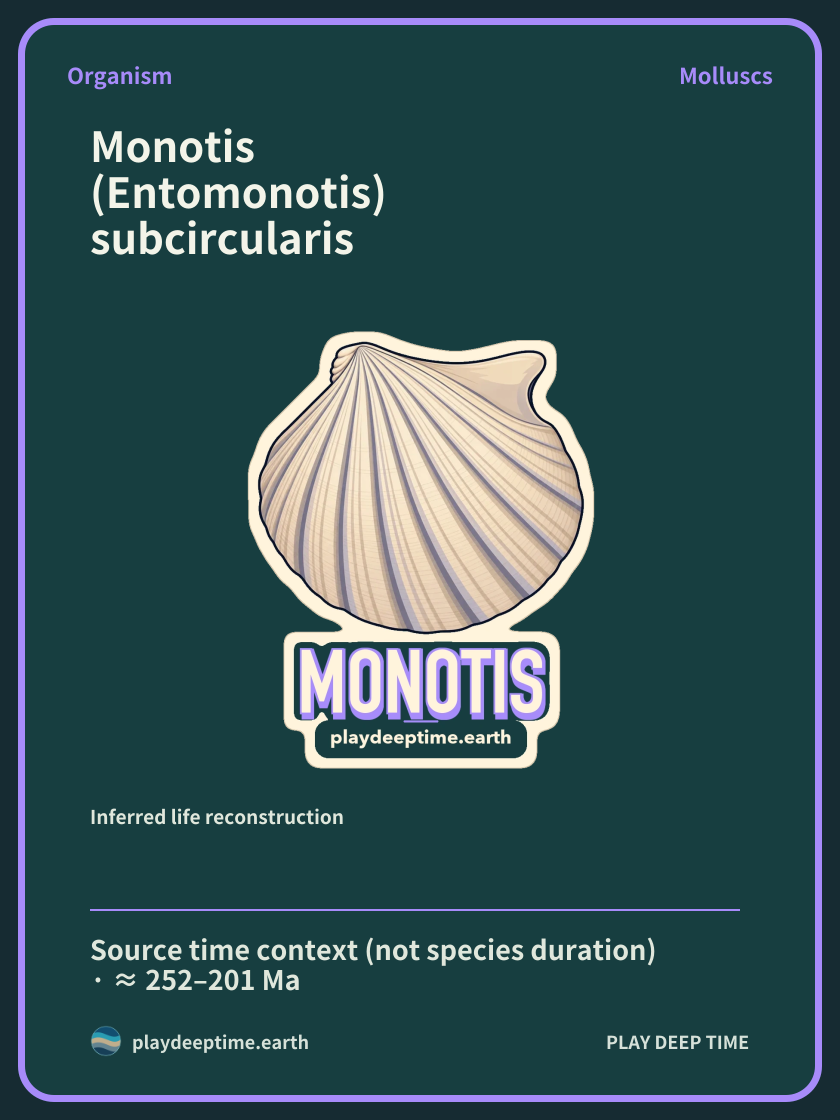
Monotis subcircularis is a Late Triassic bivalve. Strong and weak radiating ribs, with still finer ribs between them, create a distinctive rhythm. Even small surface patterns can help distinguish ancient organisms.[1]
Loading illustration…
Key facts
The ribs do not repeat at a uniform thickness. Weaker ribs occur between strong ones, with finer ribs between those. Examining the closely spaced concentric growth lines crossing the radial ribs adds depth to the shell’s ornamentation.[1]
Time and place
It is studied through material from the middle and late Norian of the Late Triassic, around 220–210 million years ago. It has also been recorded from several marine formations in present-day Alaska, United States. Localities now near the Arctic preserve ancient marine bivalves.[1][2]
The time range describes source context, not the complete duration of this species.
Size, form and skeleton
The left valve is slightly more convex than the right. At the rear is a smooth, ear-like projection, behind which the outline becomes deeply concave. The contrast between the strongly ribbed main surface and the unribbed rear region is characteristic.[1]
Monotis subcircularis was a bivalve of Late Triassic seas. A study compiling Alaskan fossils describes large shells as reaching approximately 12 cm long. The rounded or oval shells preserve strong radiating ribs together with closely spaced concentric markings.[3]
Loading illustration…
Habitat and reproduction
This bivalve is important evidence for comparing Triassic marine sediments. Examining shells and associated fossils from different localities connects regions of ancient seas. A small shell links marine time and space.[1][2]
Fossil discovery
A 1963 US Geological Survey guide described differences between the valves and the stronger and weaker ribs on their surfaces. Later regional surveys added records from Alaskan localities. This fossil connects older taxonomic research with field mapping.[1][2]
References
Research questions
Is a smaller, more convex shell a juvenile or another species? Researchers compare whether the shapes of specimens found together form a continuous range. Distinguishing growth differences from species differences is an important question in fossil bivalve research.[1]
Observation
Move your gaze from the smooth rear auricle to the densely ribbed main surface. Look for the repetition of stronger and weaker ribs and the growth lines crossing them.[1]
Related organisms
 Exogyra ponderosaMolluscsSource time context (not species duration) · ≈ 143–66 Ma
Different bodies among bivalves
Explore the bodies of Monotis subcircularis and Exogyra ponderosa together. Monotis subcircularis is a Late Triassic bivalve. Exogyra ponderosa is a Cretaceous bivalve in which a flat right valve fits against a large, convex left valve.