Organism · Placental mammals
Moropus elatus
Source time context (not species duration) · ≈ 23–5.33 Ma
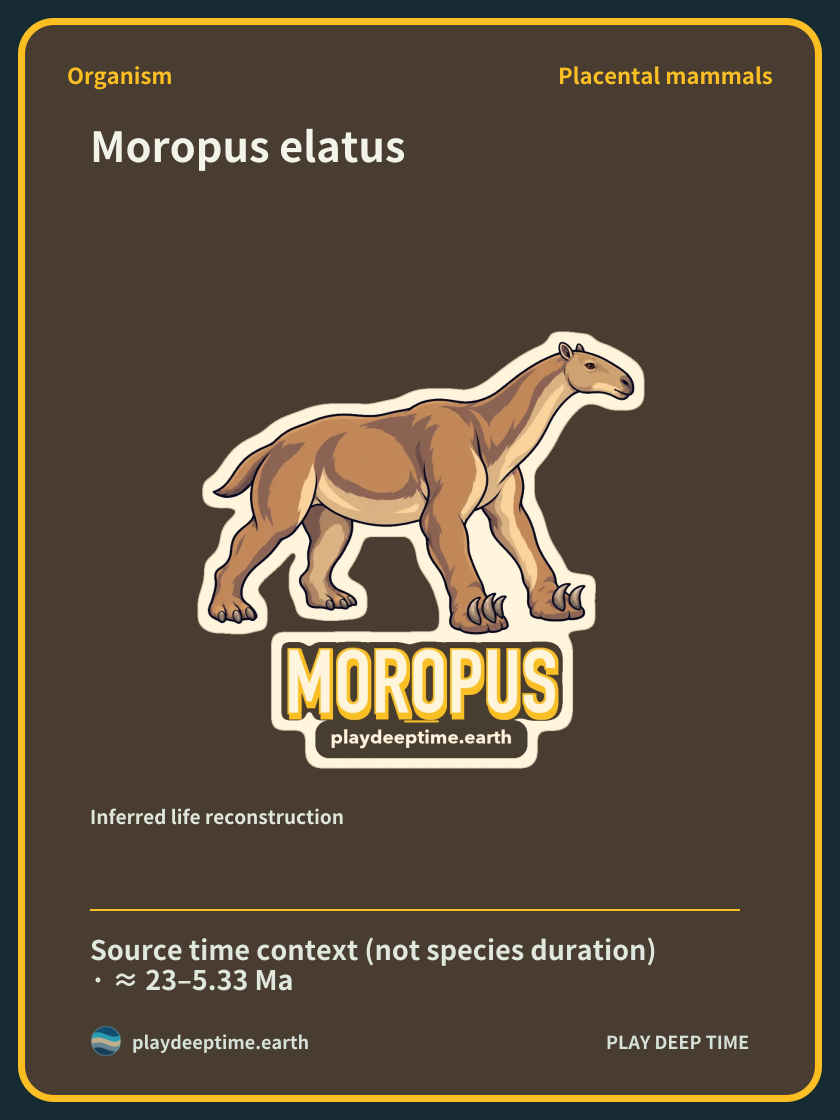
Inferred life reconstruction
Moropus elatus
Overview
Moropus elatus is a plant-eating mammal distinguished by large hook-shaped claws rather than horse hooves. It is studied as an animal with a small head, a long, sloping neck, and unusual forefeet. It offers a different example of a large herbivore’s body.[1][2]
Loading illustration…
Key facts
Its hooked claws raise a question: how did its feet contact the ground? Functional research proposed a posture in which the claws were bent upward above the foot pads. The directions in which bones connect lead to questions about how the body was supported.[1]
Time and place
This mammal is known from Miocene North America. The Miocene spans roughly 23–5 million years ago. Its body and its use can be compared with those of other herbivorous mammals with large claws.[2][3]
The time range describes source context, not the complete duration of this species.
Size, form and skeleton
A small head, a long, sloping neck, and large hooks on the forefeet are characteristic features used in comparisons. The description of forefoot specimen 1604 distinguishes the claw bone’s convex dorsal surface, concave inner surface, and split tip. Even one hook has several different surfaces.[1][2]
A comparative study gives a lower molar-row length of approximately 10.9–15 cm. This measures the row of food-chewing molars, not the length of the entire body.[4]
Loading illustration…
Habitat and reproduction
It is compared with other large-clawed herbivorous mammals. Researchers interpreted its supporting posture by considering forefoot bones and the positions of pads together. This raises questions about how the body used for feeding and the feet contacting the ground worked together in one animal.[1][2]
Fossil discovery
Skeletal research described the connections between species-specific bones and forefoot specimens. Later functional comparisons considered claw flexion and supporting posture alongside other large herbivorous mammals. These studies connect individual bone surfaces with whole-body posture.[1][2]
References
- Comparative study of large-clawed herbivorous mammals
- Study of chalicothere skeletons — Moropus
- International Commission on Stratigraphy (2024) — Geological time chart
- Li et al. (2022) — Comparison of early Miocene chalicothere mandibles
- American Museum of Natural History — Chalicotheriidae
- Anquetin·Antoine·Tassy (2007) — Miocene Chalicotheriinae
Research questions
How could it support its weight despite curved claws? Researchers compare the convex and concave surfaces of the claw bones with joints and pad positions. These unfamiliar feet raise questions about the diverse ways mammals move.[1][2]
Observation
Move your gaze from the small head along the sloping neck to the hooks on the forefeet. Remembering that the inner and outer claw surfaces differ helps explain the structure of the feet.[1][2]
Related organisms
 Chalicotherium goldfussiPlacental mammalsSource time context (not species duration) · ≈ 23–5.33 Ma
Different bodies among mammals
Explore the bodies and backgrounds of Moropus elatus and Chalicotherium together. Moropus elatus: a plant-eating mammal distinguished by large hook-shaped claws rather than horse hooves, studied as having a small head, a long, sloping neck, and unusual forefeet. Chalicotherium: Chalicotherium goldfussi is a Miocene mammal studied through jaws and finger bones of the forefeet. Material from related animals provides clues for comparing long forelimbs and a sloping back.