Organism · Primates
Morotopithecus bishopi
Source time context (not species duration) · ≈ 23–5.33 Ma
Inferred life reconstruction
Morotopithecus bishopi
Overview
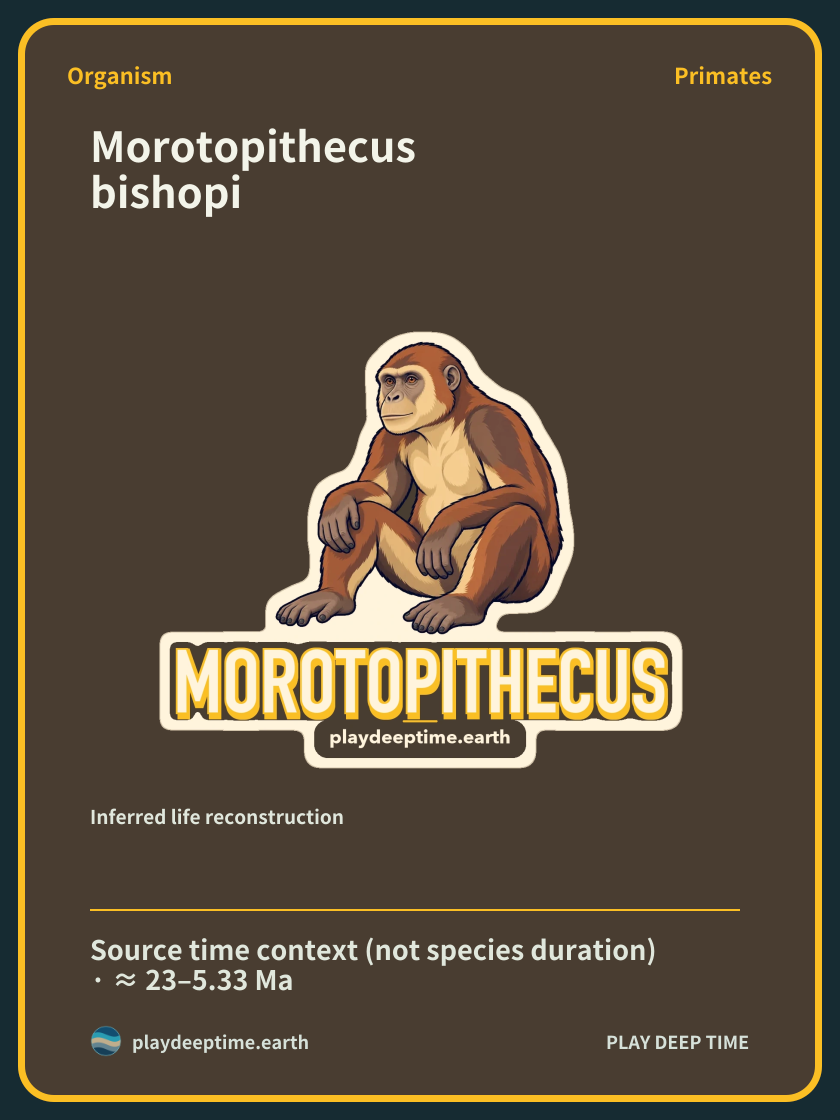
Morotopithecus bishopi is an early ape proposed on the basis of fossils from Moroto in present-day Uganda. Material from the head, teeth, vertebral column, and limbs was studied together. This is a case of exploring an ancient ape’s body by comparing bones from several regions.[1]
Loading illustration…
Key facts
Researchers regarded the left and right femoral fragments of MUZM80 as belonging to one individual. Shoulder material also came from another site in the same region. Fossils from different body parts and localities convey different information.[1]
Time and place
Miocene material from Moroto in present-day Uganda was studied. The Miocene as a whole was roughly 23–5.3 million years ago. The age of the Moroto strata and faunal comparisons were also discussed in later research.[1][3]
The time range describes source context, not the complete duration of this species.
Size, form and skeleton
The research material includes the head and teeth, lumbar vertebrae, femora, and part of the shoulder. MUZM80 from Moroto II and MUZM60 from Moroto I add clues about the limbs and shoulder respectively. Several regions of the body can be compared side by side.[1]
Loading illustration…
Habitat and reproduction
What can the lower back and shoulder tell us about posture? Researchers compared them with structures in living apes that hold their trunks upright or hang from supports. This research interprets possible postures through bone shape.[1]
Fossil discovery
A 1997 study examined head and dental material from Moroto together with newly collected femoral and shoulder material. Later discussions addressed whether primitive facial and dental features and more derived lumbar vertebrae should be assigned to the same species. Fossil attribution is intertwined with our understanding of the body.[1][2]
References
Research questions
How can we judge whether separate bones belong to the same species? Size, form, locality, and comparisons with other animals provide clues. Research on Morotopithecus shows how discussions of the attribution of several body parts can change our understanding of the whole body.[1][2]
Observation
Move your observations from the head to the lower back, shoulder, and femur. Considering separately what each part reveals about posture and body connections brings out the questions involved in comparing several fossils.[1]
Related organisms
 Victoriapithecus macinnesiPrimatesSource time context (not species duration) · ≈ 23–5.33 Ma
Different bodies among primates
Explore the bodies and living backgrounds of Morotopithecus bishopi and Victoriapithecus macinnesi together. Morotopithecus bishopi: Morotopithecus bishopi is an early ape proposed on the basis of fossils from Moroto in present-day Uganda. Material from the head, teeth, vertebral column, and limbs was studied together. Victoriapithecus macinnesi: Victoriapithecus macinnesi is a Miocene primate known from several heads, jaws, and limb remains. An abundant assemblage from Maboko in present-day Kenya has been studied.