Organism · Globothalamea
Morozovella aragonensis
Source time context (not species duration) · ≈ 56–33.9 Ma
Inferred life reconstruction
Morozovella aragonensis
Overview
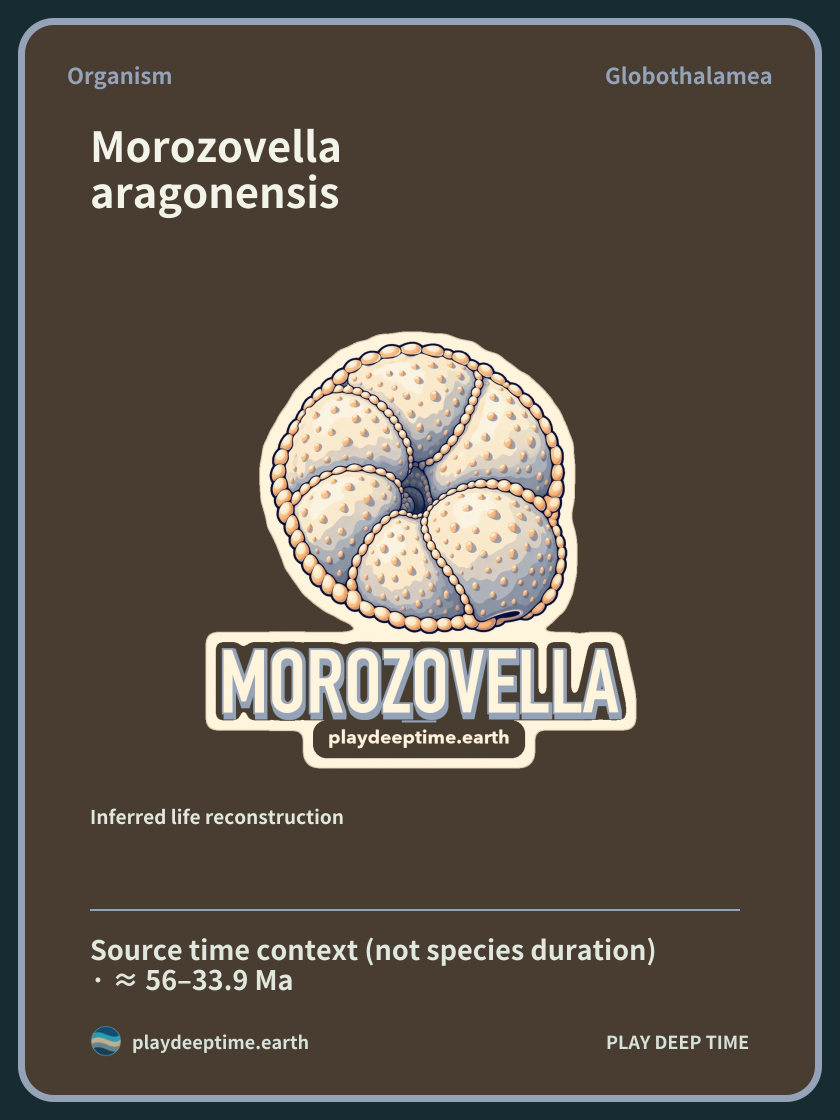
Morozovella aragonensis is an Eocene foraminifer with a calcareous shell formed from small chambers arranged in a spiral. Its features include a nearly circular outline, one convex side, and a narrow, deeply recessed center. Even this tiny shell contains several structures to explore.[1][2]
Loading illustration…
Key facts
Approximately five to seven chambers are described in the final whorl. This refers to the outermost coil, not the total number of chambers in the shell. Identifying what is being counted helps explain the form.[2]
Time and place
It was first described from Eocene fossils of the Aragon Formation in Mexico. The Eocene spans roughly 56–34 million years ago. Later expert diagnoses and specimen comparisons helped reinterpret the older description.[2][3]
The time range describes source context, not the complete duration of this species.
Size, form and skeleton
Spirally arranged chambers surround a narrow, deep central umbilicus. Descriptions include small blunt surface projections, bead-like raised boundaries between chambers, and a thickened margin. The absence of long spines does not mean that all of these smaller surface irregularities are absent.[1][2]
Loading illustration…
Habitat and reproduction
The calcareous shell consists of several chambers, boundaries between them, and an opening beneath the final chamber. Rather than treating the tiny outline as a single whole, examine chambers, gaps, and margins separately. The shell that enclosed the body remains as evidence for distinguishing foraminifers.[1][2]
Fossil discovery
Material described by Nuttall in 1930 led to later discussions of specimen designation. A 2006 synthesis compared the specimens selected by different researchers as references for the name. Connections between the numbers assigned to tiny specimens and old plates became an important taxonomic question.[2]
References
- Nuttall, W.L.F. (1930). Eocene Foraminifera from Mexico. Journal of Paleontology4:271–293; original description of Globorotalia aragonensis on p.288 transcribed by Mikrotax
- Berggren·Pearson (2006) — Morphology and classification of Morozovella
- International Commission on Stratigraphy (2024) — Geological time chart
- Mikrotax — Original-description catalogue and shell description of Hantkenina
Research questions
Do illustrations associated with one name all show different views of a single individual? The research history of this species includes debate about linking illustrations with specimen numbers. It shows why comparisons of form must accompany precise identification of individual specimens.[2]
Observation
Follow the outer spiral to see the sequence of chambers. Move from the deep central umbilicus toward the margin, looking for chamber boundaries and small surface projections.[1][2]
Related organisms
 Hantkenina compressaForaminiferaFossil record age bounds · ≈ 48.1–5.33 Ma
Different bodies among foraminifers
Explore the bodies of Morozovella aragonensis and Hantkenina compressa together. Morozovella aragonensis: an Eocene foraminifer with a calcareous shell formed from small chambers arranged in a spiral. Hantkenina compressa: a fossil foraminifer that left a small calcareous shell.