Organism · Molluscs
Myalina (Orthomyalina) subquadrata
Source time context (not species duration) · ≈ 359–252 Ma
Inferred life reconstruction
Myalina (Orthomyalina) subquadrata
Overview
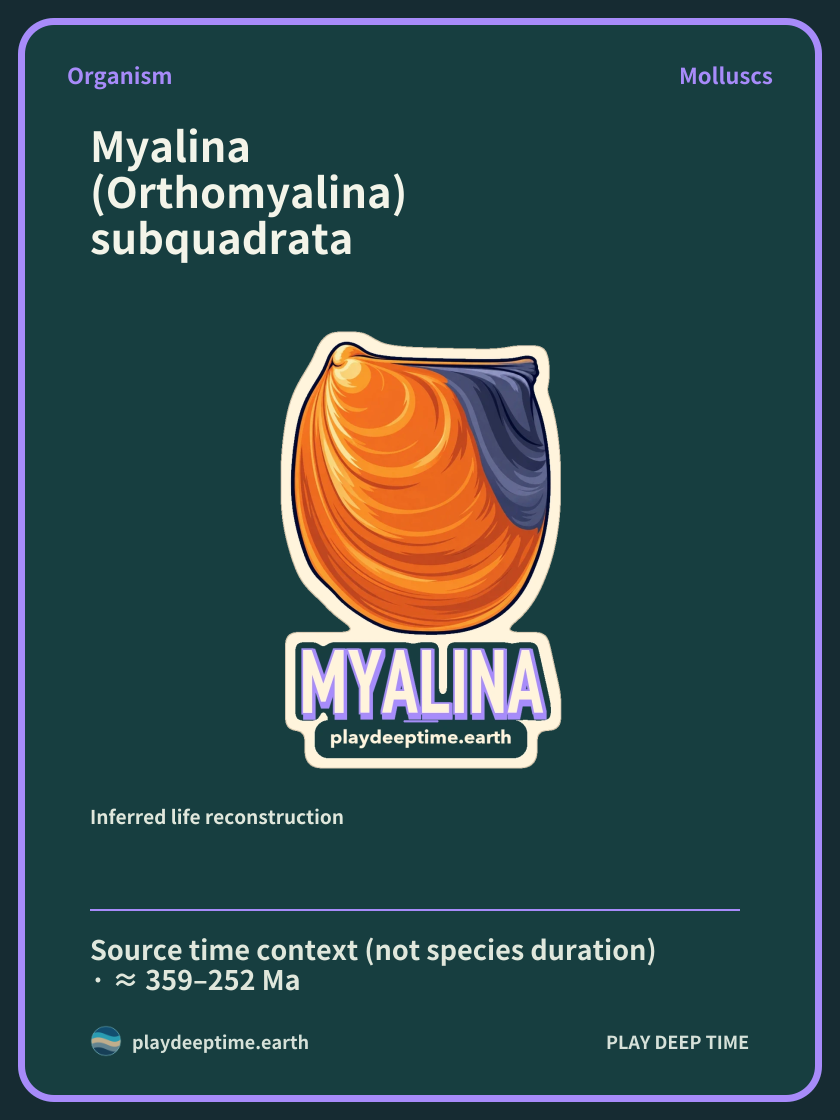
Myalina subquadrata is a bivalve known for a nearly rectangular shell and long hinge. A shallow, broad posterior groove is also distinctive. The broad shell outline can be compared alongside small differences at its margins.[1]
Loading illustration…
Key facts
The ridge extending from the umbo is described as becoming flattened in adults. Even one species can change appearance with growth stage. This provides a reason to consider how mature a specimen is when comparing shapes.[1]
Time and place
It is known from literature addressing Late Carboniferous and Early Permian occurrences. The broad background from the Carboniferous through the Permian spans roughly 360–250 million years ago. It appears in research on late Paleozoic bivalve diversity.[1][2]
The time range describes source context, not the complete duration of this species.
Size, form and skeleton
A long hinge lies along the nearly rectangular outline, with a shallow, broad groove and a short projection at the rear. The anteroventral margin is also described as well developed. Distinguishing front from rear and top from bottom reveals different regions even in a simple shell.[1]
Myalina subquadrata was a bivalve of late Paleozoic seas. Ten shells studied from the Caneyville Formation in present-day Kansas and Oklahoma, USA, were 5.3–7.8cm long. Their heights were 6.3–9.7cm, characterizing shells that extended farther vertically than lengthwise.[3]
Loading illustration…
Habitat and reproduction
The two valves are compared as structures connected by a hinge and ligament. Connecting structures within the same subgenus are examined alongside species-specific external features. One valve and the construction of the two-valved whole can be considered separately.[1]
Fossil discovery
Historical literature also discussed material confused under the name subquadrata. The broad posterior groove was treated as a feature distinguishing typical shells. The history of a name continues alongside detailed morphological comparison.[1]
References
Research questions
How can names of similar shells be sorted out when they become mixed? The literature compared posterior grooves and growth-related changes in the ridge. This process examines small features and growth stages as well as overall resemblance.[1]
Observation
Move your gaze from the long hinge to the shallow, broad groove at the rear. Examining the short projection and anteroventral margin in sequence reveals several features within the rectangular shell.[1]
Related organisms
 Monotis (Entomonotis) subcircularisMolluscsSource time context (not species duration) · ≈ 252–201 Ma
Different bodies among bivalves
Explore the bodies of Myalina (Orthomyalina) subquadrata and Monotis subcircularis together. Myalina (Orthomyalina) subquadrata: Myalina subquadrata is a bivalve known for a nearly rectangular shell and long hinge. Monotis subcircularis: Monotis subcircularis is a Late Triassic bivalve with two shell valves.