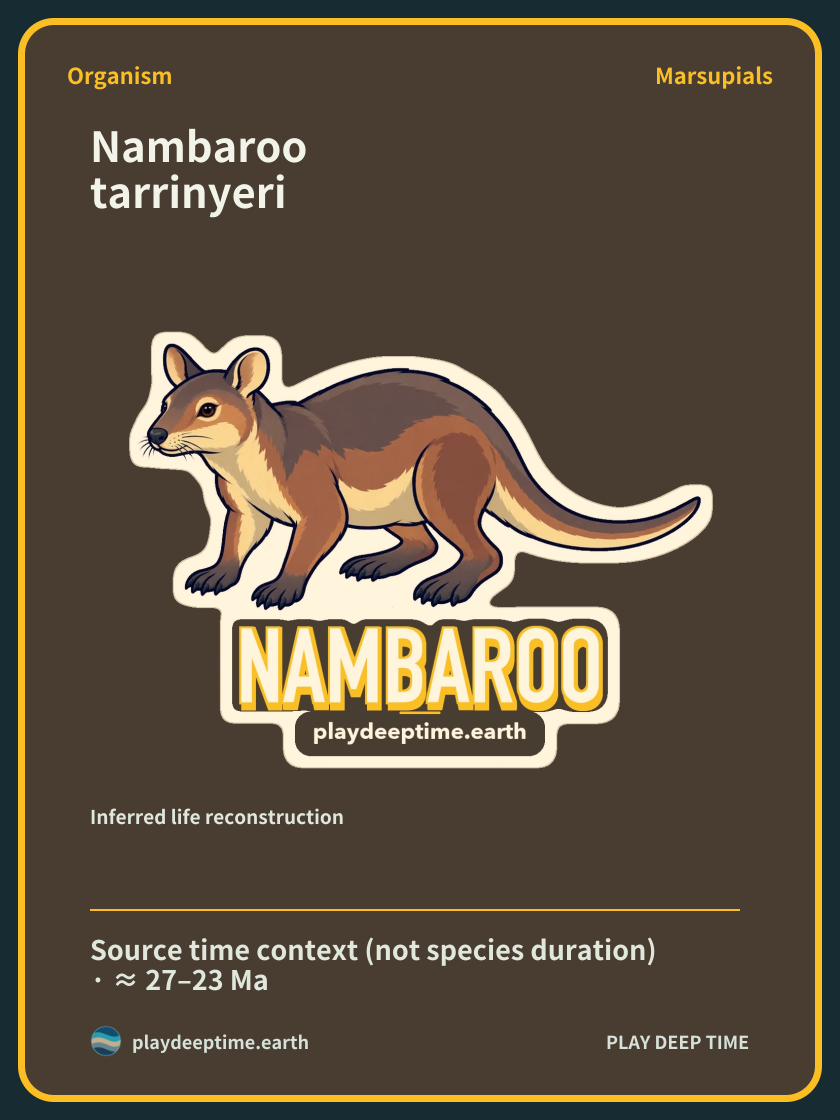
Organism · Marsupials
Nambaroo tarrinyeri
Source time context (not species duration) · ≈ 27–23 Ma
Inferred life reconstruction
Nambaroo tarrinyeri
Overview
Nambaroo tarrinyeri appears in comparisons of ancient kangaroo relatives. It is also the type species representing the genus Nambaroo. Detailed premolar structure is an important clue for recognizing this species.[1]
Loading illustration…
Key facts
A premolar attributed to NMV P157559 is described as having a backward-curving crown and seven raised cusps. Even in one small tooth, the direction of curvature and peaks on the surface are compared separately. Large skeletons are not the only protagonists of fossil research.[1]
Time and place
The fossil database’s summary of the fossil-bearing strata indicates Oligocene material roughly 27–23 million years old. A 2018 study reconsidered ancient kangaroo groups of the Oligocene and Miocene. This research examines time conveyed by strata alongside form conveyed by teeth.[2][1]
The time range describes source context, not the complete duration of this species.
Size, form and skeleton
The p3 assigned to the species refers to a lower premolar. The backward-curving crown and seven cusps are central to its description. Such tooth structures can provide more detailed information for distinguishing species than an initial impression of the whole body.[1]
Loading illustration…
Habitat and reproduction
How did ancient kangaroo relatives move? Research on Nambaroo and balbarids includes different interpretations of quadrupedal walking and hopping ability. Questions comparing species through teeth can be read alongside questions exploring locomotion through body bones.[1]
Fossil discovery
The 2018 revision transferred some Riversleigh material formerly called Nambaroo to Ganawamaya. Nambaroo tarrinyeri was treated as the type species of Nambaroo. As new comparisons accumulate, fossils once grouped under one name may be separated again.[1]
References
Research questions
Do descriptions of an organism change when a fossil’s name changes? Reclassifying material formerly introduced as Nambaroo prompts a fresh reading of which teeth and body bones belong to which group. This is a case in which organizing names also connects to research on lifestyle.[1]
Observation
Imagine the premolar’s curvature and raised cusps. You can examine how much information one small preserved fossil structure provides for distinguishing an organism’s name.[1]
Related organisms
 Macropus goliahMarsupialsFossil record age bounds · ≈ 5.33–0 Ma
Different bodies among kangaroos
Explore the bodies of Nambaroo tarrinyeri and Macropus goliah together. Nambaroo tarrinyeri: Nambaroo tarrinyeri appears in comparisons of ancient kangaroo relatives. Macropus goliah: Macropus goliah is an extinct member of the kangaroo family also associated with the name Procoptodon goliah.