Organism · Placental mammals
Nannippus peninsulatus
Source time context (not species duration) · ≈ 9.4–0.012 Ma
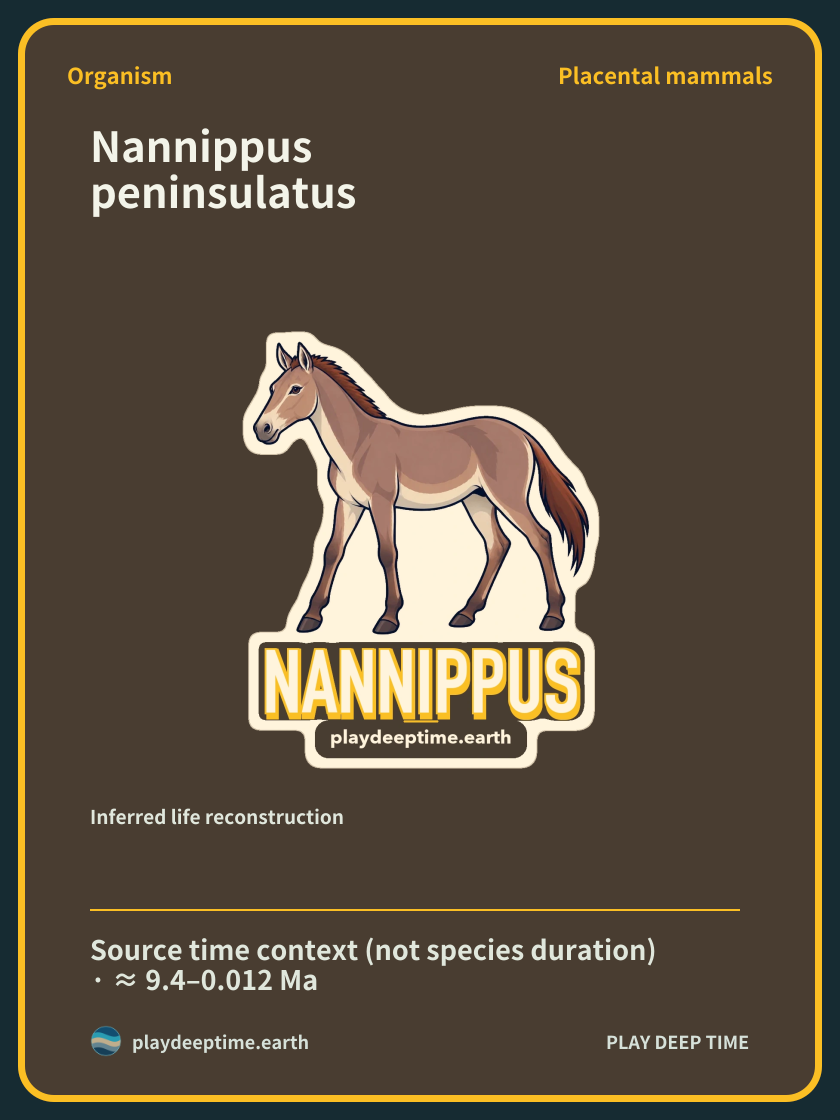
Inferred life reconstruction
Nannippus peninsulatus
Overview
Nannippus peninsulatus is a member of the horse family known from teeth. Researchers also interpreted body functions associated with running. Small dental specimens and broader comparisons among horses provide different information.[1][2]
Loading illustration…
Key facts
The holotype AMNH8345 is a tooth specimen. It is intriguing that the material representing an animal’s name can be a small tooth rather than a large skeleton.[1]
Time and place
Recorded fossil-bearing strata are summarized within a broad window of approximately 9.4 million to 12,000 years ago, spanning the Miocene through the Pleistocene. Dental material from several regions appears in research on the species.[1][4]
The time range describes source context, not the complete duration of this species.
Size, form and skeleton
Material assigned to the species includes the holotype tooth and other dental specimens. The literature treats it as an equid and compares body function. Direct dental evidence and the arrangement of horses can be considered at different scopes.[1][2]
One study estimated the body mass of Nannippus peninsulatus at approximately 75 kg. This small horse roamed Pliocene North America, revealing a time when small-bodied horses lived alongside large ones.[5]
Loading illustration…
Habitat and reproduction
How were the feet of running-adapted horses used? The literature interprets the possibility that one toe was used functionally. It invites a distinction between the anatomical number of toes and their weight-bearing function.[2]
Fossil discovery
A 1984 study compiled the holotype tooth of Nannippus and material collected from several regions. Other sources discuss tooth sections, wear, and relationships among historical names. Small fossils bring together several questions about form and naming.[1][3]
References
- MacFadden (1984) — Study of Nannippus teeth and specimens
- Comparative literature on body function in Nannippus
- Comparative study of Nannippus teeth and historical names
- Paleobiology Database — Age of fossil-bearing strata of Nannippus
- Janis·Bernor (2019) — How did horse toes and locomotion change?
- Bernor et al. (1997) — Hippotherium from Höwenegg
Research questions
Can the same tooth look different depending on wear? Comparing sections and wear states changes the clues available for reading its form. Nannippus illustrates examining one dental region in several ways.[3]
Observation
First examine the surface and wear of the tooth specimen. Picturing limb function in horses alongside it helps distinguish small dental evidence from broader body comparisons.[1][2]
Related organisms
 Hippotherium primigeniumPlacental mammalsSource time context (not species duration) · ≈ 23–5.33 Ma
Different bodies among horses
Explore the bodies and life settings of Nannippus and Hippotherium primigenium together. Nannippus: Nannippus peninsulatus is a member of the horse family known from teeth. Researchers also interpreted body functions associated with running. Hippotherium primigenium: Hippotherium primigenium is a three-toed member of the horse family. Late Miocene material from Höwenegg has been studied in detail.