Organism · Flowering plants
Nelumbo aureavallis
Source time context (not species duration) · ≈ 56–51 Ma
Inferred life reconstruction
Nelumbo aureavallis
Overview
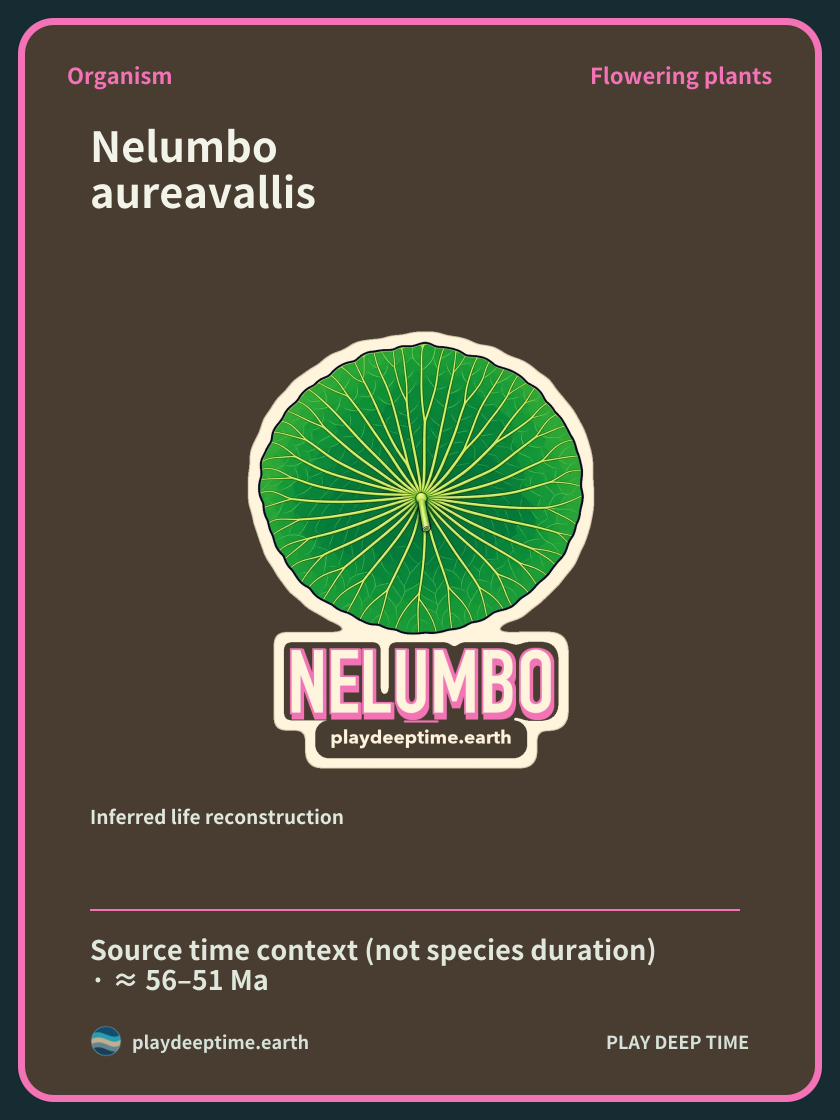
Nelumbo aureavallis is a fossil lotus relative from the Eocene. Veins radiating outward through rounded leaves reveal the appearance of an ancient waterside plant. Compare it with living lotus leaves to find similarities and differences.[1]
Loading illustration…
Key facts
Approximately 35–45 major leaf veins are reported for comparison. This exceeds the approximately 18–25 veins in other lotus relatives examined in the paper. Even familiar rounded leaves tell a new taxonomic story when their veins are counted.[1]
Time and place
It is known from early Eocene strata within a range of approximately 56–51 million years ago. The locality is the Golden Valley Formation in present-day North Dakota, USA. Ancient leaf fossils introduce the plant world of North America’s past.[3]
The time range describes source context, not the complete duration of this species.
Size, form and skeleton
The genus Nelumbo is familiar for shield-shaped leaves with petioles attached toward the center. In this species, the number of densely radiating major veins is an important comparative feature. After examining the leaf outline, follow its internal branches.[1]
Loading illustration…
Habitat and reproduction
Nelumbo, the genus containing lotuses, is a group of aquatic perennial herbs. Its broad leaves and petioles filling waterside space can be compared with living relatives. An ancient species known from leaves introduces the long history of aquatic plants.[1]
Fossil discovery
Hickey’s 1977 study of plants from the Golden Valley Formation is associated with the species name. A 2016 comparative study of lotus leaves discussed its numerous veins again. Old fossils remain useful comparisons in new research on leaf structure.[4][1][3]
References
- Li, Y., Awasthi, N., Nosova, N. & Yao, J.-X. (2016). “Comparative study of leaf architecture and cuticles of Nelumbo changchangensis from the Eocene of Hainan Island, China, and the two extant species of Nelumbo (Nelumbonaceae).” Botanical Journal of the Linnean Society 180:123–137. DOI 10.1111/boj.12361.
- PBDB summary of strata yielding Nelumbo aureavallis
- Paleobiology Database — Fossil occurrence records for Nelumbo aureavallis
- Hickey1977 — Stratigraphy and Paleobotany of the Golden Valley Formation
- D. M. Napper (1971), included by Kew — Stems and flower spikes of broadleaf cattail
Research questions
Does having more veins always indicate a different species? Leaf size and vein numbers can vary within a genus, so several features must be examined together. Comparing fossil and living lotus leaves connects plant classification with evolution.[1]
Observation
Follow the major veins radiating from the center of the leaf toward its margin.[1]
Related organisms
 Typha latifoliaFlowering plantsPresent
An ancient lotus and a living waterside plant
Explore the forms and backgrounds of Nelumbo aureavallis and Typha latifolia together. Nelumbo aureavallis: an Eocene fossil lotus relative whose rounded leaves and radiating veins reveal an ancient waterside plant. Typha latifolia: broadleaf cattail, a waterside plant with long leaves and brown, rod-like flower spikes, its flowers crowded among upright stems and narrow leaves. Nelumbo aureavallis: known from early Eocene strata approximately 56–51 million years old in the Golden Valley Formation of present-day North Dakota, USA. Typha latifolia: a living waterside plant centered on temperate regions; Kew describes a broad native range including the temperate Northern Hemisphere, parts of South America and Africa, and southern India.