Organism · Birds and early avialans
Neuquenornis volans
Source time context (not species duration) · ≈ 143–66 Ma
Inferred life reconstruction
Neuquenornis volans
Overview
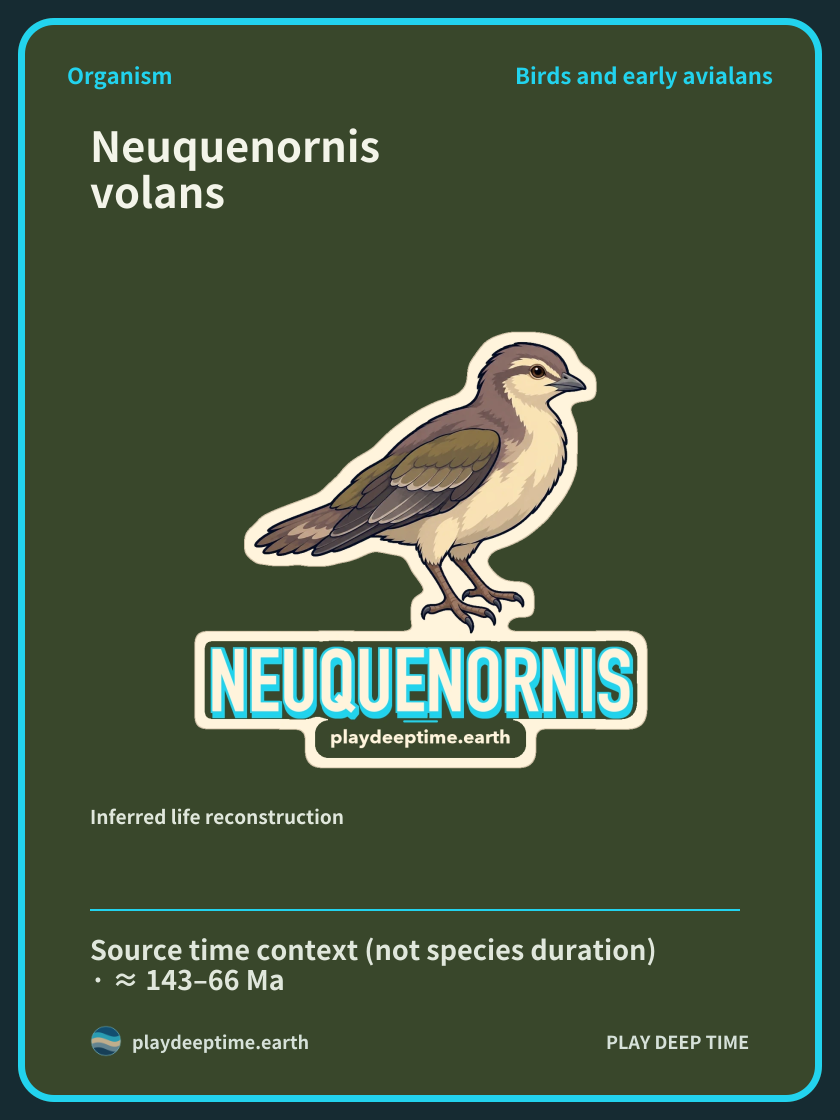
Neuquenornis volans was a bird from Patagonia in the age of dinosaurs. Fossils with articulated wing and leg bones are used to study how it flew and perched. They offer a view of the bodies of enantiornithines, a group distinct from modern birds.[1][3]
Loading illustration…
Key facts
Articulated bones can tell us more than scattered ones because they allow the relationships between wings, shoulders and legs to be compared within a single body. Researchers linked this structure to a life involving powered flight and perching on branches.[1]
Time and place
It lived in the Late Cretaceous, around 90–84 million years ago. Important fossils came from the Neuquén region of Patagonia in present-day Argentina. The Bajo de la Carpa Formation preserved the body of a bird that lived there at the time.[3][2]
The time range describes source context, not the complete duration of this species.
Size, form and skeleton
The type specimen MUCPv142 preserves some material from behind the head, along with wing, shoulder, hindlimb and trunk bones. The chest and wing bones are used to compare flight, while the feet and legs inform comparisons of perching. Another specimen compared with this species preserves the end of a humerus.[1][3]
Neuquenornis volans is estimated to have been a bird weighing a few hundred grams. In a 2016 study, the average of four calculations based on adult wing and leg bones was about 380 g.[4]
Loading illustration…
Habitat and reproduction
Researchers studying its skeleton interpreted this bird as capable of powered flight. The structure of the feet suggests a life of grasping branches and perching. We can consider both actions together: using the wings to travel through the air and the feet to secure a place to land.[1]
Fossil discovery
Chiappe and Calvo introduced Neuquenornis volans in 1994. A 1996 review of South American fossil birds compared its specimen and locality information again. Material from Neuquén and Río Negro helps connect the distribution of birds in the age of dinosaurs.[1][3]
References
- Chiappe & Calvo1994 — The skeleton of Neuquenornis volans
- International Commission on Stratigraphy — Geological timescale
- Chiappe1996 — Cretaceous bird fossils from South America
- Varricchio·Jackson (2016) — Reproduction and body size of Mesozoic birds
- Chinese Academy of Sciences — Discovery of Archaeornithura fossils
Research questions
Do similar wings necessarily imply the same relationships as those of modern birds? Comparing enantiornithine shoulders and feet reveals a separate evolutionary history. These fossils provide evidence for exploring how different bird groups of the dinosaur age flew and perched.[1][3]
Observation
Move your gaze from the shoulder to the wingtip, then to the hindlimbs and feet. Thinking about flight and branch-perching together in a single body makes each part of the skeleton more intriguing.[1]
Related organisms
 Archaeornithura meemannaeBirds and early avialansSource time context (not species duration) · ≈ 143–66 Ma
Different body forms among birds
Explore the bodies and living contexts of Neuquenornis volans and Archaeornithura meemannae together. Neuquenornis volans: Neuquenornis volans was a bird from Patagonia in the age of dinosaurs. Fossils with articulated wing and leg bones are used to study how it flew and perched. Archaeornithura meemannae: Archaeornithura meemannae was an Early Cretaceous bird whose wing feathers and fan-shaped tail feathers have been described. Two fossils assigned to the same species reveal different parts of its body.