Organism · Placental mammals
Nuralagus rex
Source time context (not species duration) · ≈ 5.33–2.58 Ma
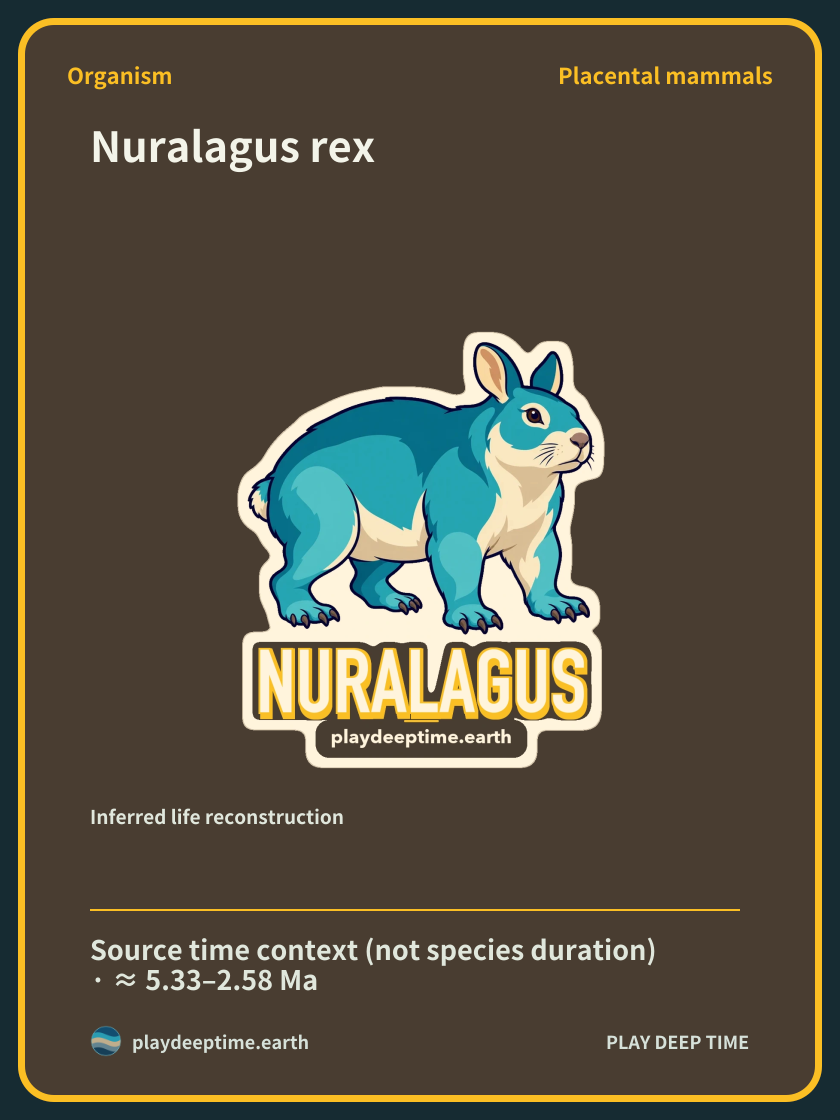
Inferred life reconstruction
Nuralagus rex
Overview
Nuralagus rex is a giant rabbit relative known from Menorca. A short, rigid trunk, robust limbs, and short, splayed hands and feet are characteristic. It shows that rabbit relatives have lived with different bodies.[1]
Loading illustration…
Key facts
Rabbit feet were not always elongated. The hands and feet of Nuralagus are described as short and splayed, and its limbs as robust. A skeleton unlike that of familiar living rabbits offers a fresh view of this giant island rabbit.[1]
Time and place
It is known from Pliocene Menorca in the Balearic Islands of present-day Spain. The Pliocene spanned approximately 5.3–2.6 million years ago. Island fossils provide evidence for comparing body forms among rabbit relatives.[1][2]
The time range describes source context, not the complete duration of this species.
Size, form and skeleton
The axial trunk is short and rigid, and the limbs are robust. The hands and feet are short and splayed, with curved terminal claw bones. The head is described as relatively small, broad, and low.[1]
The 2011 study first describing this giant rabbit in detail estimated its mean body mass at approximately 12 kg. This value was inferred from bone size.[3]
Loading illustration…
Habitat and reproduction
Short hands and feet and robust limbs provide evidence for studying ground support and movement. Body size and limb proportions can be compared with other island animals. This invites exploration of diverse bodies and possible lifestyles within rabbit relatives.[1]
Fossil discovery
Researchers assembled the skeleton by matching joint surfaces of several bones. Comparing head, limbs, and trunk, they described the giant rabbit of Menorca. Scattered bones together reveal a body arrangement different from familiar rabbits.[1]
References
Research questions
Why did this island rabbit develop a short, robust body? Trunk, limb, hand, and foot proportions are compared with those of other rabbit relatives. The fossil body broadens the view toward island environments and evolutionary questions.[1]
Observation
Move your gaze from the short, broad head to the sturdy trunk and short, splayed hands and feet. Imagining it beside a living rabbit with long, slender feet makes the differences clear.[1]
Related organisms
 Hypolagus vetusPlacental mammalsFossil record age bounds · ≈ 23–1.4 Ma
Different bodies among rabbit relatives
Explore the bodies of Nuralagus rex and Hypolagus vetus together. Nuralagus rex is a giant rabbit relative known from Menorca. Hypolagus vetus is an ancient rabbit from western North America.