Organism · Placental mammals
Odobenocetops peruvianus
Source time context (not species duration) · ≈ 7.2–5.3 Ma
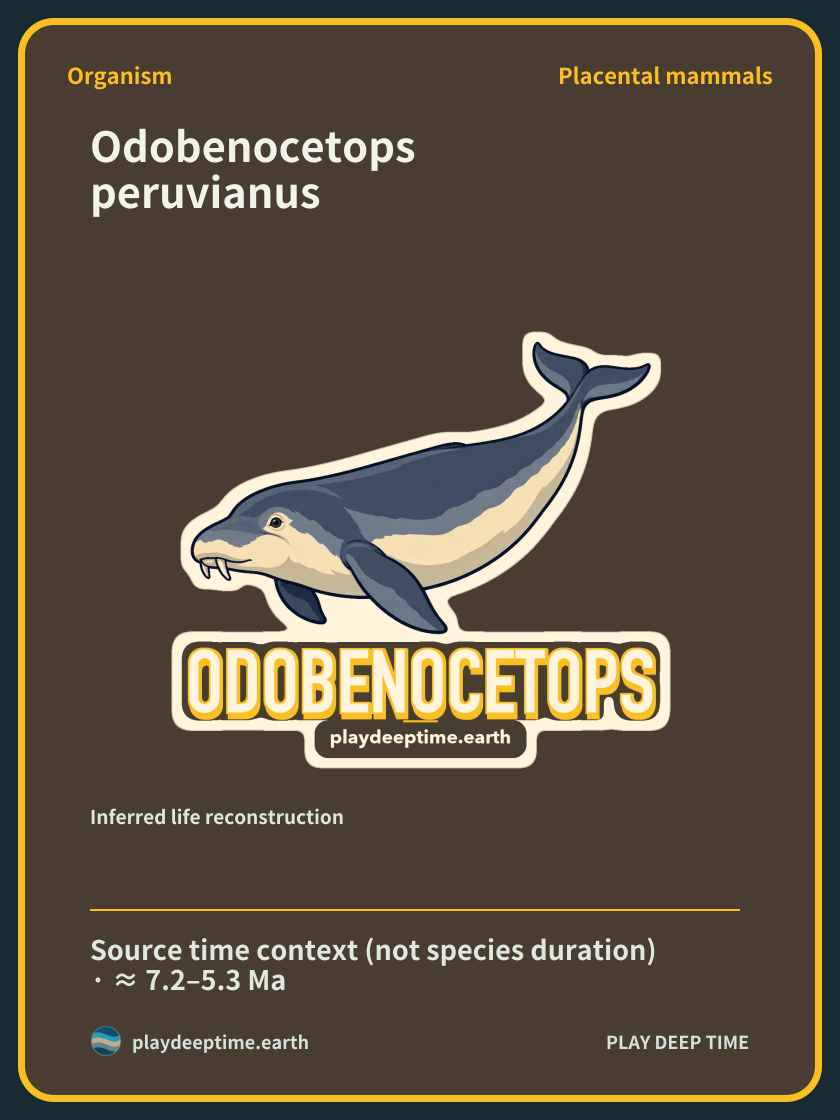
Inferred life reconstruction
Odobenocetops peruvianus
Overview
Odobenocetops peruvianus is a fossil toothed whale with a short, rounded snout and unequal tusks. Its head recalls a walrus, yet it has been studied in relation to the dolphin superfamily. Similar outward appearances and actual relationships raise different questions.[3][4]
Loading illustration…
Key facts
The tusks are not symmetrical on the left and right. A 1993 study described a whale head with a short snout and asymmetric tusks. Anyone expecting a long-snouted dolphin encounters a very different face.[3]
Time and place
This toothed whale is known from later Cenozoic material in the Pisco Formation of present-day southern Peru. Registered fossil-bearing strata are summarized as a broad window of roughly 7.2–5.3 million years ago. Its unusual head reveals marine-animal diversity at this time.[3][5]
The time range describes source context, not the complete duration of this species.
Size, form and skeleton
Features include a short, blunt snout, downward-projecting premaxillary regions, and asymmetric tusks. The eyes are studied as facing upward. Head regions combine in a way unlike familiar dolphins.[1][3]
One skull specimen of Odobenocetops peruvianus has a basal length of 41.2 cm. Although its face recalls a walrus, it belonged to the whales. This specimen preserves two relatively small tusks, allowing comparisons with the face of another specimen bearing large tusks.[6]
Loading illustration…
Habitat and reproduction
The short snout, tusks, and eye orientation raised questions about feeding and use of the surroundings. Researchers compared cranial traits with those of other groups in the dolphin superfamily. Similarity in head structures can be considered alongside interpretations of life habits.[3][4]
Fossil discovery
The 1993 original paper introduced a new toothed whale with a short snout and asymmetric tusks. A 2002 reassessment examined skulls including USNM488252 and SMNKPAL2491, along with separate auditory-bone material. Several heads made morphological comparisons more specific.[3][2]
References
- 2002 study — Cranial diagnosis of odobenocetopsids
- 2002 study — Cranial material of Odobenocetops peruvianus
- 1993 study — A toothed whale with a short snout and asymmetric tusks
- Study of the delphinoid relationships of Odobenocetops
- Paleobiology Database — Fossil-bearing strata of Odobenocetops
- de Muizon·Domning (2002) — Anatomy of Odobenocetops, a walrus-like whale
- Lambert et al. (2010) — Livyatan from the Miocene of Peru
Research questions
How was the head of a walrus-like whale constructed? Researchers compare features of the snout, premaxillae, tusks, and auditory region together. It invites us to consider similar structures appearing in distantly related animals alongside actual evolutionary relationships.[3][4]
Observation
Move your gaze from the rounded snout to the unequal tusks and upward-facing eyes. Picture a familiar toothed whale’s head beside it to reveal the unusual facial combination.[3]
Related organisms
 Livyatan melvilleiPlacental mammalsSource time context (not species duration) · ≈ 12–7.2 Ma
Different bodies among whales
Explore the bodies of Odobenocetops and Livyatan together. Odobenocetops: Odobenocetops peruvianus is a fossil toothed whale with a short, rounded snout and unequal tusks. Livyatan: Livyatan melvillei is a fossil toothed whale from Miocene Peru.