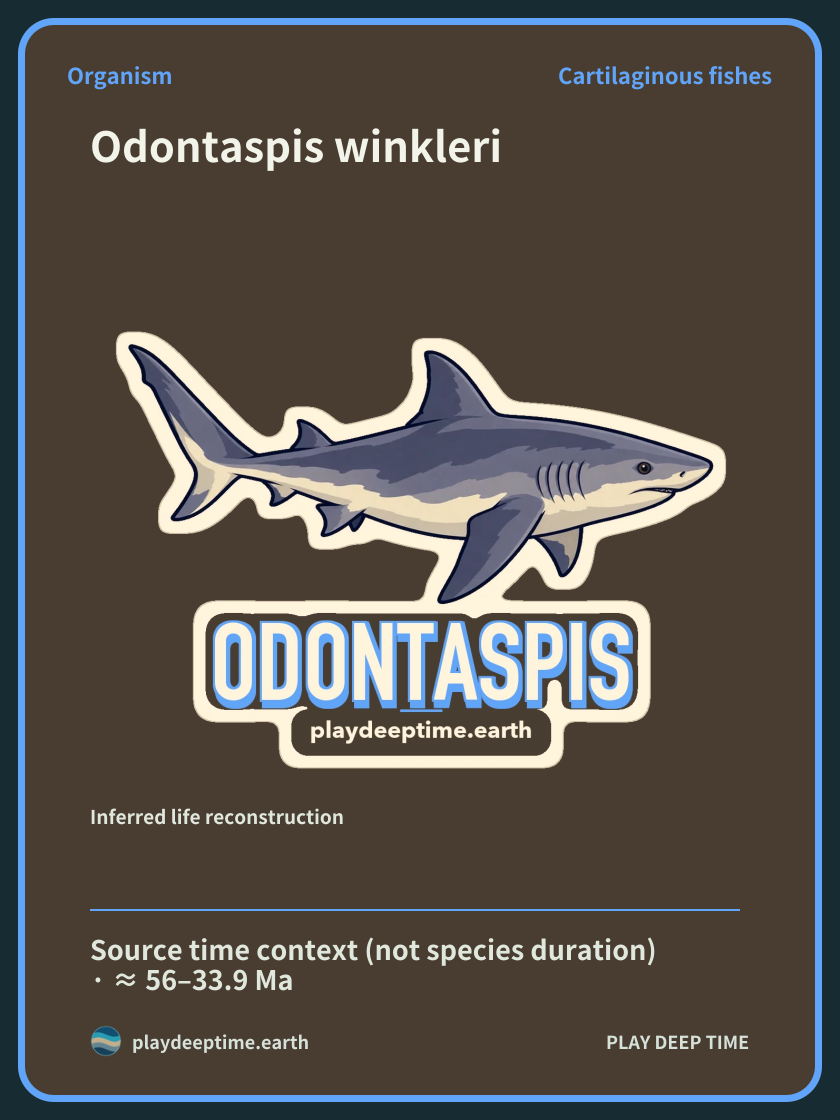
Organism · Cartilaginous fishes
Odontaspis winkleri
Source time context (not species duration) · ≈ 56–33.9 Ma
Inferred life reconstruction
Odontaspis winkleri
Overview
Odontaspis winkleri is an Eocene shark whose form is explored through small teeth. Small cusplets flank a slender, pointed central cusp. Teeth that survived longer than the entire body in the sea have carried this shark's name forward.[1]
Loading illustration…
Key facts
The tooth has more than one point. Two pairs of small cusplets flank the large central cusp, with the outer cusplets very small. Comparing the central and lateral points begins to reveal features that distinguish it from other shark teeth.[1]
Time and place
This marine shark dates to the Middle Eocene, roughly 48–38 million years ago. A 2023 study presented specimens from Vyshhorod in the Dnipro–Donets Basin of present-day northern Ukraine. These small fossils evoke the seas of Eocene Europe.[1]
The time range describes source context, not the complete duration of this species.
Size, form and skeleton
The teeth studied measure about 1.09–1.73 cm vertically. Their surfaces are smooth, and their edges lack serrations. Comparing anterior, anterolateral, and lateral teeth reveals the variety of shapes even within a single shark's mouth.[1]
Loading illustration…
Habitat and reproduction
This species appears in a study of Eocene marine organisms from Ukraine. Comparing several sharks and rays from the same strata allows us to explore the diversity of the ancient sea. The shapes of the sharp teeth provide a starting point for investigating how food was used.[1]
Fossil discovery
Two anterior teeth, one anterolateral tooth, and three lateral teeth from Vyshhorod were assigned to this species. These six small museum specimens were compared with fossils from other regions. Recording teeth together with their discovery locations supports research into shark distributions.[1]
References
Research questions
How much can teeth differ as their position in the mouth changes? Researchers compare the central cusp, lateral cusplets, roots, and edges together. Distinguishing differences between species from variation among teeth within a single species is an intriguing problem in fossil-shark research.[1]
Observation
Examine the slender central cusp and the small cusplets on either side. Compare which shapes change as the position of the teeth shifts from the front toward the back of the mouth.[1]
Related organisms
 Hemipristis serraCartilaginous fishesSource time context (not species duration) · ≈ 23–5.33 Ma
Different bodies among sharks
Examine the bodies of Odontaspis winkleri and Hemipristis serra together. Odontaspis winkleri: Odontaspis winkleri is an Eocene shark whose form is explored through small teeth. Hemipristis serra: Hemipristis serra is a fossil shark readily remembered for its teeth with large serrations.