Organism · Placental mammals
Orycteropus afer
Present
Living species illustration
Orycteropus afer
Overview
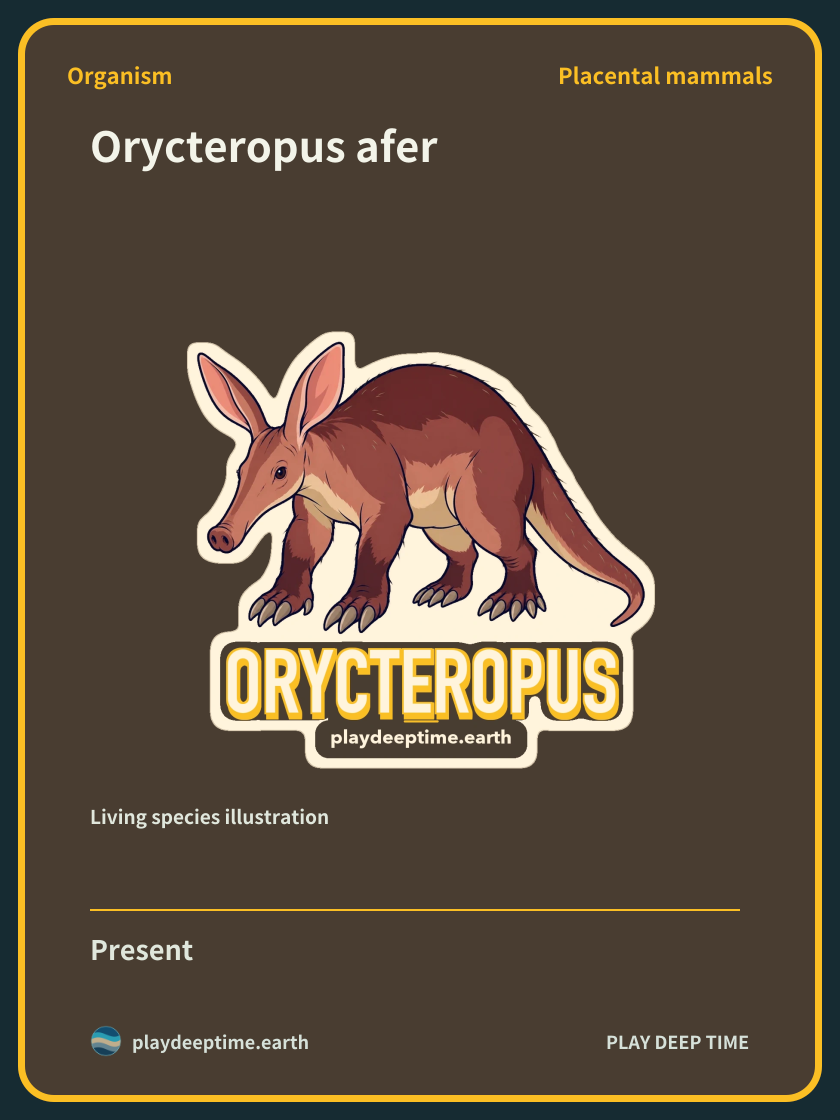
The aardvark, Orycteropus afer, is an African mammal with a long snout, large ears and powerful forelimbs. It digs burrows with strong, shovel-like claws. The body of one aardvark also leads to stories about other animals that use underground spaces.[2]
Loading illustration…
Key facts
Burrows dug by aardvarks provide space for other animals too. A 1988 species account summarized how various vertebrates use them for shelter or raising young. One animal's digging lifestyle is thus connected to other animals' homes.[2]
Time and place
This mammal lives in Africa today. Its body and way of life can be explored through institutional and research records of its modern distribution and ecology. Separately, the assignment of Early Pliocene fossils from Langebaanweg in present-day South Africa has also been studied.[2][1]
The time range describes source context, not the complete duration of this species.
Size, form and skeleton
It has a long snout, large ears, short, powerful forelimbs and a muscular tail. Four toes are described on the forefeet and five on the hind feet. The 1988 species account reports a total-length range of about 1.4–2.2 m.[2]
Loading illustration…
Habitat and reproduction
It uses its long tongue to gather food such as ants and termites. The digging forefeet, a snout with a well-developed sense of smell, and the long, slender tongue work together.[2]
The species account states that usually one offspring is born. The young remain in the burrow before accompanying the mother on her nightly activities. As they grow, young individuals begin digging burrows for themselves.[2]
Fossil discovery
A 1988 species account brought together records of external form, bones, reproduction and ecology. In 2005, a study compared Langebaanweg fossils with living aardvarks. Studies of living bodies and comparisons with ancient bones continue alongside one another.[2][1]
References
Research questions
How do aardvark burrows affect the lives of surrounding animals? Researchers examine the animals using the burrows together with the surrounding environment. Features such as a long snout and powerful forelimbs lead to wider questions about ecological relationships.[2]
Observation
Move your gaze from the long snout and large ears to the short, sturdy forelimbs. Examining the claws and long tail as well reveals a body built for digging and using underground spaces.[2]
Related organisms
 Aplodontia rufaPlacental mammalsPresent
Different mammals that use underground spaces
Explore the different records of bodies and time represented by these two animals. Orycteropus afer: The aardvark, Orycteropus afer, is an African mammal with a long snout, large ears and powerful forelimbs. It digs burrows with strong, shovel-like claws. This mammal lives in Africa today. Its body and way of life can be explored through institutional and research records of its modern distribution and ecology. Mountain beaver: Aplodontia rufa is a burrowing rodent of western North America, also known as the mountain beaver. It is a living species known from the Cascade and Sierra Nevada mountain regions of western North America. A 2012 Canadian report summarized its distribution in southwestern British Columbia and south of the Fraser River.