Organism · Placental mammals
Pachyaena ossifraga
Fossil record age bounds · ≈ 56–48.1 Ma
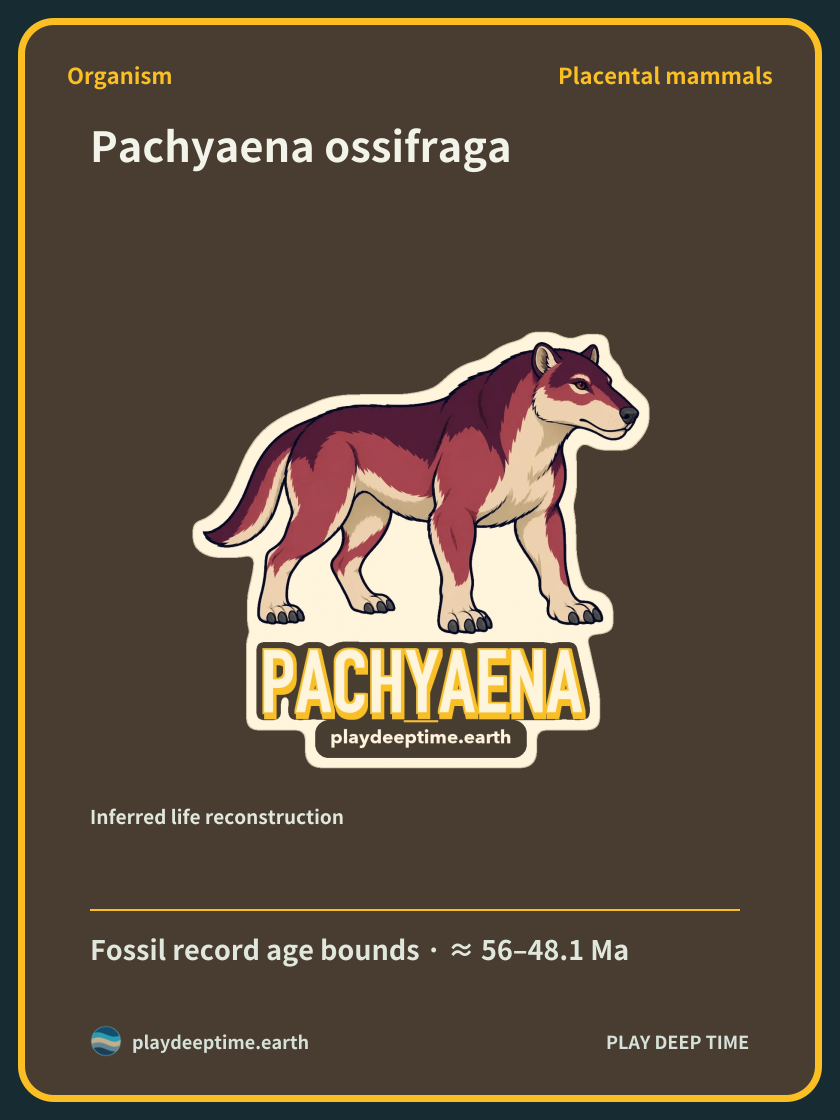
Inferred life reconstruction
Pachyaena ossifraga
Overview
Pachyaena ossifraga is an Eocene mesonychian mammal. Vertebrae and long bones preserved in several partial skeletons reveal its body organization. Research has explored this animal by examining the neck and back in greater detail than the head.[1]
Loading illustration…
Key facts
A 1992 study compared the structure of almost the entire vertebral column using three partial skeletons. Other specimens can supply information missing from any one individual. It illustrates why several fossils are studied together.[1]
Time and place
Partial skeletons are known from the Willwood Formation of the Bighorn and Clarks Fork basins in present-day northwestern Wyoming, USA. The material is early Eocene. The Eocene as a whole spans roughly 56–34 million years ago.[1][2]
The time range describes source context, not the complete duration of this species.
Size, form and skeleton
The study describes long processes on the neck and anterior back vertebrae. In the lower back and lumbar region, interlocking structures make the back stiffer. Different features appear in different regions along the spine from neck to lower back.[1]
Body mass estimated from limb bones found with the vertebrae is approximately 60–70 kg.[5]
Loading illustration…
Habitat and reproduction
How do neck and back bones relate to movement? In 1992, researchers examined strong neck processes and structures supporting the lumbar region together to interpret how the body was supported. Small connections within the spine help explain the whole body’s organization.[1]
Fossil discovery
UM 94783, UM 95074, and YPM-PU 14708, used in the study, are separate partial skeletons. Researchers compared this material with vertebrae of living mammals. The spine added a new chapter to earlier research that began with teeth and feet.[1]
References
- Zhou et al. (1992) — Vertebrae and body structure of Pachyaena
- International Commission on Stratigraphy (2024) — Geological time chart
- Zhou et al. (1992) — Vertebrae and body structure of Pachyaena
- Smithsonian Institution. Diacodexis metsiacus (Cope), USNM V19272.
- Functional and behavioral implications of vertebral structure in Pachyaena ossifraga (Mammalia, Mesonychia)
Research questions
Do all vertebrae serve the same role? Bones of the neck, chest, and lower back differ in shape and articulation. Research on Pachyaena examines these regions separately to understand structures supporting the head and body.[1]
Observation
Move your gaze from the neck behind the head to the upper shoulders, back, and lumbar region. Thinking of the spine in sections helps reveal how supporting structures vary within one body.[1]
Related organisms
 Diacodexis metsiacusPlacental mammalsSource time context (not species duration) · ≈ 56–33.9 Ma
Eocene mammals connected through the Willwood Formation
Pachyaena and Diacodexis are linked through the early Eocene Willwood Formation in present-day Wyoming, USA. Follow different evidence, such as studies of postcranial bones and jaw specimens, to compare mammals from the same broad time and region.