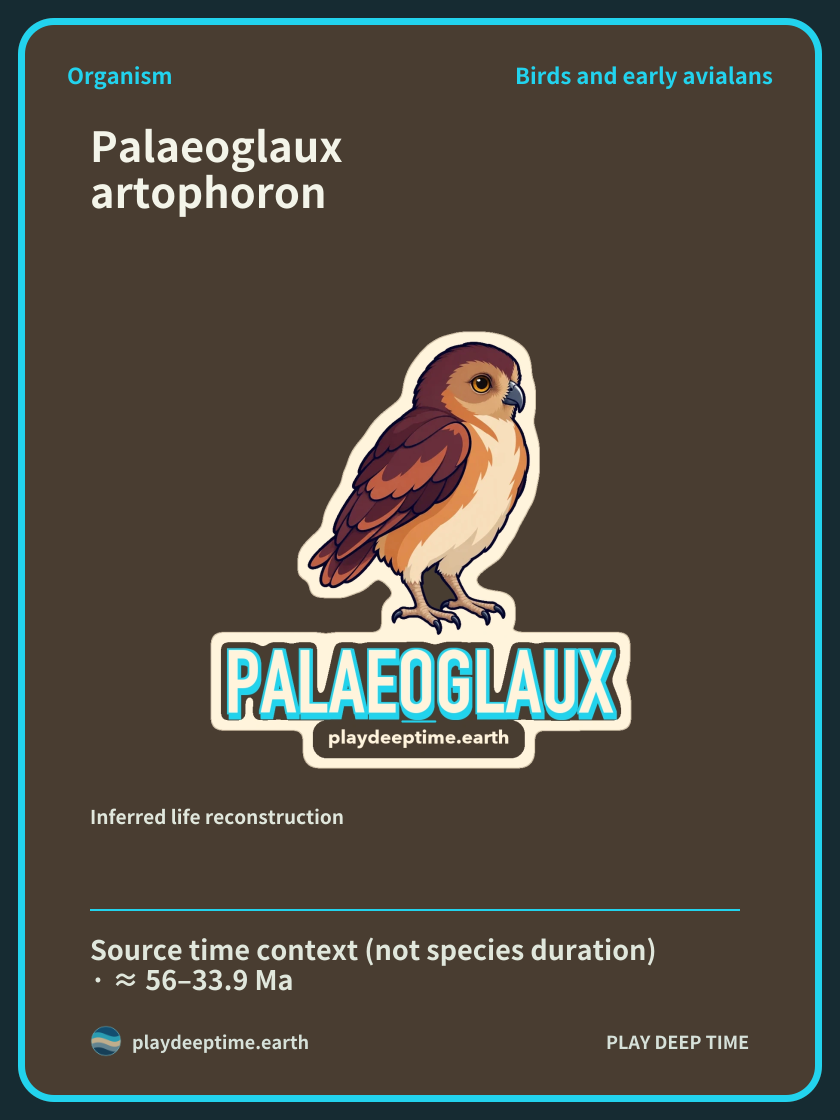
Organism · Birds and early avialans
Palaeoglaux artophoron
Source time context (not species duration) · ≈ 56–33.9 Ma
Inferred life reconstruction
Palaeoglaux artophoron
Overview
Palaeoglaux artophoron is a fossil owl from Eocene Messel, Germany. Folded wings, legs, and feet remain almost fully connected. It offers a view of a bird from ancient European forests in a warmer climate than today.[1][4]
Loading illustration…
Key facts
The A and B attached to the type specimen number do not indicate two birds. One fossil is divided between a slab and its counterpart. Comparing both slabs allows different parts of the same body to be read.[1]
Time and place
It is associated with Messel around the Middle Eocene, approximately 48 million years ago. These are ancient lake deposits near present-day Frankfurt, Germany. The site is known for varied mammals and plants as well as birds.[1][3][4]
The time range describes source context, not the complete duration of this species.
Size, form and skeleton
The two slabs of SMF-ME1144 preserve an almost articulated body skeleton. The wings are folded, and the legs and feet can also be compared. The bone connecting ankle and foot was reported as approximately 3 cm long.[1]
Loading illustration…
Habitat and reproduction
Forests of a warm climate spread around the Messel lake. Owls, other birds, and mammals using the trees formed part of the region’s fauna. Considering it alongside Darwinius from the same locality evokes several layers of the Eocene forest.[4][1]
Fossil discovery
Peters introduced it in 1992 as a new owl from the Messel oil shale. The well-connected skeleton provided evidence for comparing wing and leg proportions. Later research on early owls also discussed its relationships with other fossil species.[1][2]
References
Research questions
Did an owl-like body arise all at once? Comparing the heads, wings, and legs of early owls lets us investigate how different features appeared at different times. Distinguishing the Messel species from other Eocene owls is also part of that process.[2][1]
Observation
Examine the folded wings, both legs, and feet together. Picturing the two slabs of one fossil fitted together offers an engaging way to understand the body’s connections.[1]
Related organisms
 Darwinius masillaePrimatesSource time context (not species duration) · ≈ 56–33.9 Ma
Organisms of the Messel forest
A fossil owl and the primate Darwinius are both known from Eocene strata at Messel. Placing a bird alongside a mammal broadens our view of biodiversity in the forest surrounding the ancient lake.