Organism · Insects
Palaeovespa florissantia
Source time context (not species duration) · ≈ 37–34 Ma
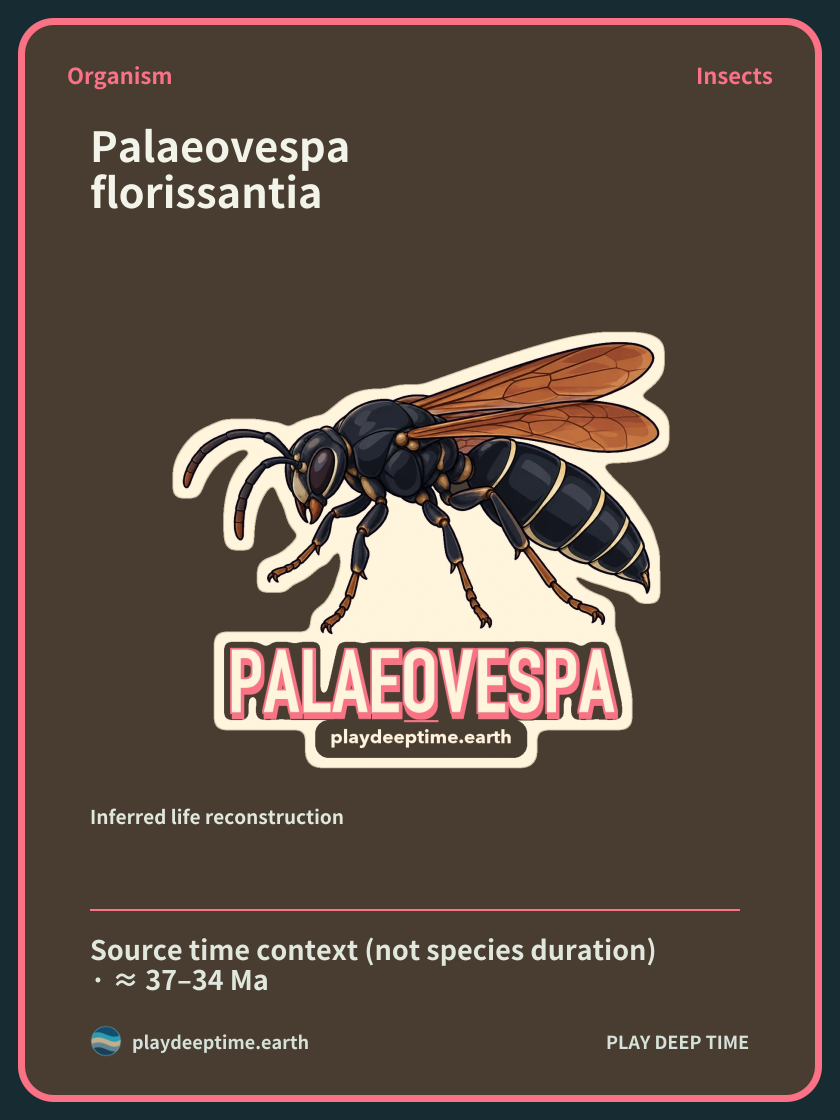
Inferred life reconstruction
Palaeovespa florissantia
Overview
Palaeovespa florissantia is a fossil wasp known from the Eocene Florissant Formation. Even its folded wings preserve clues to classification. A small insect fossil tells the story of ancient wasps through wing lines and body segments.[1]
Loading illustration…
Key facts
Its name contains the place of discovery. The species name florissantia is explained as referring to the fossil-bearing Florissant Formation. An organism’s name thus becomes a small map to a fossil locality.[1]
Time and place
It is known from the Florissant Formation in present-day Colorado, USA. The fossil-bearing strata are summarized within a broad Eocene time window of roughly 37–34 million years ago. Among the insect fossils of this formation, it offers a glimpse of ancient wasps.[2][1]
The time range describes source context, not the complete duration of this species.
Size, form and skeleton
The description of type specimen MCZ2026 includes an elongated first discoidal cell preserved in the folded wing. The shape of a compartment between wing veins provides a taxonomic clue. Palaeovespa bodies are compared through a broad, rounded thorax and an abdomen broadly attached at its base.[1]
The preserved body of the type specimen of Palaeovespa florissantia measures about 2.5cm to just beyond the middle of the fifth abdominal segment. This does not include the entire tip of the abdomen. In 1906, the researcher described this specimen as a large, robust wasp.[8]
Loading illustration…
Habitat and reproduction
Considering the connections among wings, thorax, and abdomen reveals the construction of an insect body. Palaeovespa was described through comparisons of body form and wing venation with living wasps. Even small folded wings preserve features for comparison with related groups.[1]
Fossil discovery
It was named in Cockerell’s 1906 study of fossil Hymenoptera from Florissant. A later summary introduces MCZ2026 as a particularly large specimen among the Florissant hymenopteran fossils Cockerell had seen at the time. It initially looked like a large scoliid wasp but was described as having features of Vespidae.[1]
References
- Palaeovespa — Morphology and discovery of fossil wasps from Florissant
- Paleobiology Database — Fossil-bearing strata of Palaeovespa
- US National Park Service — Fossil redwoods of Florissant
- Palaeovespa — Morphology and discovery of fossil wasps from Florissant
- Paleobiology Database — Fossil-bearing strata of Palaeovespa
- NPS, Florissant fossil redwoods (Sequoia affinis)
- NPS, Fossil wasp (Palaeovespa sp.)
- Cockerell (1906) — A fossil wasp from Florissant
Research questions
Can a wasp be recognized from folded wings? The shapes and lengths of cells divided by wing veins are important subjects of comparison. This research examines the overall body impression together with small wing structures to find similarities among related insect groups.[1]
Observation
After looking at the rounded thorax and the abdominal segments behind it, move your gaze to the folded wings. Remember that even one small cell in a wing can provide a clue to identifying a fossil insect.[1]
Related organisms
 Sequoia affinisSeed plantsFossil record age bounds · ≈ 66–2.58 Ma
Florissant redwoods and small wasps
Sequoia affinis and Palaeovespa florissantia connect through the Eocene record of Florissant in present-day Colorado, USA. Alternate between the slender leaves on a branch and small cells in an insect wing to find detailed traces of different organisms preserved in one region.