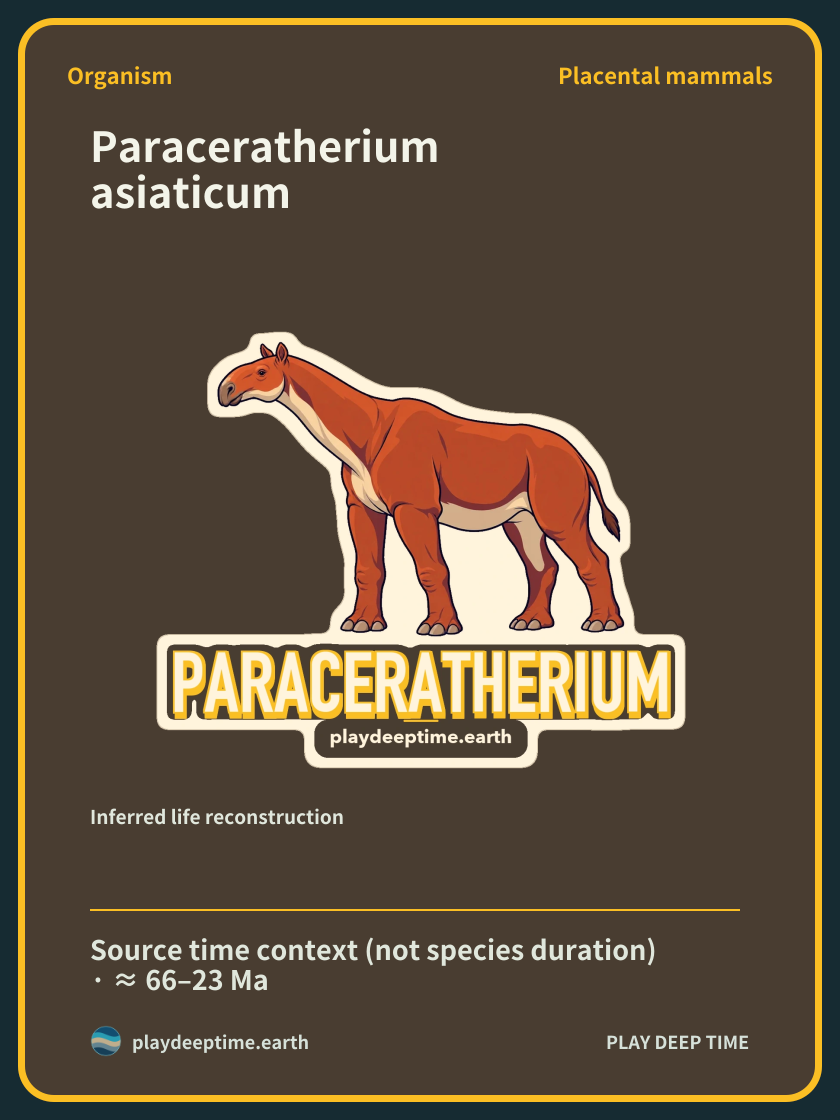
Organism · Placental mammals
Paraceratherium asiaticum
Source time context (not species duration) · ≈ 66–23 Ma
Inferred life reconstruction
Paraceratherium asiaticum
Overview
Paraceratherium asiaticum is an Oligocene Asian rhinoceros relative. It appears in research on the giant rhinoceros relatives of Paraceratherium. Old expedition records and large teeth tell its story.[1][2]
Loading illustration…
Key facts
Worn teeth can reveal as much as new ones. Material from Turgai included molars ranging from almost unworn to heavily worn. Comparing stages of wear shows how chewing surfaces changed with use.[2]
Time and place
It connects with the Oligocene fossil record of Asia. The Oligocene spanned approximately 34–23 million years ago. Important historical material was gathered during expeditions in the Turgai region of present-day Kazakhstan.[1][2]
The time range describes source context, not the complete duration of this species.
Size, form and skeleton
Historical Turgai material includes descriptions of large incisors and molars. The thick conical incisors, also called tusks, have blunt tips and coarse surface lines. Areas smoothed through use were compared closely with molar chewing surfaces.[2]
Paraceratherium asiaticum was a giant rhinoceros relative living in Oligocene Asia. A 2022 study combined estimates calculated separately from humeral, femoral, and radial circumferences to obtain approximately 12 t. Because the animal had a long neck and long legs, the bones and comparison methods used strongly affect size reconstructions.[3]
Loading illustration…
Habitat and reproduction
Fossil teeth preserve traces of food processing. Turgai material was studied for incisor surface wear and worn molars. Examining these differences together helps investigate how a large mammal used its teeth.[2]
Fossil discovery
In 1916, the Bayarunas expedition, supported by the Geological Museum of the Russian Academy of Sciences, gathered new material at Turgai. According to Borissiak’s 1924 account, a seemingly intact lower jaw broke apart in a rainstorm before packing, leaving only teeth and small bone fragments. Protecting fossils in the field, as well as discovering them, shaped research history.[2]
References
- Deng et al.2021 — Paraceratherium, a giant rhinoceros relative from Asia
- Borissiak1924 — New material of Indricotherium from Turgai
- Li·Jiangzuo·Deng (2022) — Body-mass estimates for giant rhinoceroses
- 2018 study — The age and evolutionary relationships of Elasmotherium
- Study of the forehead dome and nasal bones of Elasmotherium
Research questions
How can records of one animal studied under several names be connected? Old Turgai literature uses the name Indricotherium. Reexamining tooth and bone form connects the classification and discovery history of the Paraceratherium group.[2][1]
Observation
Imagine the enlarged incisors alongside the chewing surfaces of the molars. Wear patterns and surface differences, as well as tooth size, provide clues to the animal’s life.[2]
Related organisms
 Elasmotherium sibiricumPlacental mammalsSource time context (not species duration) · ≈ 2.58–0.0117 Ma
Different bodies among rhinoceros relatives
Explore the bodies of Paraceratherium and Elasmotherium sibiricum together. Paraceratherium asiaticum is an Oligocene Asian rhinoceros relative. Elasmotherium sibiricum is an extinct rhinoceros from Pleistocene Eurasia.