Organism · Trilobites
Paradoxides paradoxissimus
Source time context (not species duration) · ≈ 520–500 Ma
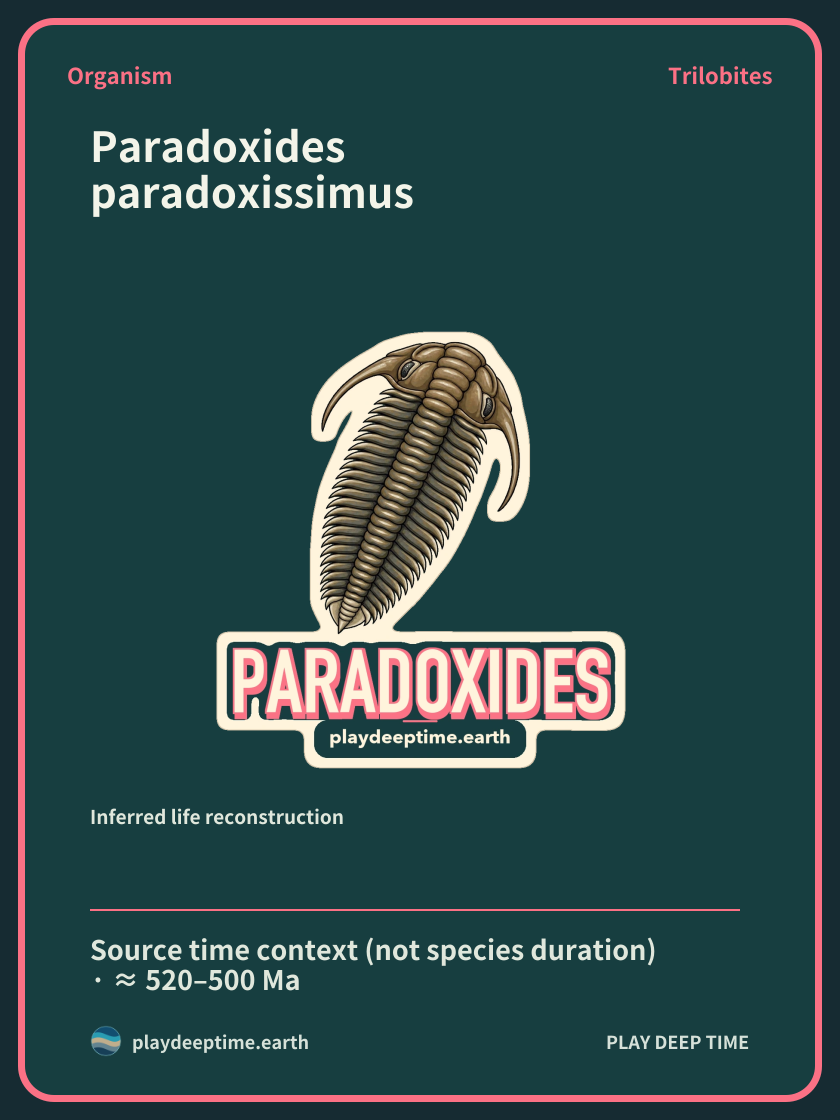
Inferred life reconstruction
Paradoxides paradoxissimus
Overview
Paradoxides paradoxissimus is a trilobite known for its broad head and long cheek spines. Its long trunk narrows toward the rear, and its tail shield is very small. The transition from a large head to a small tail is striking.[1]
Loading illustration…
Key facts
The studied specimen from the type locality is described as having twenty-one thoracic segments. Many segments extend behind the large head to form a long trunk.[1]
Time and place
Middle Cambrian material from the lower Alum Shale at Oltorp in Västergötland, present-day Sweden, has been studied. The broad range of the recorded fossil-bearing strata is summarized as roughly 520–500 million years ago. This trilobite allows its stratigraphy and specimens to be examined together.[1][2]
The time range describes source context, not the complete duration of this species.
Size, form and skeleton
Long cheek spines extend from both sides of the broad, curved head shield. Behind the head, twenty-one thoracic segments form a trunk that narrows rearward, ending in a very small tail shield. The size contrast between head, trunk, and tail is worth examining.[1]
Loading illustration…
Habitat and reproduction
How might a long, segmented body be preserved in a fossil? The reference specimen is described as a strongly compressed impression in alum shale. Examining the overall body structure alongside traces of compression in the rock also invites consideration of the preservation process.[1]
Fossil discovery
The study discusses the type specimen RM Ar.46147 and also compares a separate incomplete specimen and a plaster cast. The actual fossils and the cast contribute different information. This is an example of understanding old material through several forms of record.[1]
References
Research questions
How can the original outline be recognized in a compressed trilobite? Repeated trunk segments must be compared together with the boundaries of the head and tail shields. This research distinguishes the organism's structures from changes that occurred during preservation.[1]
Observation
Follow the broad head and long cheek spines along the rearward-narrowing trunk. Finding the very small tail shield after the many thoracic segments reveals the strong contrast between front and rear.[1]
Related organisms
 Olenellus thompsoniTrilobitesSource time context (not species duration) · ≈ 539–487 Ma
Different bodies among trilobites
Examine the bodies of Paradoxides paradoxissimus and Olenellus thompsoni together. Paradoxides paradoxissimus: Paradoxides paradoxissimus is a trilobite known for its broad head and long cheek spines. Olenellus thompsoni: Olenellus thompsoni is a trilobite treated as the type species of the genus Olenellus.