Organism · Molluscs
Passaloteuthis bruguieriana
Source time context (not species duration) · ≈ 201–143 Ma
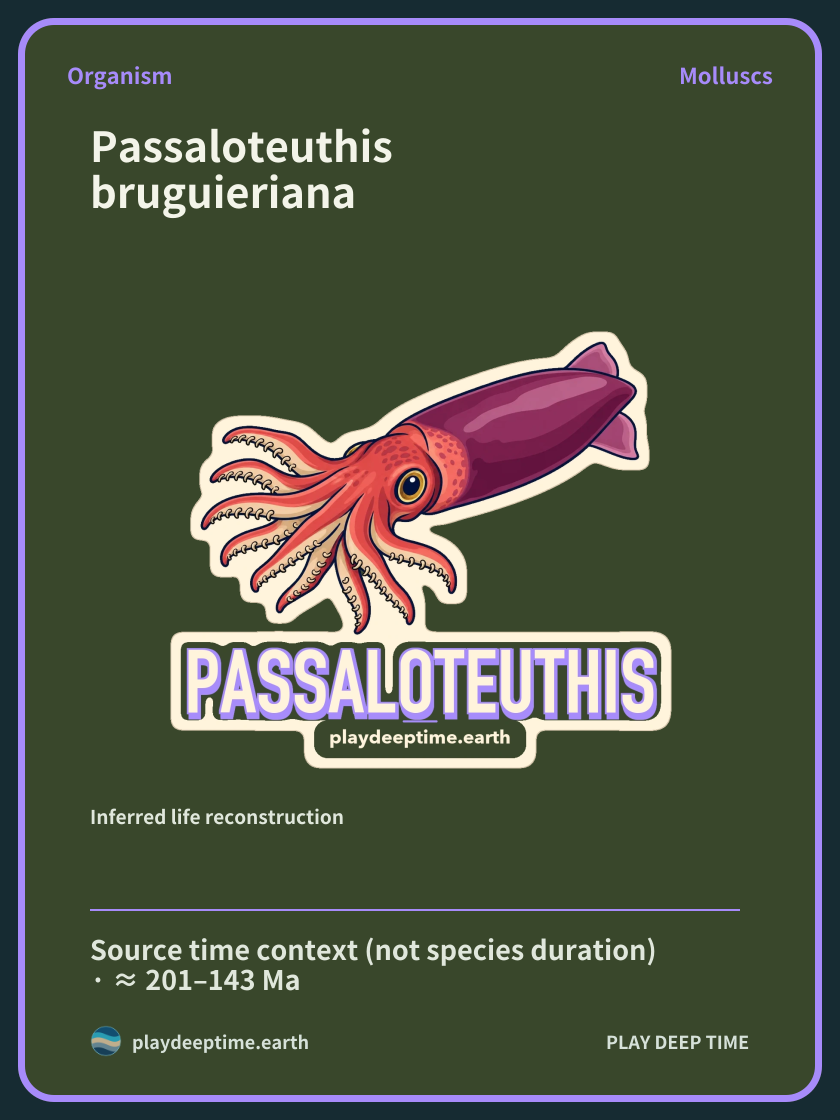
Inferred life reconstruction
Passaloteuthis bruguieriana
Overview
Passaloteuthis bruguieriana is an Early Jurassic cephalopod known for a hard internal rostrum. The rostrum is described as robust, cylindrical to conical, and blunt-tipped. Its internal hard parts, rather than external appearance, provide the starting point for research.[1]
Loading illustration…
Key facts
The hard rostrum seen in belemnite fossils was not a shell exposed outside the body. Weak grooves on its surface are also features of an internal hard part. This encourages a distinction between what preserves well and what was visible in life.[1]
Time and place
The species description includes late Pliensbachian material from the Early Jurassic. The study addresses strata at Tournadous in the Causses region of present-day France. The Jurassic spanned approximately 200–140 million years ago.[1][4]
The time range describes source context, not the complete duration of this species.
Size, form and skeleton
MNHNL BEL275 and BEL276 are rostrum specimens treated under this species name. They are described as having a robust cylindrical-to-conical outline, blunt tip, and weak dorsolateral grooves. The elongated outline and small surface grooves can be compared separately.[1]
A study treating Passaloteuthis bruguieriana as the same species as Passaloteuthis laevigata describes the lateral diameter of the hard, cylindrical internal skeleton in Italian specimens as usually 12–15 mm. Roughly finger-thick, this fossil is the rear part of the internal shell, not the whole body.[5]
Loading illustration…
Habitat and reproduction
The related comparison species Passaloteuthis bisulcata preserves soft-body evidence. Features such as ten hook-bearing arms help explain belemnite bodies. Fossils preserving hard internal skeletons and those preserving soft bodies thus supply different information.[3]
Fossil discovery
Research on belemnites from Tournadous compared rostrum specimens by species. Other taxonomic studies addressed relationships among bruguieriana, laevigata, and bisulcata. Following distinctions between names and specimens helps reveal ancient cephalopods.[1][2]
References
- Study — Early Jurassic belemnites from Tournadous, France
- Study — Classification of Early Jurassic belemnites
- Study — Body structure of belemnites
- International Commission on Stratigraphy (2024) — Geological time chart
- Weis, Mariotti & Di Cencio (2015), Systematics and evolutionary implications of Early Jurassic belemnites from the Peri-Mediterranean Tethys
- Study — Morphology and feeding relationships of Triassic cephalopods
Research questions
How can hard and soft parts preserved in different fossils be compared? The rostrum reveals the internal skeleton in detail, while soft tissues of a comparison species invite consideration of other body structures. The way fossils survive is itself an important research question.[1][3]
Observation
After examining the long body outline, imagine the hard rostrum inside. Distinguishing the cylindrical-to-conical hard part of the fossil from the body’s exterior in life helps in reading belemnite evidence.[1][3]