Organism · Arthropods
Pectocaris spatiosa
Source time context (not species duration) · ≈ 539–487 Ma
Inferred life reconstruction
Pectocaris spatiosa
Overview
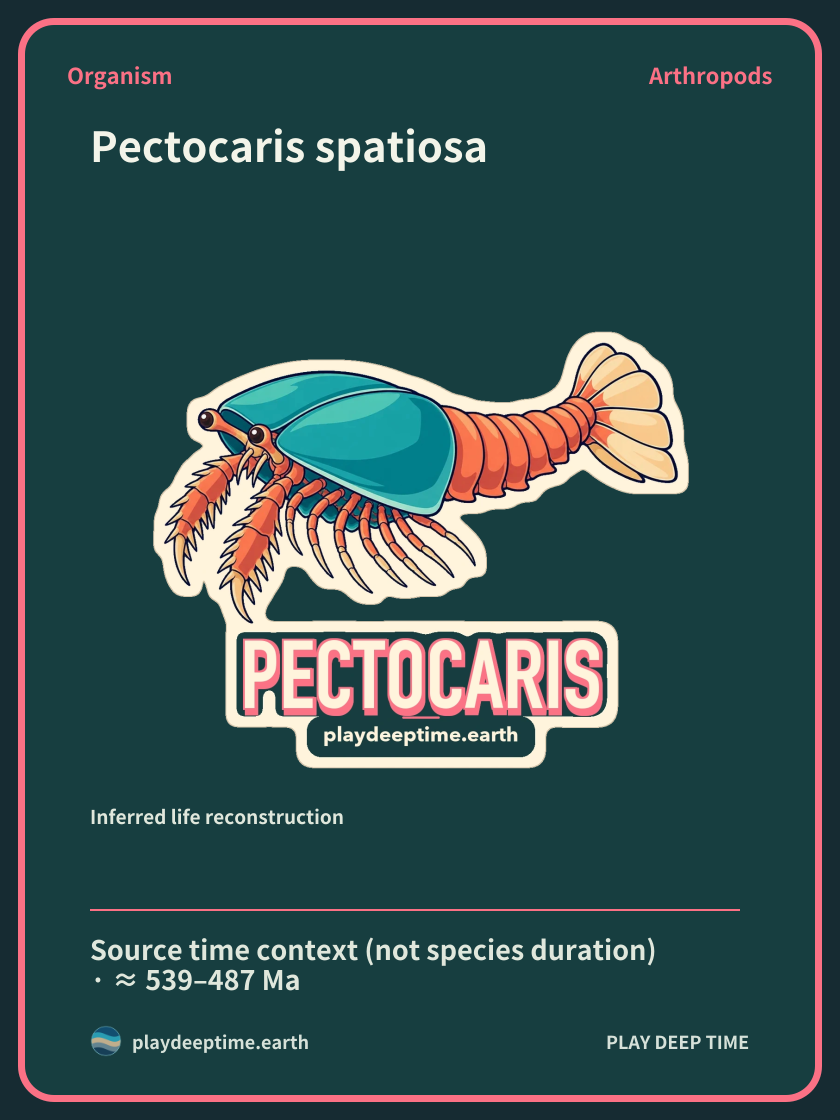
Pectocaris spatiosa is an arthropod known for a two-valved carapace covering the front of its body and stalked eyes. It is compared through an arrangement in which a broad tail fan follows a segmented trunk. Different kinds of structures can be found at the front and rear of its body.[1]
Loading illustration…
Key facts
The stout, spiny first appendages differ in shape from the slender trunk appendages. Move your gaze from the prominent front appendages to the small appendages of the trunk. Different structures occur in sequence within a single organism.[1]
Time and place
It is known from literature comparing the form of Cambrian arthropods. The Cambrian spanned approximately 540–490 million years ago. Later studies explicitly identified the species while comparing features of its carapace and appendages.[1][2]
The time range describes source context, not the complete duration of this species.
Size, form and skeleton
Paired stalked eyes project around the bivalved carapace covering the front of the body. Behind it are a segmented trunk, a robust abdomen, and a broad tail fan. We can examine structural differences from the large carapace to the appendages and tail.[1]
Pectocaris spatiosa is described in the literature as an arthropod reaching approximately 9 cm in body length. It is larger than Pectocaris eurypetala, with which it was compared, and is characterized by an elongated body.[3]
Loading illustration…
Habitat and reproduction
Were the front and trunk appendages alike? Comparisons of the species distinguish the stout, spiny first appendages from the slender ones that follow. Looking at both their position and shape reveals a more varied body arrangement.[1]
Fossil discovery
Later arthropod studies cited earlier descriptions of Pectocaris to compare species-level features. The eyes, carapace, appendages, and tail fan provided points of comparison with other animals. New research leads to questions that revisit older fossils.[1]
References
- Comparative arthropod study — Carapace and appendages of Pectocaris
- International Commission on Stratigraphy (2024) — Geological time chart
- Vannier et al. (2006) — Comparison of Early Cambrian arthropods
- Study — Comparison of biramous appendages of Isoxys
- Visual evolution study — Comparison of stalked eyes in Isoxys auritus
Research questions
The two-valved carapace alone may resemble that of other bivalved animals. Comparing stalked eyes, appendages, and the segmented rear together reveals their different arrangements. Research reads the broad outline alongside small connections.[1]
Observation
Move your gaze from the stalked eyes around the carapace to the front appendages and segmented trunk. Following the body to the broad tail fan reveals how its different regions change.[1]
Related organisms
 Isoxys auritusArthropodsSource time context (not species duration) · ≈ 539–487 Ma
Different bodies among arthropods
Explore the bodies and life settings of Pectocaris spatiosa and Isoxys auritus together. Pectocaris spatiosa: Pectocaris spatiosa is an arthropod known for a two-valved carapace covering the front of its body and stalked eyes. It is compared through an arrangement in which a broad tail fan follows a segmented trunk. Isoxys auritus: Isoxys auritus is an arthropod known for its rounded carapace, rear spines, and projecting stalked eyes. The appendages beneath its carapace are also compared.