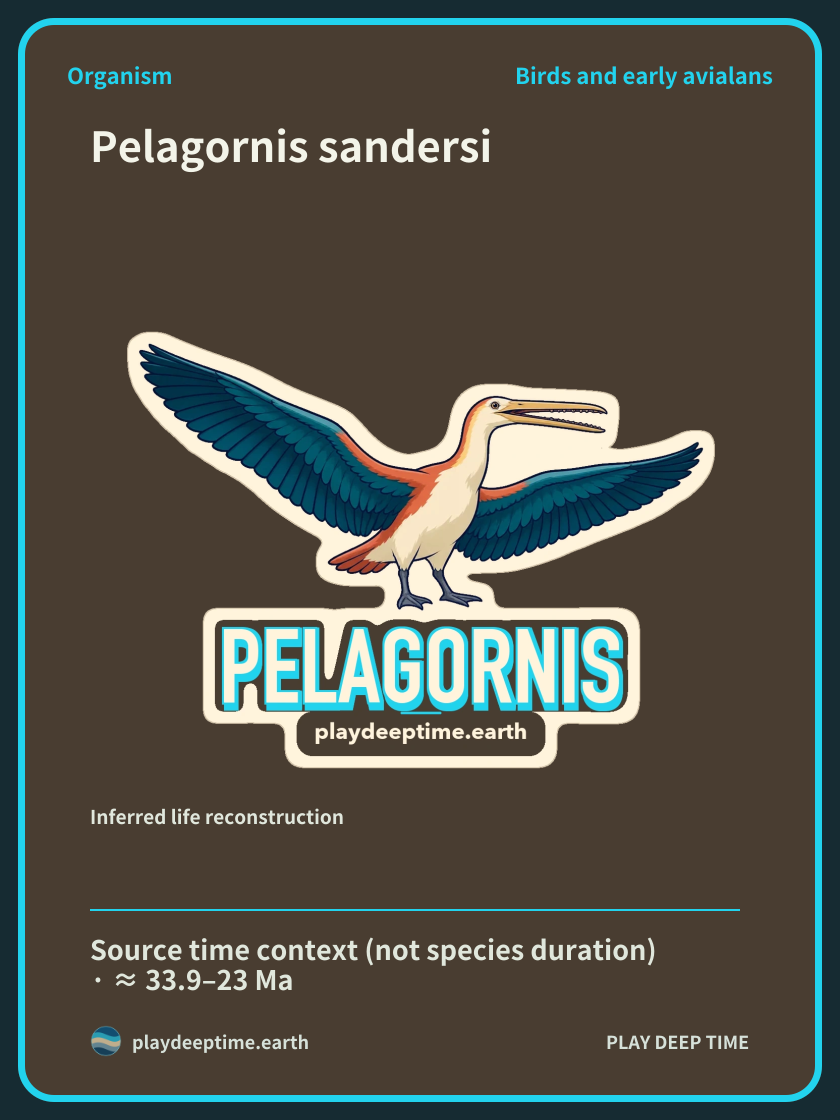
Organism · Birds and early avialans
Pelagornis sandersi
Source time context (not species duration) · ≈ 33.9–23 Ma
Inferred life reconstruction
Pelagornis sandersi
Overview
Pelagornis sandersi is an extinct seabird with a long beak and enormous wings. Pointed projections along the jaws and reduced hind limbs are characteristic. In 2014, a researcher estimated a wingspan of approximately 6–7 m and used models to investigate its flight.[1]
Loading illustration…
Key facts
The apparent teeth on its beak are projections continuous with the jawbone. Unlike true teeth, they are called pseudoteeth. The skull even records the arrangement of small projections between larger ones.[1]
Time and place
The reference specimen was collected from the Chandler Bridge Formation near Charleston Airport in present-day South Carolina, United States. The 2014 paper described these strata as Late Oligocene, approximately 28–25 million years old. Strata near an airport thus revealed an ancient seabird.[1]
The time range describes source context, not the complete duration of this species.
Size, form and skeleton
ChM PV4768 preserves the head, lower jaw, and several bones of the shoulder, forelimbs, and hind limbs. Skull length was reported as approximately 56.9 cm. The approximately 6–7 m wingspan was reconstructed by combining preserved bones with the proportions of related birds and estimated feather lengths.[1]
Loading illustration…
Habitat and reproduction
The researcher compared 24 models varying body mass, wingspan, and wing shape. The results supported the possibility of a seabird that glided efficiently over long distances. Calculations thus explored what long wings meant in its actual life.[1]
Fossil discovery
The species name sandersi honors Albert Sanders of the Charleston Museum, who collected the reference specimen. The 2014 study addressed its head, limbs, and flight models together. The collector’s name and the fossil’s body both remain part of the new species’ story.[1]
References
Research questions
How much flapping could such long wings support? The 2014 models indicated efficient gliding, but sustained flapping depended on assumptions about body mass and wingspan. Even the flight of one bird is studied by comparing several conditions.[1]
Observation
After examining the large and small projections along the long beak, move your gaze to the wingtips. Imagining the extremely long wings alongside the small hind limbs helps explain why this bird attracted attention in flight research.[1]
Related organisms
 Xenorophus sloaniiPlacental mammalsSource time context (not species duration) · ≈ 33.9–23 Ma
Seabirds and whales of Oligocene South Carolina
Pelagornis and Xenorophus are known from Oligocene material in present-day South Carolina, United States. Explore research on the seabird’s wings and the early toothed whale’s skull separately to broaden the story of this region’s ancient sea.