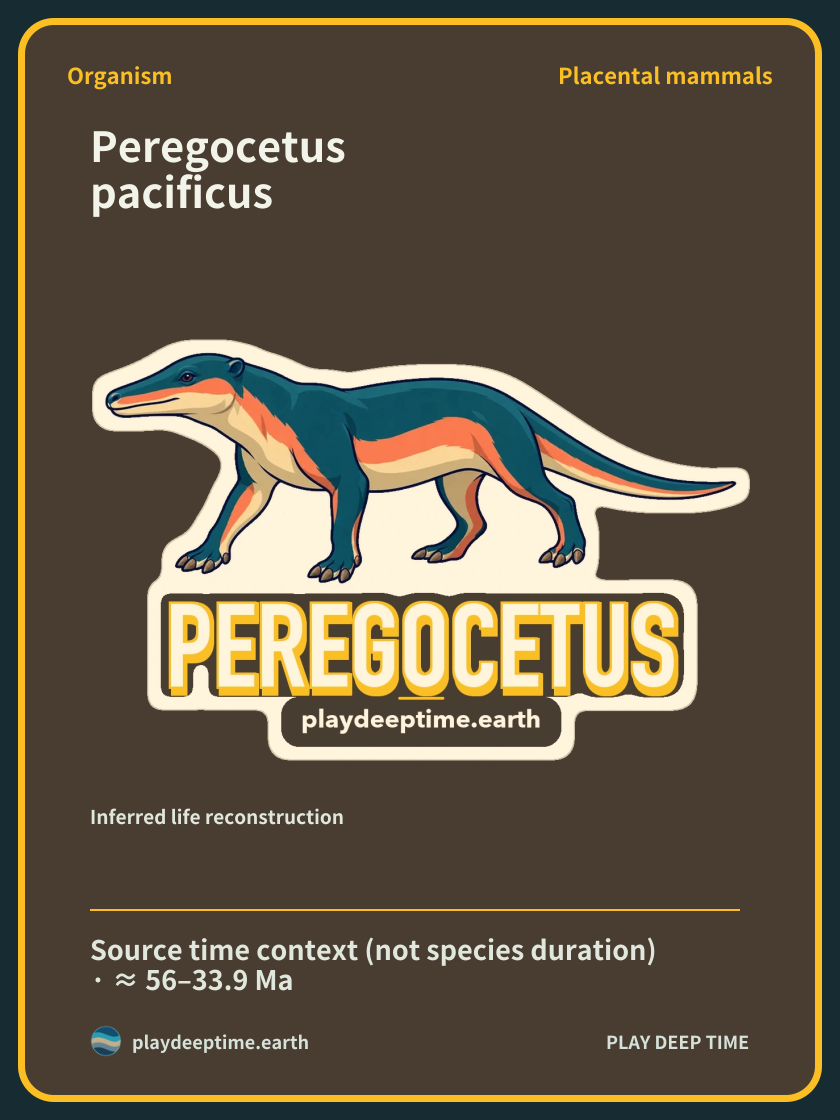
Organism · Placental mammals
Peregocetus pacificus
Source time context (not species duration) · ≈ 56–33.9 Ma
Inferred life reconstruction
Peregocetus pacificus
Overview
Peregocetus pacificus is an early whale with four legs and small hooves. Fossils from the coast of present-day Peru reveal a whale that stood on land and moved through water. The discovery tells of the long journey by which whales spread toward the South Pacific.[1]
Loading illustration…
Key facts
Small hooves remained at the tips of this whale’s feet. Its pelvis and legs are interpreted as structures that could support its body on land. At the same time, its tail vertebrae invite consideration of body movements that helped it travel through water.[1]
Time and place
It is a Middle Eocene whale from around 42.6 million years ago. It came from Playa Media Luna in the Pisco Basin of present-day southern Peru. Marine sediments of the Yumaque strata preserved the body of this early whale.[1]
The time range describes source context, not the complete duration of this species.
Size, form and skeleton
Specimen MUSM3580 preserves the lower jaw and teeth, vertebrae, pelvis, and many parts of all four limbs. Small hooves occur at the ends of the feet, and the pelvis connects with the trunk. The tail vertebrae have well-developed projections extending sideways.[1]
Peregocetus is an early whale estimated to have been approximately 4 m long. The Natural History Museum of San Marcos University in Peru reported this size in its announcement of the discovery.[2]
Loading illustration…
Habitat and reproduction
The researchers interpreted it as capable of supporting its body and walking on land, while also moving well in water. Its tail vertebrae were compared with tail-assisted swimming in otters and beavers. This is a hypothesis about a whale that used both land and sea.[1]
Fossil discovery
Lambert and colleagues reported this four-legged whale in 2019. The discovery extended the history of early whales known from South Asia and Africa to western South America. The body bones and the age of the strata became important evidence for studying dispersal routes.[1]
References
Research questions
How did early whales cross the Atlantic to reach South America? The Peruvian fossil invites examination of a dispersal hypothesis through the South Atlantic. The structures of the legs and tail raise questions not only about the route, but also about the body that made such a long journey possible.[1]
Observation
Move your gaze from the small hooves to the legs, pelvis, and tail. Examine how structures for supporting the body on land and moving in water coexist in a single animal.[1]
Related organisms
 Mystacodon selenensisPlacental mammalsSource time context (not species duration) · ≈ 56–33.9 Ma
Different bodies among whales
Explore the bodies of Peregocetus pacificus and Mystacodon selenensis together. Peregocetus pacificus: Peregocetus pacificus is an early whale with four legs and small hooves. Mystacodon selenensis: Mystacodon selenensis is an early toothed member of the baleen-whale lineage.