Organism · Placental mammals
Phosphatherium escuilliei
Source time context (not species duration) · ≈ 56–33.9 Ma
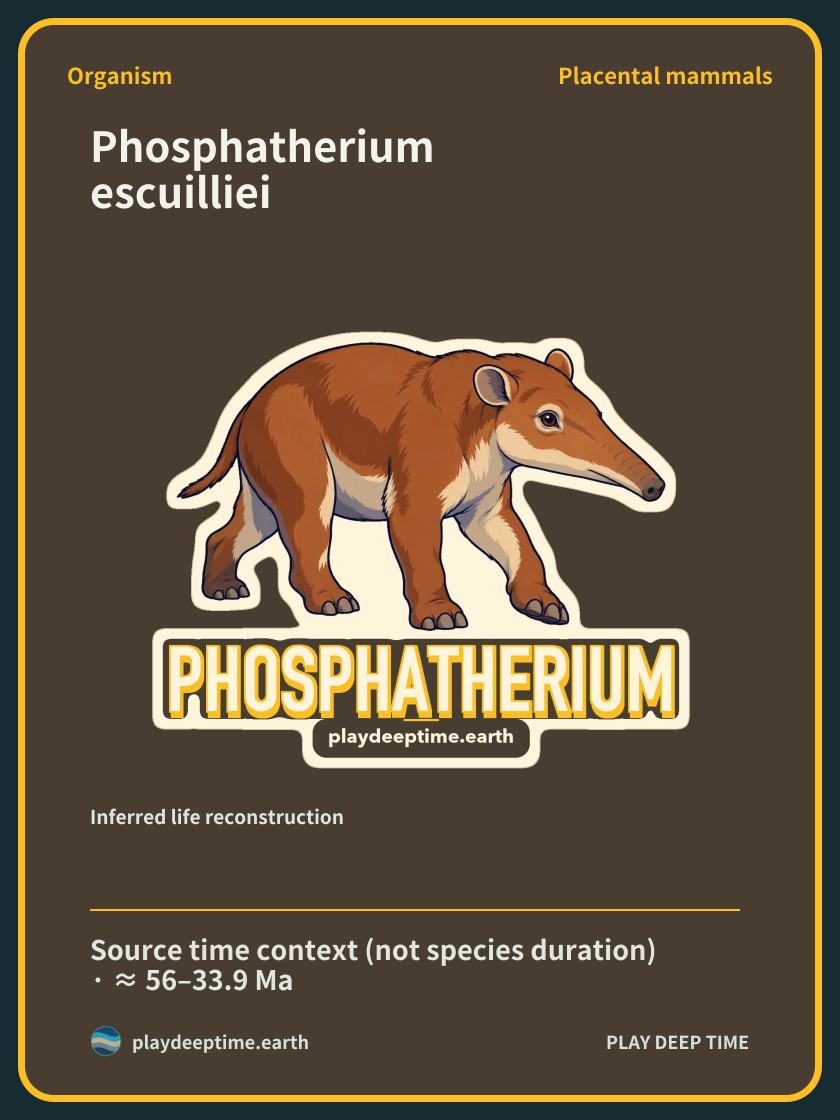
Inferred life reconstruction
Phosphatherium escuilliei
Overview
Phosphatherium escuilliei was a very early elephant relative. Small skull and tooth fossils from Morocco became keys to exploring the beginnings of proboscideans. Its unfamiliar early appearance stands out more than the familiar image of an elephant.[1][2]
Loading illustration…
Key facts
Did skulls and teeth evolve at the same pace? Many early features remain in its head, but prominent transverse ridges developed on the molars. A 2005 study highlighted this contrast and proposed that feeding adaptations may have appeared early.[2]
Time and place
It lived at the very beginning of the early Eocene, around 56 million years ago. Fossils are known from the Ouled Abdoun phosphate basin in present-day Morocco. Localities including Sidi Daoui connect to research on early African proboscideans.[2]
The time range describes source context, not the complete duration of this species.
Size, form and skeleton
The face and snout are long and narrow, with nasal bones positioned toward the front. Transverse ridges cross the chewing surfaces of the molars. Considering head outline and tooth surfaces together reveals its unusual combination.[1][2]
The early elephant relative Phosphatherium escuilliei is described as weighing about 10 kg. Unlike today’s enormous elephants, animals of such small size were also present near the beginning of the group’s history.[12]
Loading illustration…
Habitat and reproduction
What food suited molars with transverse ridges? In 2005, researchers interpreted them as adaptations for browsing on leaves. The functions of tiny teeth invite consideration of ancient relationships between plants and mammals.[2]
Fossil discovery
After it was named in 1996, new skull material and upper and lower teeth were added. A 2005 study used these to reconstruct the skull and dentition in detail. Reference specimen MNHN PM2 preserves part of the upper jaw and teeth as a starting point of this discovery.[2]
References
- Gheerbrant et al.2005 — The skull and teeth of the early proboscidean Phosphatherium
- Gheerbrant et al.2005 — New material of Phosphatherium and proboscidean evolution
- Bardet, N. et al. (2013). “A Giant Chelonioid Turtle from the Late Cretaceous of Morocco with a Suction Feeding Apparatus Unique among Tetrapods.” PLOS ONE 8(7): e63586. DOI: 10.1371/journal.pone.0063586.
- Gheerbrant et al.2005 — The skull and teeth of the early proboscidean Phosphatherium
- Gheerbrant et al.2005 — New material of Phosphatherium and proboscidean evolution
- Jouve, S. (2005). A new description of the skull of Dyrosaurus phosphaticus (Thomas,1893) (Mesoeucrocodylia: Dyrosauridae) from the Lower Eocene of North Africa. Canadian Journal of Earth Sciences 42(3):323–337. DOI10.1139/E05-008.
- 2008 — New dyrosaurid crocodylomorph and faunal turnover at the K–P transition
- ICS geologic time chart2024/12
- Jouve (2005) — A new description of the skull of Dyrosaurus phosphaticus
- Gheerbrant et al.2005 — The skull and teeth of the early proboscidean Phosphatherium
- Gheerbrant et al.2005 — New material of Phosphatherium and proboscidean evolution
- Bardet et al. (2017) — Vertebrate fossils from Morocco
Research questions
In what sequence did the features of living elephants arise? Comparing early proboscidean skulls and teeth shows that several features did not appear all at once. Phosphatherium reveals an early scene in that long transformation.[1][2]
Observation
Examine the long, narrow face and transverse molar ridges. Comparing the different stories told by skull and teeth makes this early elephant relative’s unfamiliar appearance more intriguing.[1][2]
Related organisms
 Ocepechelon bouyaiTurtle lineageSource time context (not species duration) · ≈ 143–66 Ma
Different times recorded in one phosphate basin
Ocepechelon and Phosphatherium are known from different times and areas of the Ouled Abdoun Basin in present-day Morocco. Connect the tubular snout of a latest Cretaceous sea turtle with the skull and teeth of an early Eocene elephant relative to explore different periods preserved in one basin.
 Dyrosaurus phosphaticusCrocodylomorphsSource time context (not species duration) · ≈ 56–33.9 Ma
Two faces of early Eocene North Africa
Dyrosaurus phosphaticus and Phosphatherium escuilliei are known from different parts of early Eocene North Africa. Connect a crocodile relative from present-day Algeria and Tunisia with an early elephant relative from Morocco, comparing an elongated, slender snout with the arrangement of skull and teeth.