Organism · Dinosaurs
Pisanosaurus mertii
Source time context (not species duration) · ≈ 252–201 Ma
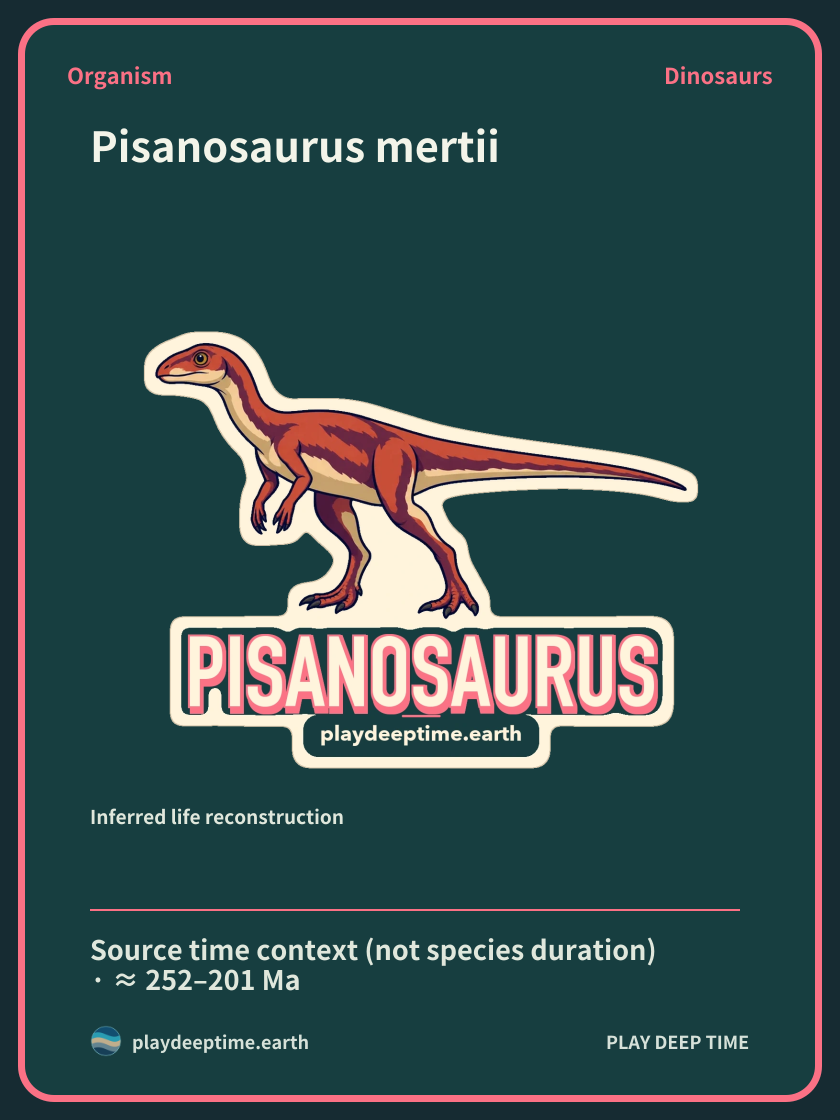
Inferred life reconstruction
Pisanosaurus mertii
Overview
Pisanosaurus mertii is studied from a small Late Triassic skeleton. Its jaws, vertebrae, and incomplete limbs connect to questions about early dinosaur relationships. A few bones can become keys to changing a large evolutionary story.[1]
Loading illustration…
Key facts
Where this organism belongs on the family tree has long been debated. The question also relates to the relationship between ornithischian dinosaurs and silesaurids. It illustrates how combining different features of a small skeleton can affect a broader evolutionary account.[1]
Time and place
PVL2577 is a Late Triassic fossil from the Ischigualasto Formation in present-day Argentina. The Triassic spans approximately 250–200 million years ago. It provides material for comparing body plans of early dinosaurs and related groups.[1][3]
The time range describes source context, not the complete duration of this species.
Size, form and skeleton
The described skeleton includes jaws, vertebrae forming the body axis, and incomplete limbs. Each preserved region conveys different information about the head and body.[1][2]
Scott Hartman’s reconstruction of Pisanosaurus based on type specimen PVL 2577 has a body length of about 56 cm. It portrays a small biped assembled by connecting preserved bones with body proportions.[4]
Loading illustration…
Habitat and reproduction
Considering jaw and limb structures together broadens questions about how the body was used. Pisanosaurus provides material for examining early relationships through comparisons of several regions. An impression from one part of the jaw can be read alongside information from the whole postcranial skeleton.[1]
Fossil discovery
Researchers have repeatedly discussed its evolutionary position by reexamining the jaws and postcranial skeleton of PVL2577. The same fossil has been interpreted differently in light of new comparative material and analyses. Its research story continues long after discovery.[1]
References
- Triassic record of early dinosaurs — Pisanosaurus
- Nesbitt et al. (2020) — The skeleton of Asilisaurus
- International Commission on Stratigraphy (2024) — Geological time chart
- Scott Hartman — Skeletal reconstruction of Pisanosaurus
- Scott Hartman — Skeletal reconstruction of Pisanosaurus
- Sereno — Study of the shoulder and forelimbs of Herrerasaurus
- Western Australian Museum — Herrerasaurus
Research questions
Do different body regions convey the same evolutionary signal? Comparing jaw features with postcranial features reveals cases that are difficult to classify using a single character. Pisanosaurus poses such questions in early dinosaur research.[1]
Observation
Move your gaze from the jaws to the body axis and then to the limbs. Considering separately what each preserved part reveals brings out the research value of this small skeleton.[1]
Related organisms
 Herrerasaurus ischigualastensisDinosaursSource time context (not species duration) · ≈ 252–201 Ma
Early dinosaur questions explored through Triassic skeletons
Examine the different records of bodies and time preserved in these two organisms. Pisanosaurus mertii: studied from a small Late Triassic skeleton, its jaws, vertebrae, and incomplete limbs connect to questions about early dinosaur relationships. PVL2577 is a Late Triassic fossil from the Ischigualasto Formation in present-day Argentina. The Triassic spans approximately 250–200 million years ago. Herrerasaurus: Herrerasaurus ischigualastensis is presented as a predatory early dinosaur of the Late Triassic. Its elongated hands and the relationship between forelimbs and hind limbs have been studied. It is known from the Late Triassic of present-day Argentina. The Triassic as a whole spans approximately 250–200 million years ago.