Organism · Dinosaurs
Plateosaurus trossingensis
Source time context (not species duration) · ≈ 252–201 Ma
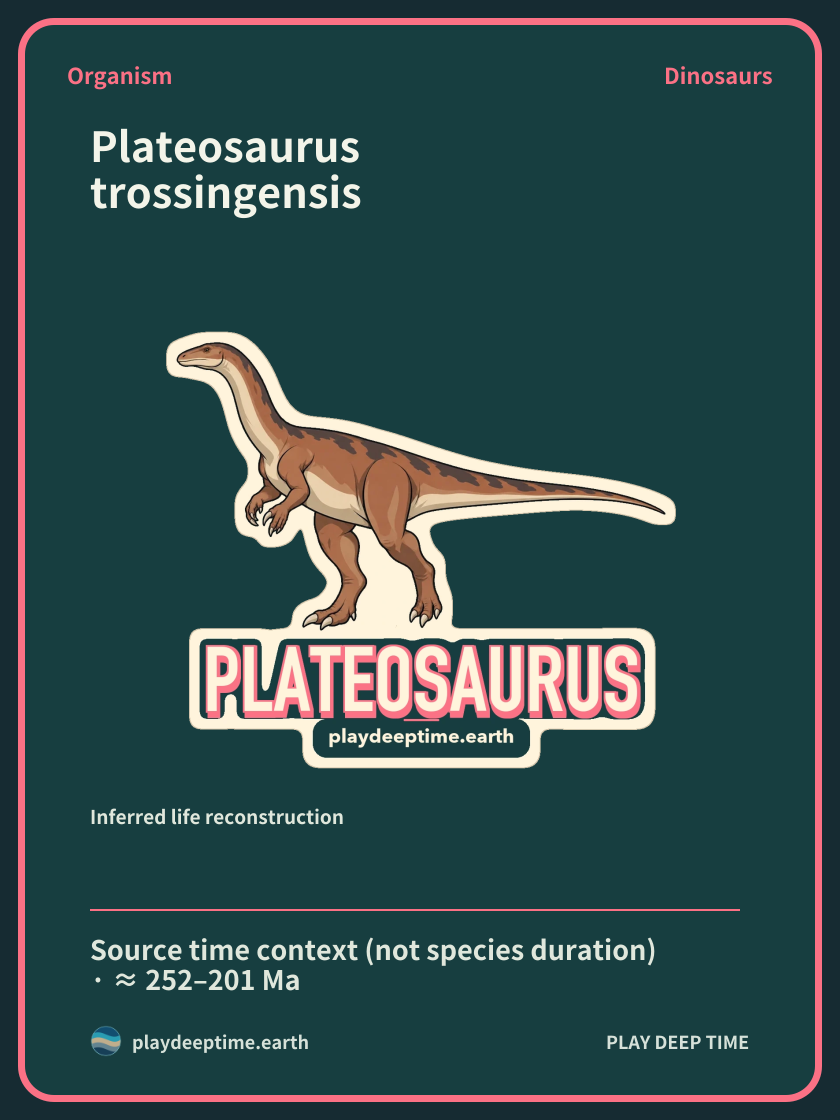
Inferred life reconstruction
Plateosaurus trossingensis
Overview
Plateosaurus trossingensis was a Late Triassic dinosaur known for a small head, long neck and tail, and large hind limbs. The grasping structure of its hands has also been studied. Its elongated body regions can be considered alongside differences within a small hand.[1]
Loading illustration…
Key facts
The first through third fingers are described as having strong claws, while the fourth and fifth have reduced, slender structures. Even within the same hand, the fingers differ in their construction.[4]
Time and place
Late Triassic material has been studied. The Triassic as a whole spans approximately 250–200 million years ago. Material from Frick, Trossingen, and Halberstadt has been used to compare skull variation.[1][2][5]
The time range describes source context, not the complete duration of this species.
Size, form and skeleton
The body extends from a small head through a long neck and trunk to large hind limbs and a long tail. The hands are described as grasping structures. Within each hand, strong claws on the first three fingers can be compared with the more slender remaining fingers.[1][4]
The Natural History Museum in London gives a body length of about 7 m for the genus Plateosaurus.[6]
Loading illustration…
Habitat and reproduction
Could its hands be turned toward the ground? A 2010 digital study discussed limits on forearm pronation. It explored possible hand orientations from bone shapes and joint connections.[3]
Fossil discovery
Following a 2010 digital study using GPIT1, the range of motion of the GPIT2 hand was studied in 2014. A 2021 skull study compared individual variation and fossil deformation. The hands and skull of the same dinosaur lead to different research questions.[3][4][2]
References
- University of Bonn (2021) — Individual traits of Plateosaurus
- Lallensack et al. (2021) — Plateosaurus skulls from Frick
- Mallison (2010) — Digital Plateosaurus
- Reiss·Mallison (2014) — Range of motion of the Plateosaurus hand
- International Commission on Stratigraphy (2024) — Geological time chart
- Natural History Museum, London — Plateosaurus
- 2013 study — Postcranial comparisons of early dinosaurs
- 1995 study — The skull of Riojasaurus
Research questions
Do skull differences reflect variation between individuals or changes caused by compression during fossilization? Comparing material from several localities allows both possibilities to be examined. This research distinguishes diversity in life from changes during preservation.[2]
Observation
Examine the connections from the small head through the long neck to the tail. Then compare the fingers of the hands with the large hind limbs to read the whole body alongside its smaller structures.[1][4]
Related organisms
 Riojasaurus incertusDinosaursSource time context (not species duration) · ≈ 252–201 Ma
Different bodies among dinosaurs
Compare the bodies and backgrounds of Plateosaurus trossingensis and Riojasaurus incertus. Plateosaurus trossingensis: a Late Triassic dinosaur known for a small head, long neck and tail, and large hind limbs; the grasping structure of its hands has also been studied. Riojasaurus incertus: a dinosaur known from the Late Triassic Los Colorados Formation. Its appearance is understood by comparing the type specimen’s postcranial bones with a skull from another specimen.