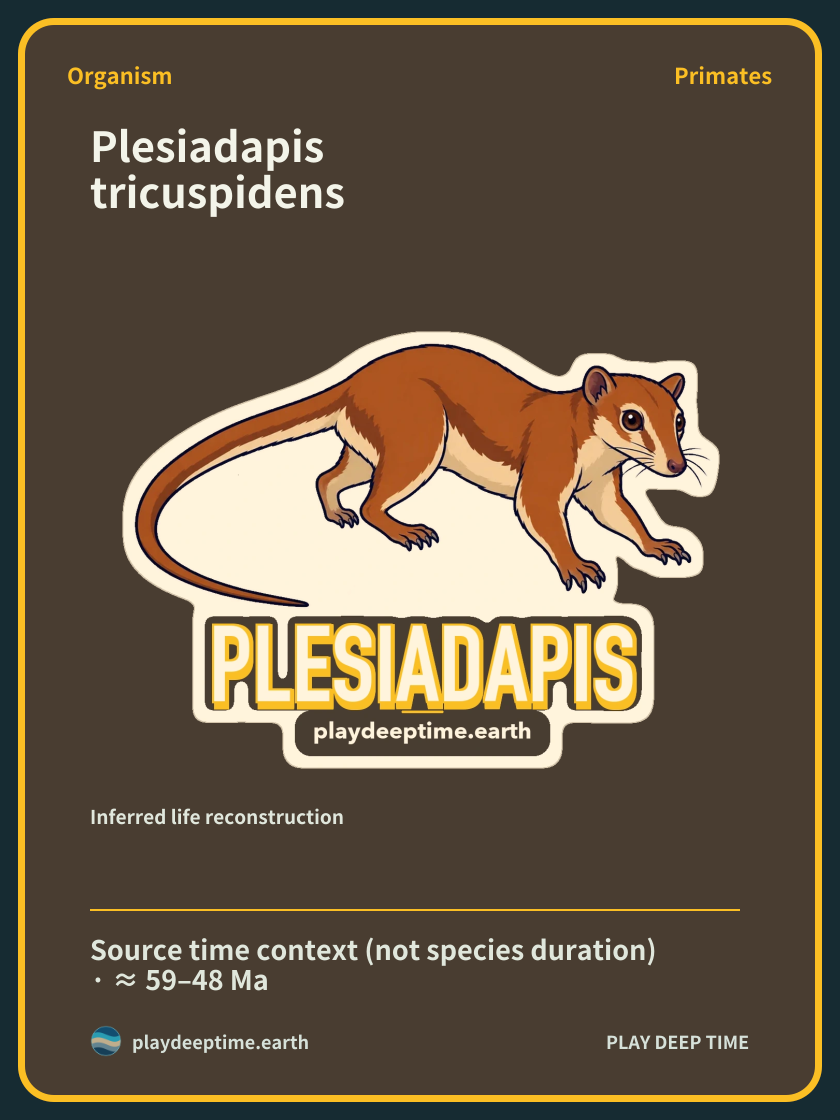
Organism · Primates
Plesiadapis tricuspidens
Source time context (not species duration) · ≈ 59–48 Ma
Inferred life reconstruction
Plesiadapis tricuspidens
Overview
Plesiadapis tricuspidens is an ancient mammal that invites questions about primate origins. Anyone expecting a monkeylike animal may be surprised by its hooked claws. Its skull, hands, and feet together reveal clues to life in trees.[1][2][3]
Loading illustration…
Key facts
Climbing hands do not always need flat nails. This animal’s long claws are linked to gripping bark. Even within the trees, monkeys, squirrels, and this ancient relative used different approaches.[3][4]
Time and place
Picture the late Paleocene, roughly 60–56 million years ago. Important fossils are known around Berru and Cernay in the Paris Basin of present-day France. Skulls and hand and foot bones from these sites reveal the mammals of that time.[5][4]
The time range describes source context, not the complete duration of this species.
Size, form and skeleton
Skull CR125 is damaged but preserves many parts. Long finger segments and hooked claws have been studied. Small differences at the ends of the hands and feet are as important for understanding life habits as the skull’s overall outline.[1][3]
Calculations using long-bone dimensions estimate a body mass of approximately 2 kg for Plesiadapis tricuspidens. A 2014 study compared this value with estimates derived from the skull and teeth.[13]
Loading illustration…
Habitat and reproduction
Research comparing its hands, feet, and limbs with living squirrels proposed arboreal quadrupedal walking and climbing. We can also picture it gripping vertical trunks with its claws. It would have used pathways through trees unlike those of ground-running animals.[4]
Fossil discovery
A skull of this species was featured in Nature in 1971. Studies of hand and foot function were later joined by CT investigations of the skull’s interior. New observation methods allow the same fossil to reveal further information.[1][5]
References
- Szalay (1971) · Cranium of the Late Palaeocene Primate Plesiadapis tricuspidens · Nature230:324–325
- Bloch et al. (2007) · New Paleocene skeletons and the relationship of plesiadapiforms to crown-clade primates
- Boyer et al. 2013 — Hands of early primates
- Youlatos & Godinot 2004 — Locomotor adaptations of Plesiadapis tricuspidens
- 2014 — Endocranial morphology of Palaeocene Plesiadapis tricuspidens
- Szalay (1971) · Cranium of the Late Palaeocene Primate Plesiadapis tricuspidens · Nature230:324–325
- Bloch et al. (2007) · New Paleocene skeletons and the relationship of plesiadapiforms to crown-clade primates
- Boyer et al. 2013 — Hands of early primates
- 2014 — Endocranial morphology of Palaeocene Plesiadapis tricuspidens
- Youlatos & Godinot 2004 — Locomotor adaptations of Plesiadapis tricuspidens
- Argot (2013) — Postcranial bones and lifestyle of Arctocyon
- International Commission on Stratigraphy (2024) — Geological time chart
- Orliac et al. (2014) — The brain and body size of Plesiadapis
Research questions
What kinds of heads, hands, and feet did ancient animals close to primates possess? Comparing their evolutionary positions with ways of climbing shows that primate features did not arise all at once. This animal represents one scene in that long sequence of change.[2][3][5]
Observation
Move your gaze from the head to the tips of the hands and feet.[3][4]
Related organisms
 Arctocyon primaevusPlacental mammalsFossil record age bounds · ≈ 59.2–56 Ma
Mammals of late Paleocene France
Plesiadapis and Arctocyon are known from late Paleocene fossils in present-day France. Connect studies of their skulls, hands, feet, and limbs to explore varied mammalian bodies after the age of dinosaurs ended.