Organism · Arthropods
Plesiosiro madeleyi
Fossil record age bounds · ≈ 317–315 Ma
Inferred life reconstruction
Plesiosiro madeleyi
Overview
Plesiosiro madeleyi was a small Carboniferous arachnid. Its front and rear body connect broadly, and the ends of its legs are divided into several parts. Fossil researchers used these small structures to investigate features of the extinct group Haptopoda.[1][2]
Loading illustration…
Key facts
Small divisions at the tips of the legs led to major taxonomic questions. Comparing Plesiosiro’s broad body junction and divided leg tips with other arachnids reveals similarities, but interpretations of relationships changed depending on how these features were considered together.[1][2]
Time and place
This fossil dates to Westphalian B in the Late Carboniferous. It was presented as a Middle Coal Measures fossil from Coseley in present-day England, United Kingdom. A 1999 redescription revisited its morphology within this locality and age context.[2]
The time range describes source context, not the complete duration of this species.
Size, form and skeleton
A 1998 synthesis described a body length of approximately 12 mm. The junction between the front and rear body is broad, and the pedipalps around the mouth resemble legs. The front legs bear weak spines, and their tips are described as characteristically divided into several segments.[1]
Loading illustration…
Habitat and reproduction
Leg shape offers clues to lifestyle. A 1999 study discussed the possibility that tooth-like projections on the legs helped grasp prey and that their structure suited crawling through narrow spaces. On this basis, it was interpreted as a small predator.[2]
Fossil discovery
Pocock described the animal in 1911. Divided tips on the front legs provided a basis for establishing a separate group, Haptopoda. Subsequent preparation and examination of specimens changed interpretations of body segmentation. A redescription of the species appeared in 1999.[1][2]
References
Research questions
Researchers explained that unclear eyes, appendages in front of the mouth, and respiratory organs made identifying close relatives difficult. They compared preserved body junctions and leg-tip structures with other groups. Such research traces arachnid history by contrasting features of a small fossil one by one.[1][2]
Observation
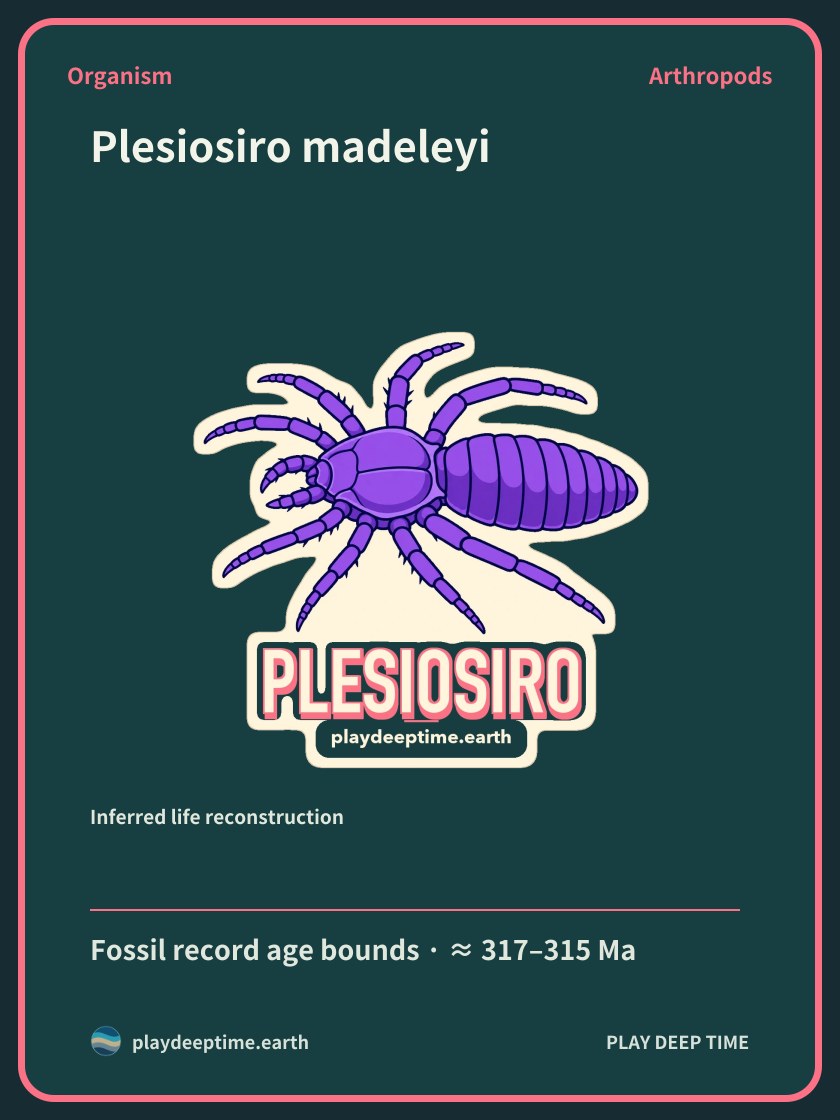
The illustration is an interpretation based on the overall form described in a specialist synthesis. Its broad body junction, leg-like pedipalps, and divided leg tips are the focus of observation. Body thickness, static posture, and coloration serve to present textually described fossil features in three dimensions.[1]
Related organisms
 Maiocercus celticusArthropodsSource time context (not species duration) · ≈ 359–299 Ma
Different bodies among arachnids
Explore the bodies and backgrounds of Plesiosiro madeleyi and Maiocercus celticus together. Plesiosiro madeleyi was a small Carboniferous arachnid. Its front and rear body connect broadly, and the ends of its legs are divided into several parts. Maiocercus celticus is a Late Carboniferous arachnid whose rear body is broader than its front body. The Crock Hey specimen preserves connections between the body and appendages.