Organism · Vascular plants
Pleuromeia sternbergii
Source time context (not species duration) · ≈ 252–201 Ma
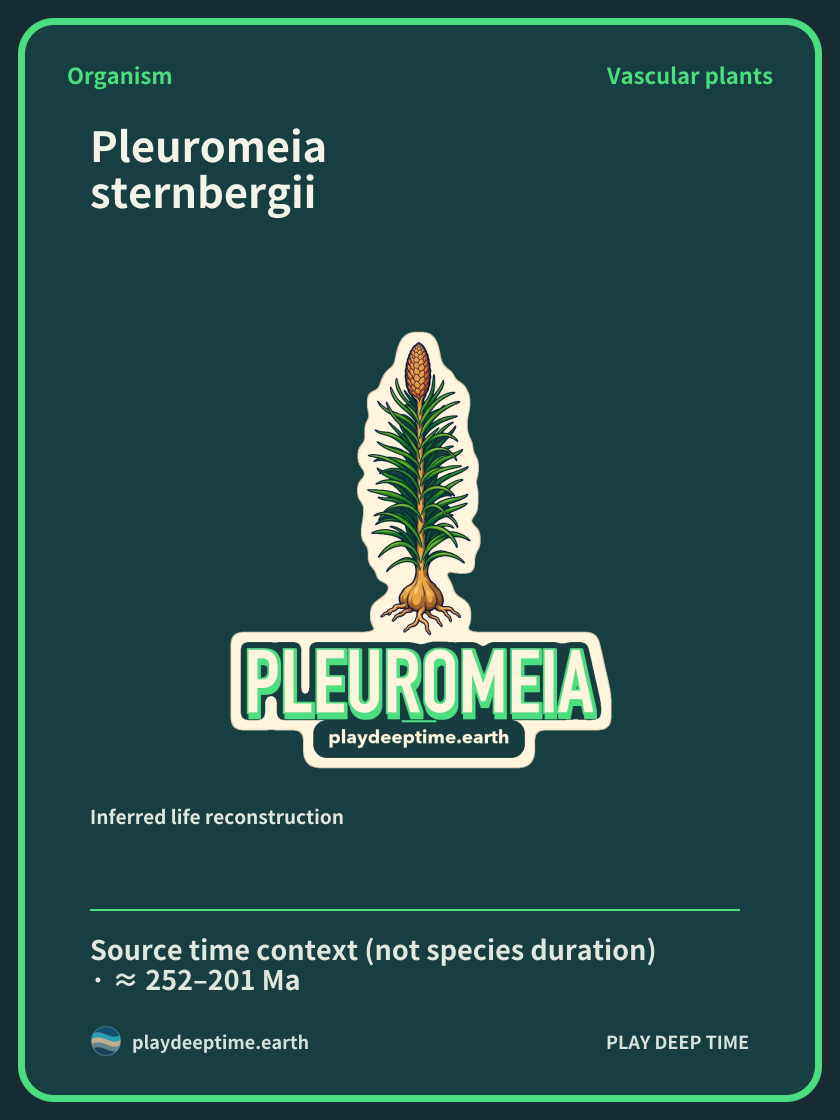
Inferred life reconstruction
Pleuromeia sternbergii
Overview
Pleuromeia sternbergii is an Early Triassic plant known for its unbranched stem and long, narrow leaves. It is studied as a form with a cone at the stem’s tip and a swollen base below. The simple stem lets us examine connections among its organs.[1]
Loading illustration…
Key facts
The long, narrow leaves are described as attaching spirally along the stem. This differs from an arrangement in which all leaves spread out at the same height. Let your gaze turn around the stem as you picture the placement of the leaves.[1]
Time and place
It is known from studies of Early Triassic plants. The Triassic as a whole spanned approximately 250–200 million years ago. A 2021 paleontological study brought together several kinds of evidence to examine the whole plant’s arrangement.[1][2]
The time range describes source context, not the complete duration of this species.
Size, form and skeleton
An unbranched stem, spirally arranged narrow leaves, and a terminal cone are the main elements of the comprehensive description. Below are a swollen base and rooting organs. Different organs can be examined in sequence from top to bottom.[1]
The stem of Pleuromeia sternbergii could reach approximately 2 m tall, though it was usually smaller. A spore-producing structure stood at the tip of the unbranched stem.[6]
Loading illustration…
Habitat and reproduction
Leaves, stems, and reproductive organs may survive as separate evidence. Research on Pleuromeia compares the terminal cone, stem, and root base together. It illustrates how a question beginning with one organ can expand to the whole plant.[1]
Fossil discovery
A 2021 study combined information from several specimens and publications to propose an overall form. The work established where separately preserved organs belonged on the body. Plant fossils too are understood by connecting several clues.[1]
References
- Looy et al. (2021) — Palaeobiology of Pleuromeia
- International Commission on Stratigraphy (2024) — Geological time chart
- Rothwell et al. (2000) — A small-bodied conifer that produced cones
- Looy et al. (2021) — Palaeobiology of Pleuromeia
- International Commission on Stratigraphy (2024) — Geological time chart
- Looy et al. (2021) — Isoetaleans during the Permian–Triassic crisis and reconstruction of Pleuromeia
Research questions
How can a leaf fragment, stem, and root base be connected into one plant? Researchers compare the features of each organ and evidence of their connections to propose an overall arrangement. We can see how small fragments meet large questions in paleobotany.[1]
Observation
Move your gaze downward from the cone at the stem’s tip along the spirally attached leaves. Continuing to the swollen base reveals the arrangement made by the stem, leaves, reproductive organs, and rooting structures.[1]
Related organisms
 Aethophyllum stipulareSeed plantsFossil record age bounds · ≈ 252–227 Ma
Following the stems of Triassic plants
Compare the Early Triassic lycophyte Pleuromeia with the conifer Aethophyllum from around the Early–Middle Triassic transition. The authors’ reconstruction of Pleuromeia shows an unbranched stem extending upward, while a small fertile specimen of Aethophyllum has two stems emerging from a taproot. Looking upward from the roots reveals their different body arrangements.