Organism · Animals
Porocypellia piriformis
Fossil record age bounds · ≈ 162–143 Ma
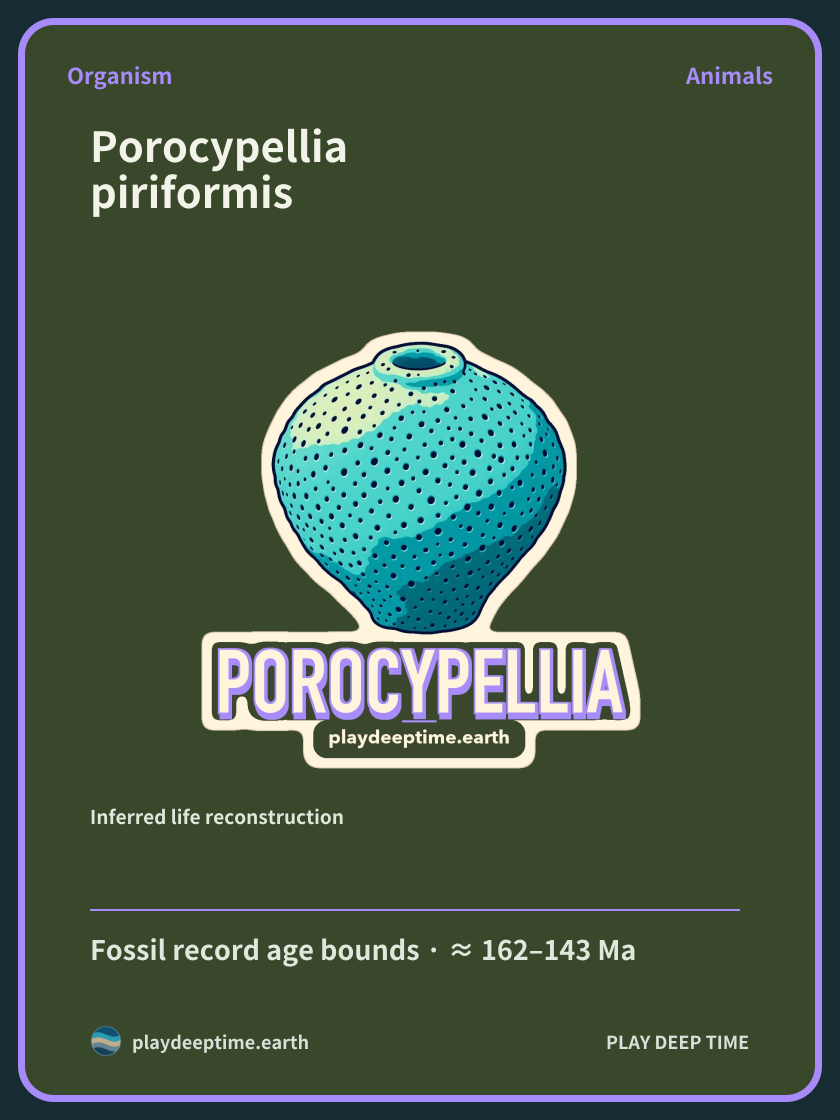
Inferred life reconstruction
Porocypellia piriformis
Overview
Porocypellia piriformis is an ancient marine sponge with a small, rounded body. Small openings spread over the skeletal surface, with one outlet at the top. Examine the arrangement of the swollen rounded body and its upper opening together.[1]
Loading illustration…
Key facts
The top and side photographs in the paper’s plate show the same specimen, ZPAL Pf.VIII/99. From above, the rounded outline and small openings stand out; from the side, the convex body and downward-tapering outline are visible. The same fossil conveys different features depending on the viewing direction.[1]
Time and place
The specimen underlying the illustration came from Oxfordian marls of the Late Jurassic. Its locality is Plettenberg in the Swabian Alb of present-day Germany. Following the age of the strata together with the present-day locality name reveals the record of an ancient sponge.[1]
The time range describes source context, not the complete duration of this species.
Size, form and skeleton
The 1997 species description explains a small sponge reaching 1cm in height and 1.3cm in upper width. Its overall shape was described as hemispherical to club-shaped, with a rounded margin around the upper outlet. The same description gives an outlet about 3mm wide and small skeletal openings 0.1–0.25mm across. The broad outline of the dense skeleton and its small openings can be examined in sequence.[1]
Loading illustration…
Habitat and reproduction
The Oxfordian marls at Plettenberg are the strata preserving this specimen. The author also introduced Kimmeridgian material from Bärenthal and Genkingen as occurrence records of the same species. Examining material from different localities and strata together reveals the scope of the record left by this ancient sponge.[1]
Fossil discovery
In 1997, Pisera described this species by comparing three specimens in his collection with historical research specimens of Goldfuss and Schrammen. Revisiting old descriptions and specimens, he provided a formal diagnosis distinguishing the species by body form and skeletal features. The author explains that earlier studies lacked a formal diagnosis.[1]
References
Research questions
The small skeletal units of sponges are important taxonomic clues. Pisera considered that Schrammen’s 1937 classification of this sponge in another group may have resulted from a thick siliceous membrane obscuring the internal skeleton. Skeletal nodes exposed on the underside of the specimen provided clues for reconsidering its classification.[1]
Observation
The illustration is based on skeletal outlines preserved in top and side photographs of ZPAL Pf.VIII/99. Move your gaze from the top opening across the rounded body to the lower outline. The viewpoint connecting the two photographs, shading, and colors are interpretations intended to make the form easier to read.[1]
Related organisms
 Minitaspongia parvisAnimalsFossil record age bounds · ≈ 359–347 Ma
Different bodies among sponges
Explore the bodies of Porocypellia piriformis and Minitaspongia parvis together. Porocypellia piriformis: Porocypellia piriformis is an ancient marine sponge with a small, rounded body. Minitaspongia parvis: Minitaspongia parvis is an ancient marine sponge characterized by an upward-widening, cup-shaped body and a lattice skeleton.