Organism · Animals
Porosphaera globularis
Source time context (not species duration) · ≈ 143–66 Ma
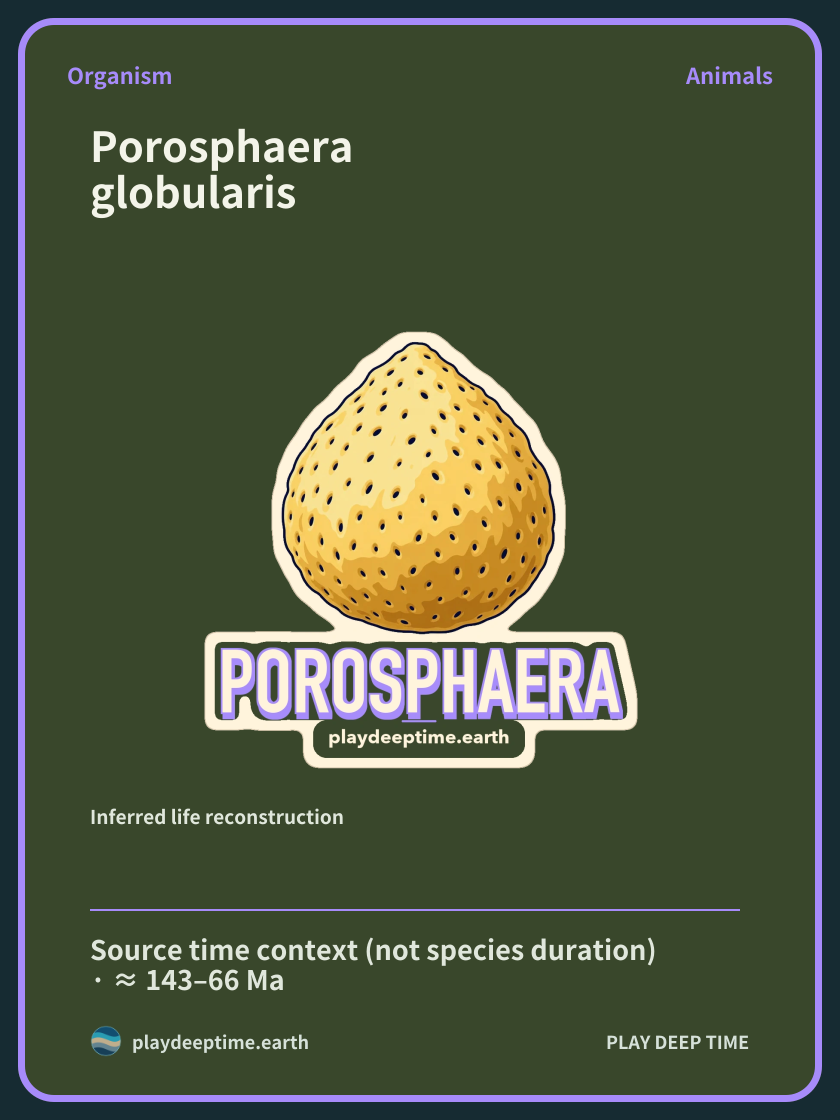
Inferred life reconstruction
Porosphaera globularis
Overview
Porosphaera globularis is a small Cretaceous calcareous sponge resembling a rounded stone. Small openings are evenly scattered over its ball-like or gently pear-shaped surface. A complex biologically formed skeleton hides within the simple outline.[2][1]
Loading illustration…
Key facts
The hard skeleton consists of small spicules joined and fused together. A 2012 study explains that four-rayed spicules merge into a framework. A fossil that looks like one solid lump becomes a body assembled from small components.[2][1]
Time and place
Campanian material from present-day Poland and Maastrichtian material from the Farokhi Formation in central Iran have been studied. Both are Late Cretaceous fossils; the Cretaceous was roughly 140–66 million years ago. Comparing fossils from different regions allows exploration of this small sponge’s ancient distribution.[2][1][3]
The time range describes source context, not the complete duration of this species.
Size, form and skeleton
The overall outline varies from nearly spherical to pear-shaped, narrowing at one end. Small surface openings are described as structures connected to internal canals. Some specimens also have shallow spreading grooves, allowing the smooth outline and detailed traces to be examined separately.[2]
Porosphaera globularis is a calcareous sponge resembling a small bead. Fossils studied from the Farokhi Formation in present-day central Iran were about 5–13mm in diameter, ranging from nearly spherical to elongated like pears.[4]
Loading illustration…
Habitat and reproduction
In 2012, the authors interpreted the Iranian fossils in relation to a relatively quiet, deeper-water environment. Small surface openings and internal canals are clues to the sponge’s body structure. One rounded fossil leads to two questions: body construction and ancient seas.[2]
Fossil discovery
A 2015 Polish study considered newly collected material together with museum collections. Researchers noted that this sponge appeared in some stratigraphic intervals but not others. Recognizing a small fossil’s shape broadened into research comparing strata.[1]
References
Research questions
Were all the holes in the surface made by the sponge itself? Researchers distinguished evenly spaced small openings from holes possibly bored later by other organisms. This research reads the original body together with traces left after death.[2]
Observation
After viewing the whole rounded body, examine how evenly its small surface openings are distributed. Compare shallow grooves visible in some parts with differences in the overall outline. There is pleasure in looking closely at a small fossil.[2]
Related organisms
 Siphonia (Siphonia) pyriformisAnimalsSource time context (not species duration) · ≈ 143–66 Ma
Different bodies among sponges
Explore the bodies of Porosphaera globularis and Siphonia pyriformis together. Porosphaera globularis: Porosphaera globularis is a small Cretaceous calcareous sponge resembling a rounded stone. Siphonia pyriformis: Siphonia pyriformis is a sponge studied from Late Cretaceous specimens in Poland.