Organism · Archosaurs
Postosuchus kirkpatricki
Source time context (not species duration) · ≈ 252–201 Ma
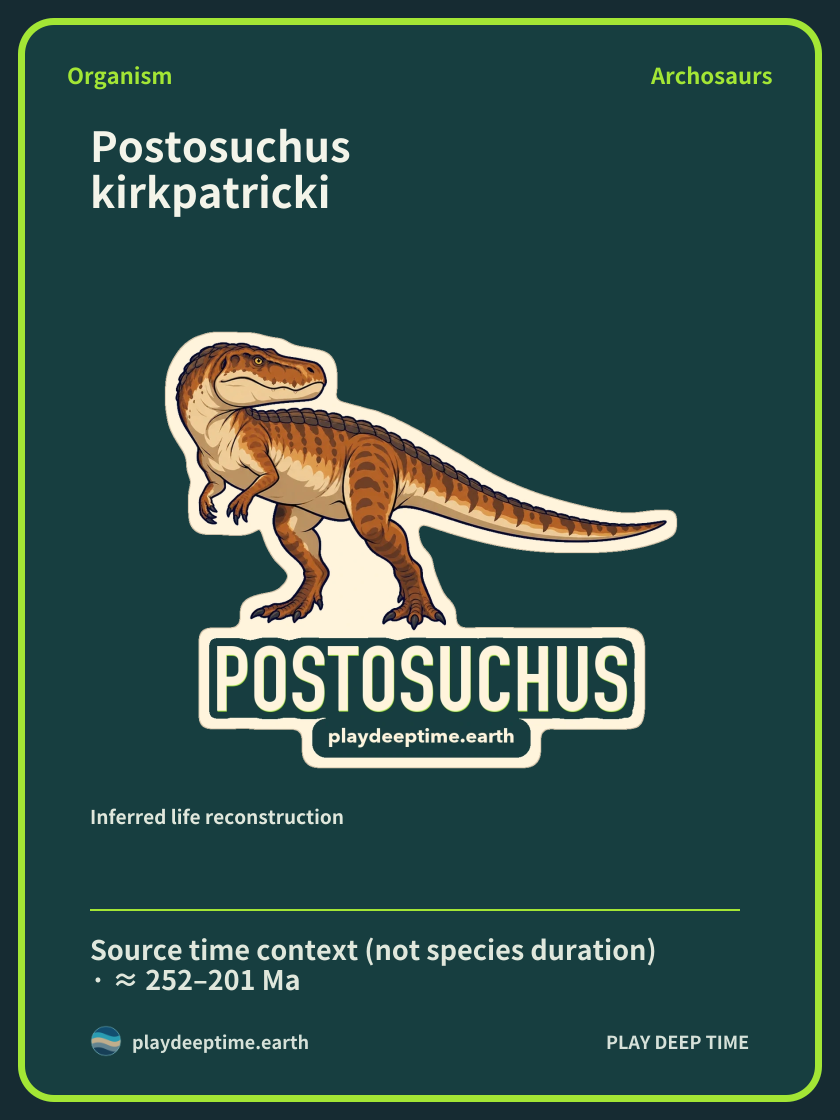
Inferred life reconstruction
Postosuchus kirkpatricki
Overview
Postosuchus kirkpatricki was a Late Triassic reptile known for a large head, short slender forelimbs, and robust hind limbs. Small hands and a long tail also formed part of its body. The contrast between forelimbs and hind limbs stands out.[1][2]
Loading illustration…
Key facts
In 2026, researchers constructed a digital model by combining CT data of a skull cast with postcranial bones from several specimens. This illustrates how fossils can be assembled into a digital body to explore possible postures.[3]
Time and place
It is known through studies of Late Triassic skeletons. The Triassic as a whole spans approximately 250–200 million years ago. Skull and postcranial research has led to digital studies of function.[2][3][4]
The time range describes source context, not the complete duration of this species.
Size, form and skeleton
A large head is followed by short, slender forelimbs and small hands, robust hind limbs, and a long tail. The skull, limbs, and vertebrae have been examined in different studies. Considering the front and rear separately makes the limb contrast clearer.[1][2]
The original 1985 description of Postosuchus estimated a total body length of about 4 m. Reconstructed from the skull and skeleton, this value conveys the large size of the Triassic predator.[5]
Loading illustration…
Habitat and reproduction
How was a body with short forelimbs supported? A 2026 study compared hypotheses involving a bipedal stance and support on the toes or the soles of the feet. It explored possible body postures from skeletal connections.[3]
Fossil discovery
Following studies of the skull in 2011 and postcranial skeleton in 2013, research on limb function and biomechanics appeared in 2026. Several sources were used in the model, including a skull cast and some limb bones of TTU-P9000 and vertebrae of TTU-P9002. Research on individual regions led to questions about the whole body.[1][2][3]
References
- Weinbaum (2011) — Skull of Postosuchus
- Weinbaum (2013) — Postcranial skeleton of Postosuchus
- Hutchinson et al. (2026) — A study of limb function in Postosuchus
- International Commission on Stratigraphy (2024) — Geological time chart
- Chatterjee(1985) — Postosuchus, a Triassic reptile from Texas
- Chun et al. (2016) — The broad jaws and plant diet of Atopodentatus
Research questions
What evidence can be used to compare ways of supporting the body? Limb bones, feet, and vertebral connections can be examined together, and posture can be varied in a model. Postosuchus illustrates anatomical research expanding into questions of function.[3]
Observation
Examine the large head, short forelimbs, and small hands before moving your gaze to the robust hind limbs. Including the long tail helps compare structures at the front and rear of the body.[1][2]
Related organisms
 Atopodentatus unicusReptiles including birdsSource time context (not species duration) · ≈ 252–201 Ma
Different bodies among reptiles
Compare the bodies and backgrounds of Postosuchus and Atopodentatus unicus. Postosuchus: Postosuchus kirkpatricki was a Late Triassic reptile with a large head, short slender forelimbs, robust hind limbs, small hands, and a long tail. Atopodentatus unicus: a reptile interpreted as having fed on plants in the sea. The fronts of its upper and lower jaws expanded sideways like a hammer.