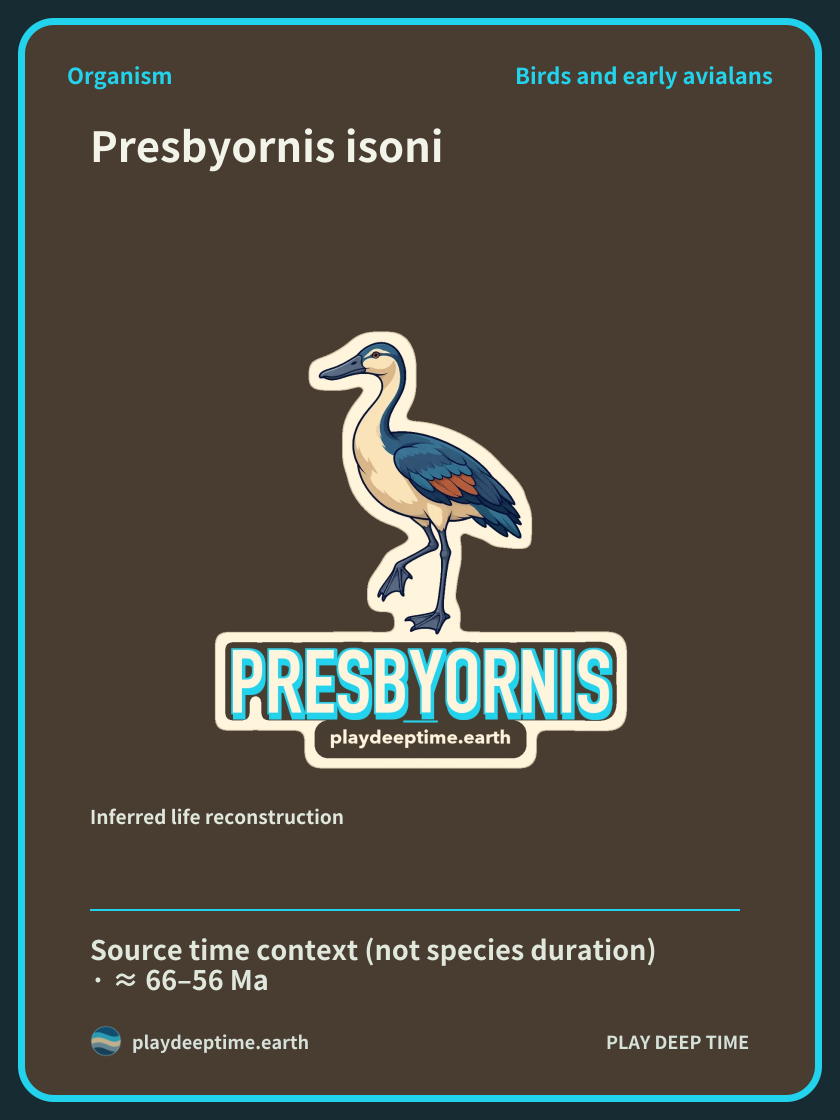
Organism · Birds and early avialans
Presbyornis isoni
Source time context (not species duration) · ≈ 66–56 Ma
Inferred life reconstruction
Presbyornis isoni
Overview
Presbyornis isoni is a large duck relative from the Late Paleocene. Although this bird is known from only a few wing bones, comparison with abundant fossils of the same genus leads us into the world of a group combining long legs with duck-like heads.[1][3]
Loading illustration…
Key facts
It has been suggested that two left wing bones found several years apart might belong to a single bird. A humerus and a wing finger bone were connected through their discovery location and form. This is one scene from fossil research in which small discoveries are linked together.[1]
Time and place
This North American bird lived in the Late Paleocene, around 60 million years ago. Important fossils came from the Aquia Formation at Blue Banks, Charles County, in present-day Maryland, USA. Marine sediments of the time preserved the bird's wing bones.[1][2]
The time range describes source context, not the complete duration of this species.
Size, form and skeleton
The reference humerus lacks its upper end, but its lower end is 23.3 mm wide. A wing finger bone studied alongside it is 40.6 mm long. These dimensions are smaller than a direct measurement of whole-body height would be, but they provide a starting point for size comparisons with other Presbyornis.[1]
Loading illustration…
Habitat and reproduction
Presbyornis pervetus, a species in the same genus, is presented as a long-legged bird that filtered small food items from water. The possibility that it nested in groups beside lakes has also been studied. Considering the life of this relative alongside isoni brings the bird group to which it belonged more vividly into view.[3]
Fossil discovery
In 1994, Olson introduced this large species while studying bird fossils from the Aquia Formation. Even without a complete skeleton, a distinctive wing bone can serve as the reference for a new name. As comparative specimens accumulate, the form represented by that name becomes clearer.[1]
References
- Olson (1994), A Giant Presbyornis (Aves: Anseriformes) and Other Birds from the Paleocene Aquia Formation of Maryland and Virginia. Proceedings of the Biological Society of Washington 107(3):429–435.
- ICS geologic time chart2024/12
- AMNH — Presbyornis pervetus
- Clarke et al.2005 — Vegavis as evidence of modern bird lineages in the Cretaceous
- Olson (1994), A Giant Presbyornis (Aves: Anseriformes) and Other Birds from the Paleocene Aquia Formation of Maryland and Virginia. Proceedings of the Biological Society of Washington 107(3):429–435.
- AMNH — Presbyornis pervetus
- ICS geologic time chart2024/12
Research questions
How much can wing bones alone reveal about a bird's size and relationships? Comparing several species within the same genus helps distinguish shared features from distinctive differences in size. This bird also invites anticipation of the next discovery that might reveal more of its body.[1][3]
Observation
Related organisms
 Vegavis iaaiBirds and early avialansSource time context (not species duration) · ≈ 143–66 Ma
Birds at the end of the dinosaur age and afterward
Vegavis and Presbyornis allow bird material from the end of the Cretaceous and the subsequent Paleocene to be read together. Examine body bones and wing bones from present-day Antarctica and North America respectively, and compare the clues left by birds from different times and regions.