Organism · Brachiopods
Productus productus
Source time context (not species duration) · ≈ 359–299 Ma
Inferred life reconstruction
Productus productus
Overview
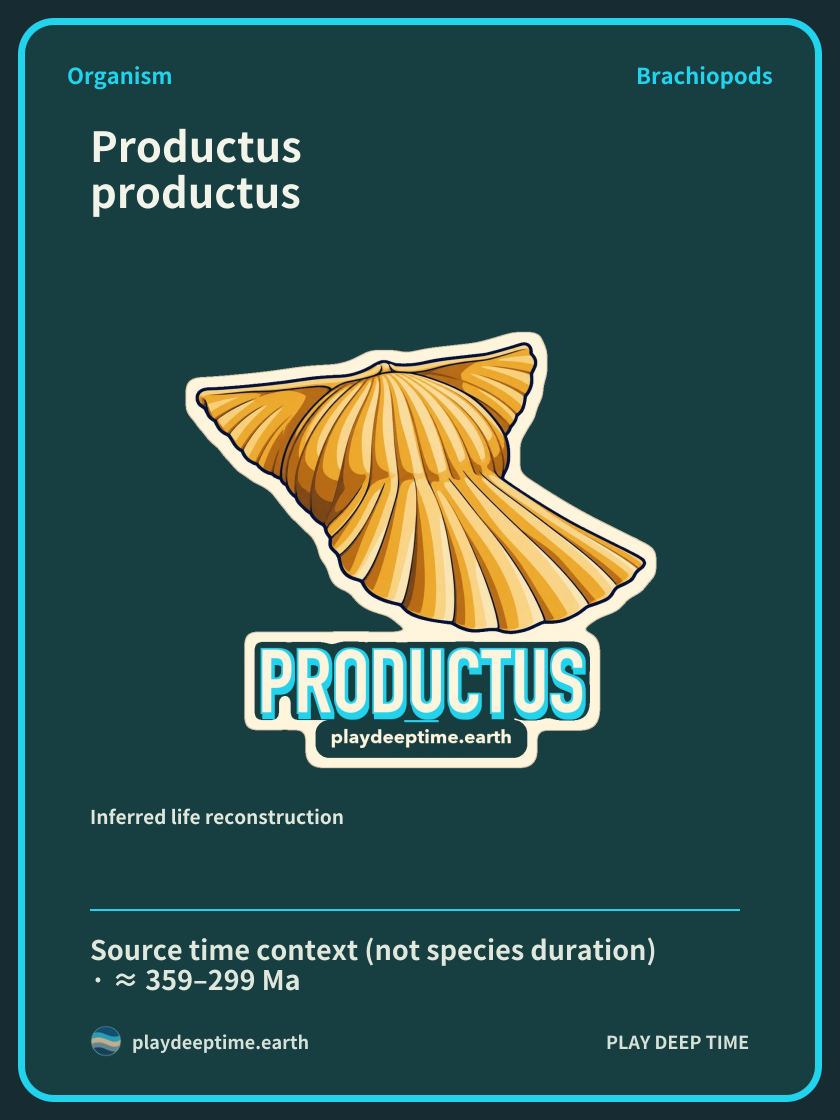
Productus productus is a brachiopod from Carboniferous seas. Its shell extends far forward from a convex body. A broad hinge and ear-like areas on either side create a distinctive outline.[1][2]
Loading illustration…
Key facts
It looks almost as though a flat plate has been attached in front of a rounded body. This contrast is easy to miss when viewing the shell from only one direction. Side and top views reveal the swollen body and the long forward extension.[1]
Time and place
Its record is associated with the late Visean of the Carboniferous, around 330 million years ago. Brachiopods in those seas displayed a variety of shell forms. Comparing several species from the same time helps us explore ancient seafloors.[3][1]
The time range describes source context, not the complete duration of this species.
Size, form and skeleton
The convex body contrasts with the shape of the long forward extension. On either side of the hinge are widened, ear-like areas. A synthesis of research on the genus compares features on both the outside and inside of the shell.[1][2]
Loading illustration…
Habitat and reproduction
Brachiopods are marine animals that filter small food particles from the water. Water entering between the shell valves passes over an internal feeding organ. Their hard shells remained in ancient sediments after these animals lived on the seafloor.[4]
Fossil discovery
BMNH B40952 is the name-bearing specimen of this species. Later researchers have compared similar fossils with it. Specimens of similar form and the characteristics of Productus were discussed again in 2022.[1][2]
References
- Treatise on Invertebrate Paleontology — Productus
- Carniti et al.2022 — Morphology and comparisons of fossil brachiopods
- International Commission on Stratigraphy — Geological timescale
- British Geological Survey — The body and feeding of brachiopods
- Treatise on Invertebrate Paleontology — Productus
- Carniti et al.2022 — Morphology and comparisons of fossil brachiopods
- International Commission on Stratigraphy — Geological timescale
- Pennsylvanian Invertebrate Fauna — The shell of Composita
- International Commission on Stratigraphy (2024) — Geological time chart
Research questions
How might the broadly extended front of the shell have helped the animal live? Specimens can be viewed from several directions and compared with other brachiopod bodies. Shell folds and proportions provide clues to relationships and ways of life.[1][4]
Observation
Follow the shell from the convex body to its long forward extension. Including the ear-like areas on either side of the hinge makes the overall outline easier to understand.[1]
Related organisms
 Composita subtilitaBrachiopodsSource time context (not species duration) · ≈ 359–299 Ma
Different shells of Carboniferous brachiopods
Productus and Composita are different brachiopods from Carboniferous seas. Compare a shell with a broad hinge and ear-like areas on either side with a rounded, egg-shaped shell to explore varied outlines within the same group.