Organism · Arthropods
Proscorpius osborni
Fossil record age bounds · ≈ 423–420 Ma
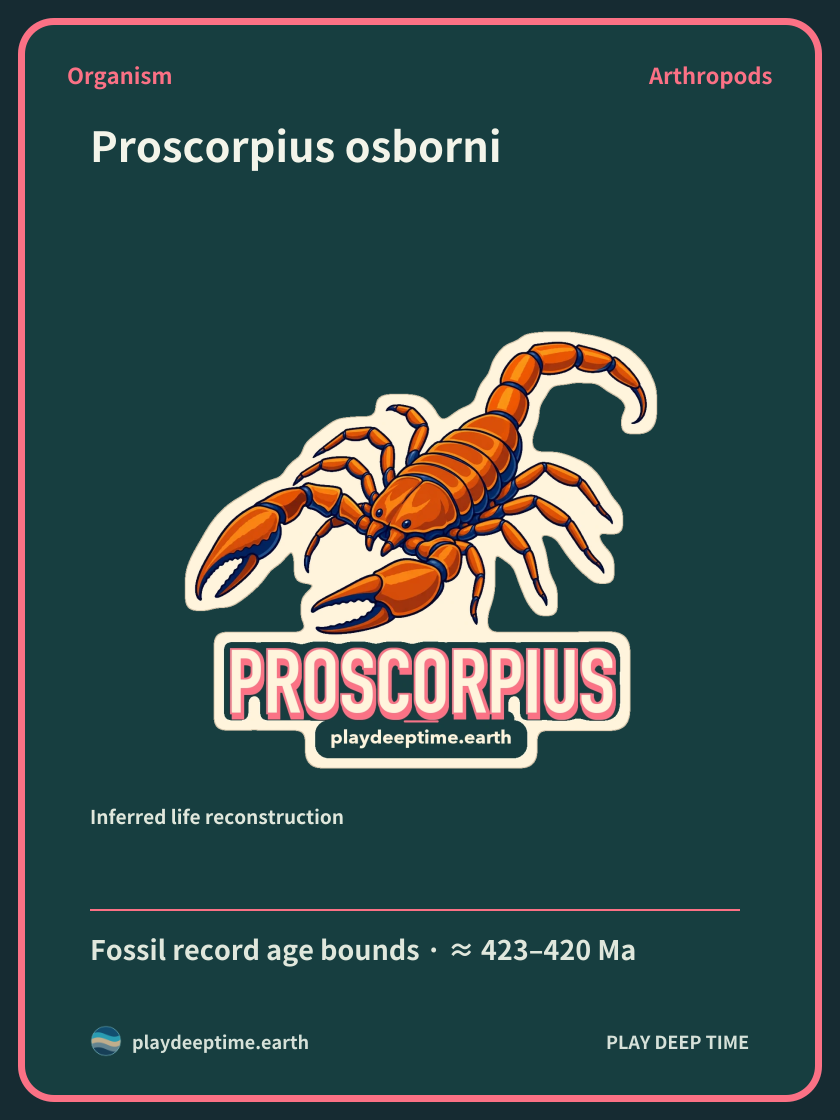
Inferred life reconstruction
Proscorpius osborni
Overview
Proscorpius osborni is a Late Silurian scorpion. Encounter an ancient scorpion through its articulated pincers and legs, segmented trunk, and tapering tail.[1]
Loading illustration…
Key facts
A 2008 study merged two names previously applied to separate scorpions into this species. Small size and different proportions were interpreted as growth differences in juveniles rather than features of new species.[1]
Time and place
These are Late Silurian Pridoli fossils discovered in present-day New York State, United States. A principal locality is Forge Hollow near Waterville, in the Phelps Member of the Fiddlers Green Formation, Bertie Group.[1]
The time range describes source context, not the complete duration of this species.
Size, form and skeleton
The tail region behind the trunk is divided into five distinct segments. These are followed by the telson, a slender, slightly curved terminal part. Successive segments and surface ridges provide observational clues.[1]
Eight studied specimens of Proscorpius osborni had total lengths of approximately 1.3–4.1 cm. The mean length reported in the 2008 study was approximately 2.8 cm. Even these small bodies reveal pincers and an elongated tail.[6]
Loading illustration…
Habitat and reproduction
The fossil-bearing strata preserve evidence of nearshore marine conditions and high salinity. They also record exposure and cracking of the sediment surface, so researchers read sediments and fossils together to investigate the ancient environment. Records of the early land plant Cooksonia at the same locality broaden questions about the setting in which the scorpion lived.[1]
Fossil discovery
The story begins with fossils collected by Osborn in 1882. Whitfield described them in 1885, and later researchers gathered old specimens from several museums together with new material to reexamine 32 specimens.[1]
References
- Dunlop et al. (2008) — Revisiting a Silurian scorpion
- Dunlop et al. (2008) — Revisiting a Silurian scorpion
- Natural History Museum — Cooksonia pertoni
- Edwards (1979) — Comparing sporangia and specimens of Cooksonia
- International Commission on Stratigraphy (2024) — Geological time chart
- Dunlop et al. (2008) — Reassessment of the Silurian scorpion Proscorpius
Research questions
Features once regarded as gill slits were reinterpreted upon reexamination as overlapping pieces of exoskeleton. This research shows how looking at a fossil again can change an old explanation.[1]
Observation
In the illustration, follow the joints of the pincers and legs toward the trunk, five tail segments, and tail tip. Locate the successive segments and surface ridges in sequence.[1]
Related organisms
 Cooksonia pertoniVascular plantsSource time context (not species duration) · ≈ 443–420 Ma
Silurian scorpions and early land plants
Proscorpius and Cooksonia pertoni are encountered through different Silurian fossil material. Compare the scorpion’s segmented body with the plant’s branching stems and sporangia to explore distinct structures in ancient animals and plants.