Organism · Primates
Proteopithecus sylviae
Source time context (not species duration) · ≈ 56–33.9 Ma
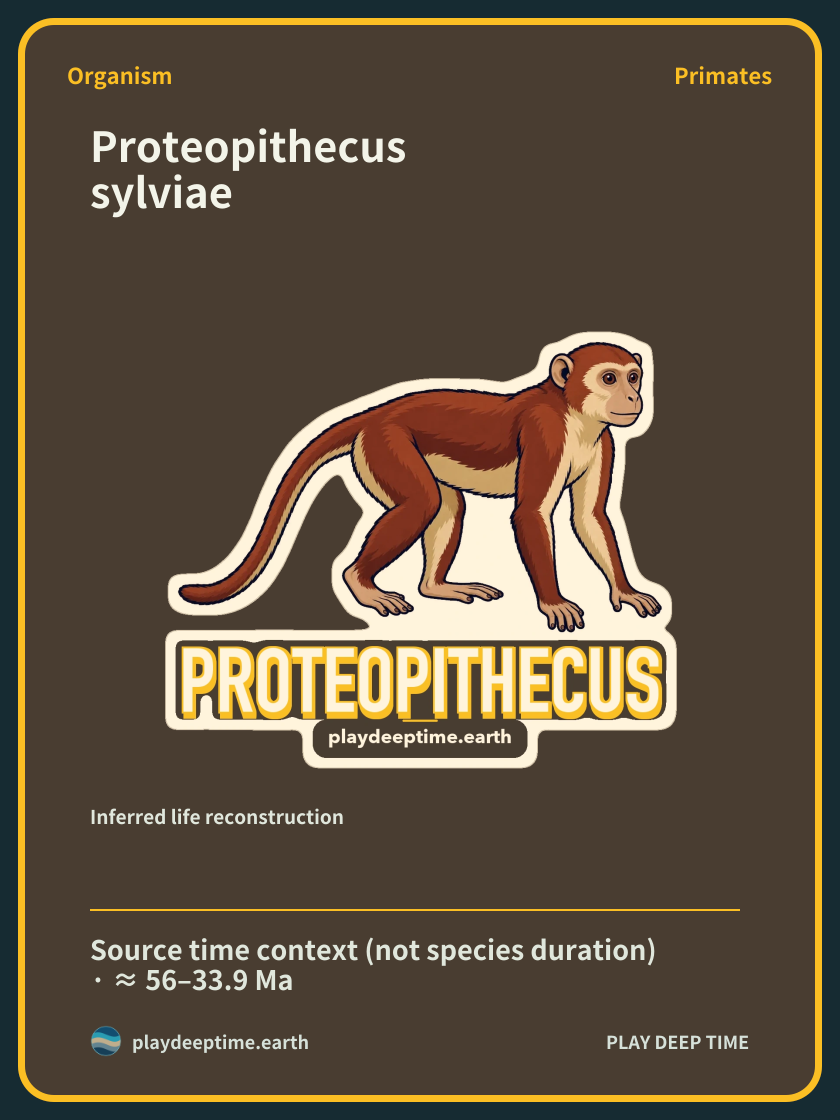
Inferred life reconstruction
Proteopithecus sylviae
Overview
Proteopithecus sylviae was a small primate from late Eocene Egypt. Skulls, lower jaws, and leg bones convey different clues to the body. Material from locality L41 raises questions about both the faces and movements of ancient primates.[1][2]
Loading illustration…
Key facts
Leg material directly associated with a lower jaw has been reported. Two tibiae and a femur were studied together, helping identify the animal to which the legs belonged. Association, as well as the appearance of isolated bones, is an important clue.[2]
Time and place
It was a late Eocene primate from locality L41 in the Fayum of present-day Egypt. The Eocene spans approximately 56–34 million years ago. Comparison with Catopithecus from the same locality reveals varied faces and bodies of ancient primates.[1][2][4][5]
The time range describes source context, not the complete duration of this species.
Size, form and skeleton
Partial skulls are described as having relatively long nasal bones and a broad, rounded braincase. CGM42214 and DPC14095 are different skull specimens. Lower jaw and leg material provides clues for comparing the body as well as the face.[1][2]
A 2013 study using heel-bone specimen DPC 24776 estimated a body mass of about 280 g. A small foot bone helps convey the light build of this early primate.[11]
Loading illustration…
Habitat and reproduction
In 1999, researchers inferred running and leaping with the trunk held horizontally from hind limb form. This interpretation compared its legs with those of small living platyrrhines. Bone shapes were used to explore how an ancient primate moved.[2]
Fossil discovery
A partial-skeleton study appeared in 1999 after a 1997 skull description. Questions beginning with the face expanded to the association between lower jaw and legs. Separately referred humerus material also contributed to comparisons of early primate bodies.[1][2][3]
References
- 1997 study — The skull of Proteopithecus
- 1999 study — A partial skeleton of Proteopithecus
- Comparative study of humeri in early anthropoids
- International Commission on Stratigraphy (2024) — Geological time chart
- Study of Catopithecus skulls and the Fayum locality
- Study of the skull of Catopithecus browni
- Study of the skull and incisors of Catopithecus
- Study of canine differences in Eocene primates from Egypt
- 1997 study — The skull of Proteopithecus
- 1999 study — A partial skeleton of Proteopithecus
- Boyer et al. (2013) — The relationship between primate heel bones and body size
Research questions
How can the owner of a leg bone be identified? Material directly associated with a lower jaw provides a clue linking it to a name. Comparison with assignments inferred from size and frequency at a locality reveals several methods of connecting fossils.[2][3]
Observation
Move your gaze from the nasal bones and rounded rear outline of the head to the trunk and legs. Comparing its face with Catopithecus shows that primates from the same broad time and region had different appearances.[1][2][5]
Related organisms
 Catopithecus browniPrimatesSource time context (not species duration) · ≈ 56–33.9 Ma
Primates of the late Eocene Fayum
Catopithecus and Proteopithecus are studied together from late Eocene material at L41 in the Fayum, Egypt. Compare the heads and bodies of different primates known from the same time and region.