Organism · Dinosaurs
Psittacosaurus mongoliensis
Source time context (not species duration) · ≈ 143–66 Ma
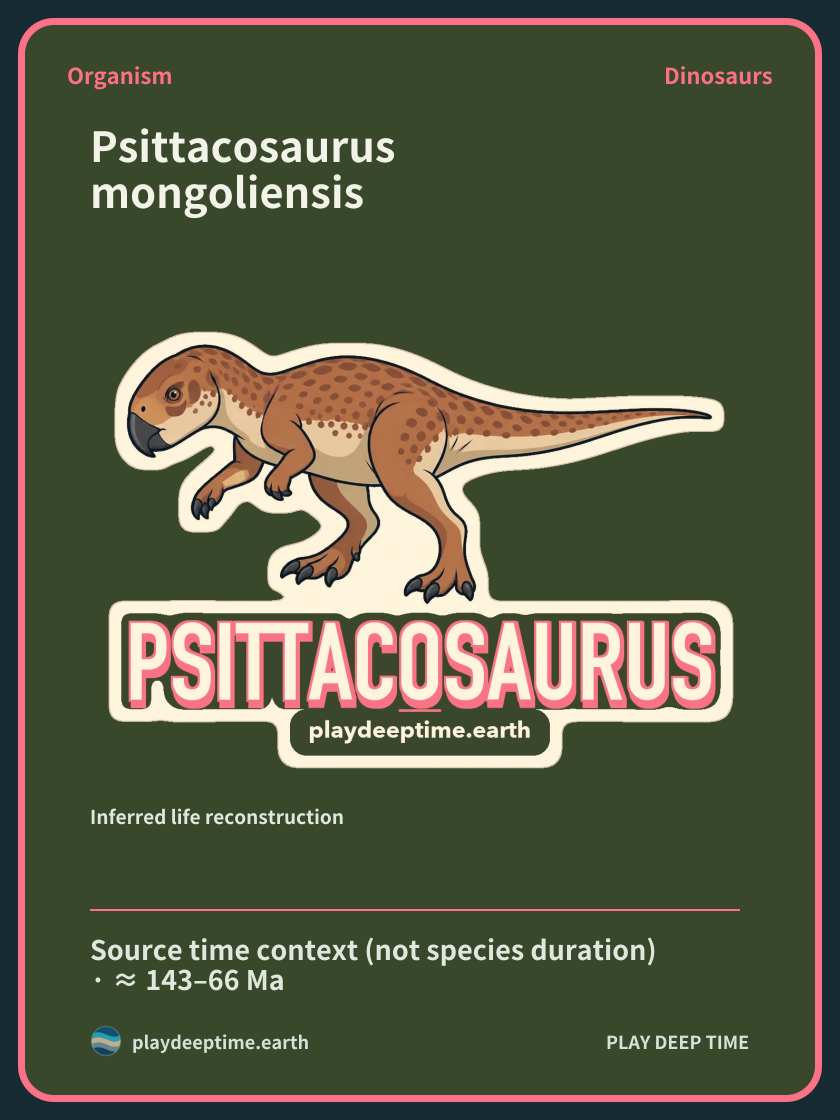
Inferred life reconstruction
Psittacosaurus mongoliensis
Overview
Psittacosaurus mongoliensis is a ceratopsian dinosaur with a conspicuous beak. Museum accounts present a posture supported on two legs. It reveals a body arrangement different from familiar large horned dinosaurs.[1]
Loading illustration…
Key facts
Psittacosaurus and Triceratops belong to the same broad ceratopsian group. Picture its relative famous for large head ornaments while comparing beaks and body arrangements.[1][5]
Time and place
This is a Cretaceous dinosaur. The Cretaceous spans roughly 140–66 million years ago. Species-specific museum accounts and anatomical research on basal ceratopsians provide different features.[1][3]
The time range describes source context, not the complete duration of this species.
Size, form and skeleton
Species-specific museum descriptions discuss the beak and bipedal posture. Sources on basal ceratopsians also compare several parts of the hand. Observations can extend from conspicuous head structures to forelimbs and hind limbs.[1][2]
Loading illustration…
Habitat and reproduction
Did all ceratopsians hold their bodies in the same posture? Compare the bipedal posture of Psittacosaurus with the quadrupedal arrangement of large Triceratops. Different bodies are known within the same broad group.[1][5]
Fossil discovery
Museums present the beak and posture of P. mongoliensis. A book on basal ceratopsian anatomy compared structures across several early relatives. Species accounts and research on a broader group provide information at different scales.[1][2]
References
Research questions
Which parts of related ceratopsians can be viewed side by side? Compare the beak, head, and connections of front and rear limbs. Diverse arrangements appear in posture as well as in large horns and frills.[1][5]
Observation
Move your gaze from the beak to the front and rear limbs. Picture larger ceratopsian relatives alongside it to compare different bodies within the same group.[1][5]
Related organisms
 Triceratops horridusDinosaursSource time context (not species duration) · ≈ 143–66 Ma
Different bodies within the ceratopsian group
Psittacosaurus and Triceratops belong to the same broad ceratopsian group. Compare their different beaks, heads, and forelimb and hind-limb arrangements.