Organism · Turtle lineage
Puppigerus camperi
Source time context (not species duration) · ≈ 56–33.9 Ma
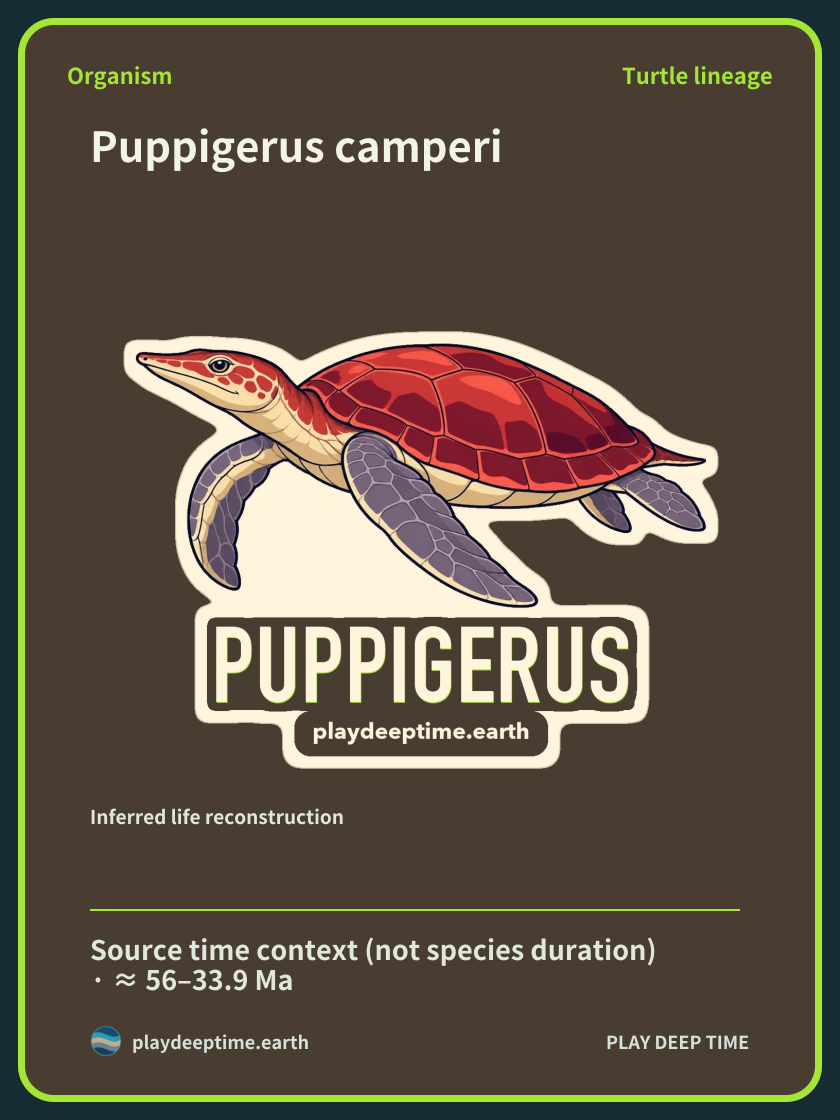
Inferred life reconstruction
Puppigerus camperi
Overview
Puppigerus camperi is an Eocene sea turtle characterized by a long, narrow head and a pointed, projecting snout. Skeletons preserving the head, separate postcranial skeletons, and carapaces have been studied. Its face and body can be connected across different fossils.[3][1]
Loading illustration…
Key facts
Two Belgian specimens preserve different regions. R0073 is registered as a skeleton with a head, while R0080 is a skeleton without one. Noting this difference helps explain which evidence reveals relationships between head and body.[1][2]
Time and place
The Belgian specimens are registered as Lutetian material from the middle Eocene. R0080 came from Maransart in present-day Walloon Brabant, Belgium. The Eocene spanned approximately 56–34 million years ago.[1][2][4]
The time range describes source context, not the complete duration of this species.
Size, form and skeleton
The head is long and narrow, with the snout projecting to a point. The head outline and the carapace enclosing the body reveal features of different regions.[3]
Puppigerus camperi was a sea turtle swimming in Eocene seas. A specimen discovered in the Ouled Abdoun Basin of present-day Morocco had a skull 10.1 cm long and 6.2 cm wide. Its triangular outline from above and elongated snout help evoke this turtle’s appearance.[5]
Loading illustration…
Habitat and reproduction
Comparing an Eocene sea turtle with living sea turtles draws attention to connections between head, carapace, and limbs. Material preserving the head and skeleton together allows this species to be explored from face to body. Locate the long snout first, then follow the rest of the animal.[1][3]
Fossil discovery
The Belgian museum catalogue connects these specimens with Moody’s 1974 morphological study and turtle research from 2018. Collection numbers link studies from different periods. A fossil already studied can be read again through comparison with other specimens.[1][2]
References
- Royal Belgian Institute of Natural Sciences — Puppigerus R0073
- Royal Belgian Institute of Natural Sciences — Puppigerus R0080
- Lapparent de Broin et al. (2018) — Comparison of fossil turtle skulls and carapaces
- International Commission on Stratigraphy (2024) — Geological time chart
- Tong·Hirayama·Tabouelle (2012) — Puppigerus, an Eocene sea turtle from Morocco
- Joyce·Lyson (2015) — Review of the fossil record of Baenidae
Research questions
What does a skeleton without a head reveal compared with one preserving a head? One helps compare the body, while the other connects face and body. Distinguishing the regions preserved in each specimen is a starting point for understanding the whole animal.[1][2]
Observation
Follow both edges of the long, narrow head from the pointed snout. Moving your gaze to the carapace and limbs reveals facial features alongside the turtle-like body arrangement.[3][1]
Related organisms
 Chisternon undatumReptiles including birdsFossil record age bounds · ≈ 51.1–37.7 Ma
Different bodies among turtles
Explore the bodies of Puppigerus camperi and Chisternon undatum together. Puppigerus camperi is an Eocene sea turtle characterized by a long, narrow head and a pointed, projecting snout. Chisternon undatum is an Eocene turtle from the Bridger strata of Wyoming.