Organism · Brachiopods
Rafinesquina alternata
Fossil record age bounds · ≈ 471–443 Ma
Inferred life reconstruction
Rafinesquina alternata
Overview
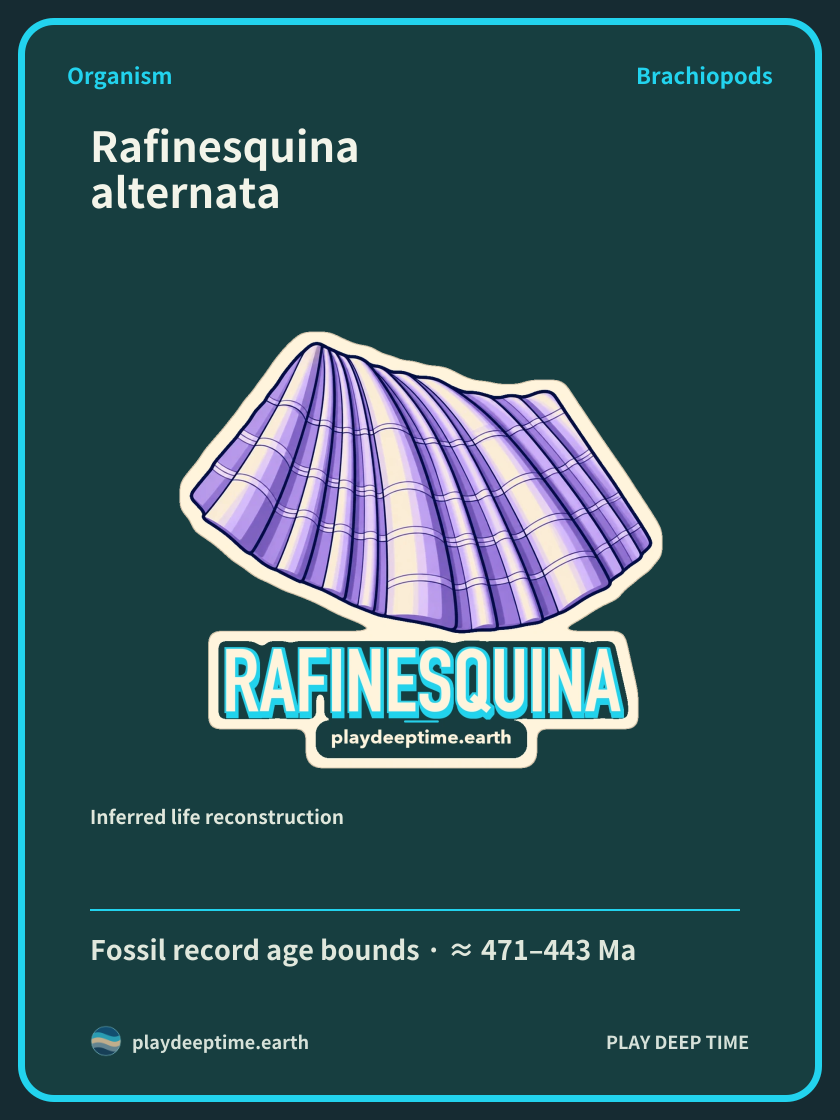
Rafinesquina alternata is a brachiopod with alternating thick and fine ribs spreading across its shell. Follow the radial ornamentation and growth lines at the front margin together to discover the order of a small surface.[1]
Loading illustration…
Key facts
One thick rib alternates with several fine ribs. Examining their spacing and thickness provides important clues for distinguishing similar shells.[1]
Time and place
The Atlas presents it as an Ordovician organism of the Caradoc–Ashgill. Example specimen OUIP1046 came from the Arnheim Formation in Franklin County, present-day Indiana, United States.[1]
The time range describes source context, not the complete duration of this species.
Size, form and skeleton
A 1931 description quoted by the Atlas states that shell width is commonly approximately 4 cm. The species is presented as varying in outline and convexity as well as size.[1]
Loading illustration…
Habitat and reproduction
The Atlas introduces research interpreting adults as living unattached on the bottom. The possibilities of displacement by currents or burial in mud led to questions about shell form.[1]
Fossil discovery
The University of New Brunswick holds UNB-2020-0193, which preserves both valves. Its institutional record connects the species name with Conrad’s 1838 description and explains surface ribs and growth lines.[2]
References
- Rafinesquina alternata — Atlas of Ordovician Life
- University of New Brunswick — Description of specimen UNB-2020-0193
- Atlas of Ordovician Life — Surface features and interpretations of the lifestyle of Rafinesquina
- Harvard Museum of Comparative Zoology — Endoceras specimens and shell structure
- University of Kentucky archival material — Ordovician fossil plate descriptions from 1931
Research questions
Studies gathered in the Atlas compared how shell size and form vary across different strata. The varied appearances of one species provided research material for understanding ancient currents and depositional environments.[1]
Observation
The illustration shows a small region of the shell surface. Find the fine ribs between thick ones, then examine growth traces crossing their direction in sequence.[1]
Related organisms
 Endoceras proteiformeMolluscsFossil record age bounds · ≈ 458–443 Ma
Outside and inside Ordovician shells
Rafinesquina and Endoceras are Ordovician animals from different groups. Examine the thick and fine ribs on a brachiopod shell and the straight shell and internal tube of a cephalopod to discover different clues supplied by shells.