Organism · Mammals
Repenomamus giganticus
Source time context (not species duration) · ≈ 143–66 Ma
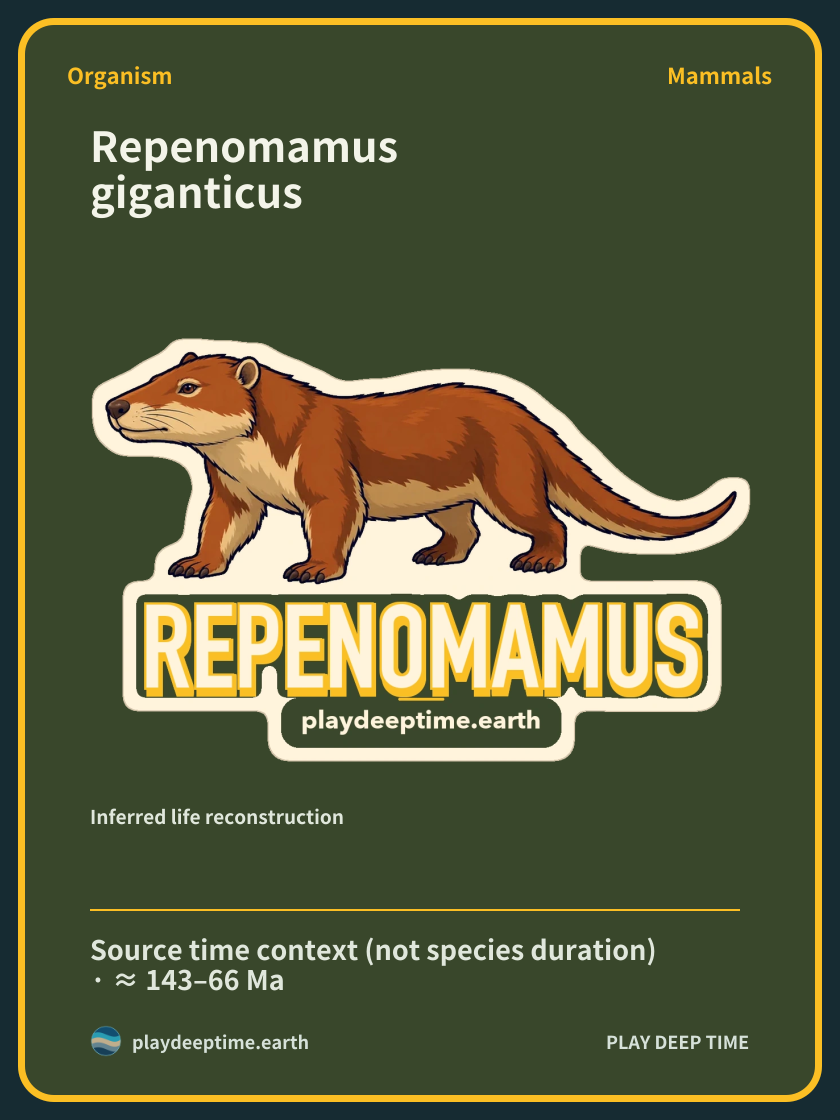
Inferred life reconstruction
Repenomamus giganticus
Overview
Repenomamus giganticus was a mammal from the Early Cretaceous Yixian Formation. A powerful jaw, elongated trunk, and short, robust limbs are described. A fossil with the skull and postcranial bones connected reveals several body regions together.[1]
Loading illustration…
Key facts
Type specimen IVPP V14155 is described as preserving a skull, lower jaw, and articulated postcranial skeleton. The connection from jaw to trunk forms a basis for studying this animal.[1]
Time and place
Material from the Early Cretaceous Yixian Formation has been studied. The Cretaceous as a whole spans approximately 140–66 million years ago. Several sources of material from the same genus have been used to compare the bodies and lives of Mesozoic mammals.[1][2]
The time range describes source context, not the complete duration of this species.
Size, form and skeleton
Behind the skull and powerful lower jaw, an elongated trunk and short, robust limbs continue. Trunk, sacral, and tail material is also described. With the skull and postcranial bones known together, connections among several regions can be examined.[1]
A 2021 study cites earlier estimates giving a body mass of about 12–14 kg.[5]
Loading illustration…
Habitat and reproduction
How did closely related species with similar bodies live? Repenomamus robustus, in the same genus, is known from a case of a juvenile dinosaur preserved in its stomach. The body structure of giganticus can be considered alongside feeding evidence from a related species.[1]
Fossil discovery
A 2005 study considered large Repenomamus mammals together with evidence of feeding on a juvenile dinosaur. IVPP V14155 of giganticus provides skull and postcranial evidence, whereas robustus provides the different clue of stomach contents. The study brings together different discoveries from two species.[1]
References
- Hu et al. (2005) — A study of large Mesozoic mammals
- International Commission on Stratigraphy (2024) — Geological time chart
- 2002 study — Sinobaatar and the Jehol Biota
- Hu et al. (2005) — A study of large Mesozoic mammals
- Morales-García et al. (2021) — Jaw shape and mechanical advantage are indicative of diet in Mesozoic mammals
Research questions
What more can be compared when the skull and postcranial skeleton are preserved together? Jaw shape, an elongated trunk, and robust limbs can be connected in the same material. This research considers several body regions together rather than one part alone.[1]
Observation
Move your gaze from the powerful jaw to the elongated trunk and short, robust limbs. Including the connection between the rear trunk and tail helps reveal the organization linking head and body.[1]
Related organisms
 Sinobaatar lingyuanensisMammalsSource time context (not species duration) · ≈ 143–66 Ma
Different mammals of the Yixian Formation
Sinobaatar and Repenomamus are mammals known from Early Cretaceous material of the Yixian Formation. Compare their different bodies and specimens to explore the diversity of mammals in the age of dinosaurs.