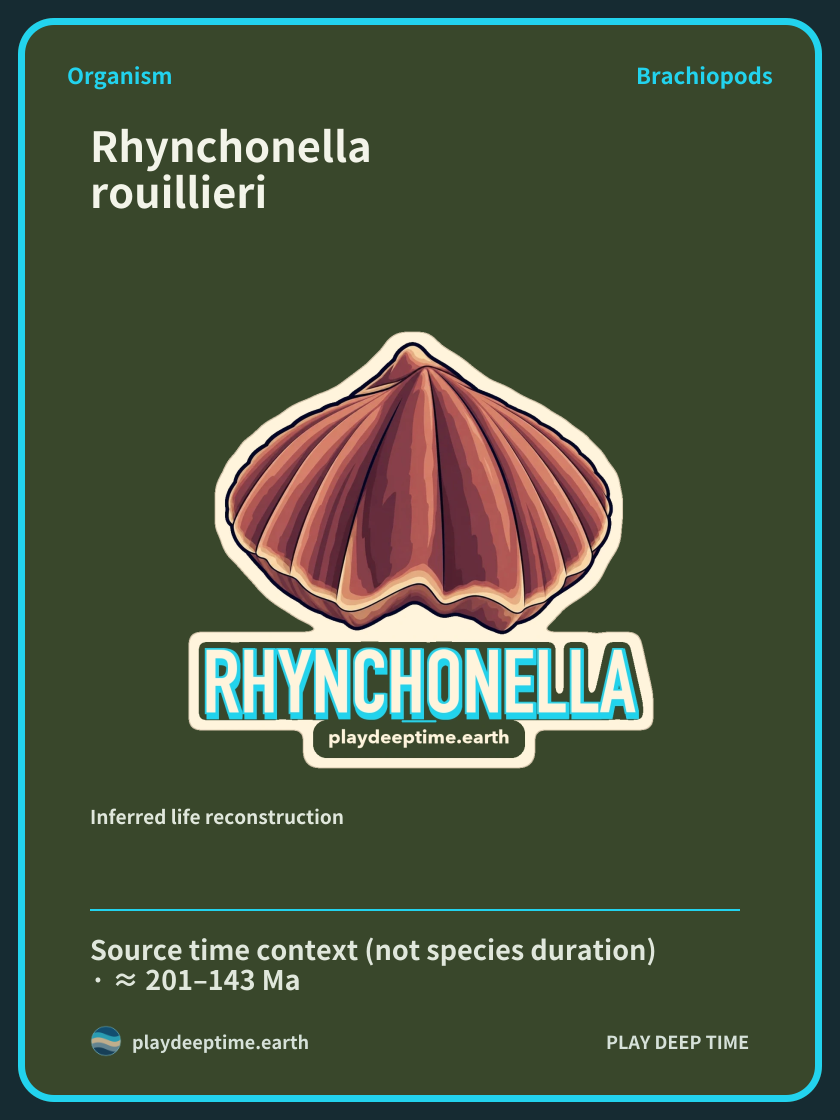
Organism · Brachiopods
Rhynchonella rouillieri
Source time context (not species duration) · ≈ 201–143 Ma
Inferred life reconstruction
Rhynchonella rouillieri
Overview
Rhynchonella rouillieri is a Jurassic brachiopod with two convex valves that fit together. Its adult outline is nearly pentagonal, with a prominent central fold. Although it evokes a bivalve, it belongs to the separate group of brachiopods.[1][3]
Loading illustration…
Key facts
Even shells of the same species differ slightly in the number of raised central ribs. Two or three ribs are described on the dorsal central fold. These documented differences show variation in the forms of fossil organisms.[2]
Time and place
The history of its name connects with Upper Jurassic material from around Moscow in present-day Russia. Ager compared its Volgian records with those of similar species. Broadly, this is a story from the later part of the Jurassic, which spanned approximately 200–140 million years ago.[2][4]
The time range describes source context, not the complete duration of this species.
Size, form and skeleton
Two convex valves, a short posterior hinge margin, and a small, sharply curved beak are described. A broad sulcus occurs ventrally, opposite a distinct dorsal central fold. Examining front and side views separately reveals different outlines of the same shell.[1][3]
This brachiopod lived in Late Jurassic seas in what is now Poland. The reported shell measured approximately 2 cm from the beak-like pointed rear end to the front margin. Sharp folds stood out on its fingernail-sized surface.[5]
Loading illustration…
Habitat and reproduction
The two valves surrounding the body face each other across a central sulcus and fold. Ribs also appear within the broad sulcus. Following the junction between the valves, as well as the outline of the closed shell, reveals the brachiopod’s organization.[1]
Fossil discovery
The name proposed by Eichwald in 1868 has been repeatedly compared in later studies. Researchers continued to reassess shells treated under different names or as varieties in older publications. Understanding an old species name requires its naming history as well as its appearance.[2]
References
- Makridin (1964) — The shell and variation of Rhynchonella
- Ager — The morphology and name of Rhynchonella
- Study in the Sorbonne collection — Shell of Rhynchonella rouillieri
- International Commission on Stratigraphy (2024) — Geological time chart
- Lewiński (1922), Monographie géologique et paléontologique du Bononien de la Pologne
- Gaillac Museum study — Spiriferina walcotti
Research questions
How can apparently similar Rhynchonella species be distinguished? Ager’s discussion brings together ribs on the central fold, beak direction, and differences in occurrence age. This compares multiple features in sequence beyond a first impression of resemblance.[2]
Observation
First locate the raised central region of the shell and the broad sulcus opposite it. Following the small rear beak and short hinge margin helps establish front and back.[3][1]
Related organisms
 Spiriferina walcottiBrachiopodsSource time context (not species duration) · ≈ 201–143 Ma
Different bodies among brachiopods
Explore the bodies of Rhynchonella rouillieri and Spiriferina walcotti together. Rhynchonella rouillieri is a Jurassic brachiopod with two convex valves that fit together. Spiriferina walcotti is an Early Jurassic brachiopod with a transversely broad shell.