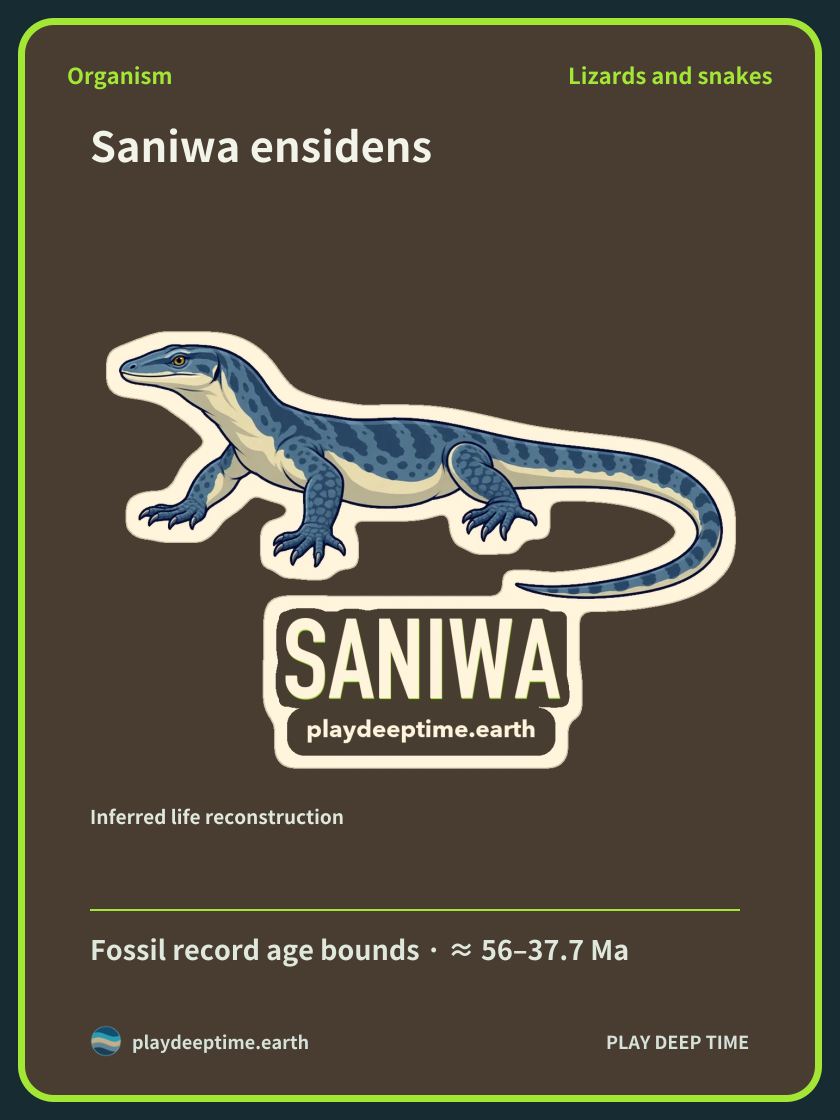
Organism · Lizards and snakes
Saniwa ensidens
Fossil record age bounds · ≈ 56–37.7 Ma
Inferred life reconstruction
Saniwa ensidens
Overview
Saniwa ensidens was an Eocene North American lizard studied as a relative of monitor lizards. Old type material and an articulated skeleton discovered later reveal its head and body. The connections among small bones allow comparisons of an ancient lizard’s form.[3][1]
Loading illustration…
Key facts
Traces of cartilage, skin, and scales have been reported as well as bones. Researchers described such preservation in a new skeleton in 2007. The state before bones had fully ossified also raises questions about its growth stage.[3]
Time and place
It is known from the Eocene of present-day Wyoming, United States. Type material was collected from the Bridger Formation, while records of another museum skeleton name the Green River Formation. The Eocene spans approximately 56–34 million years ago.[2][6][7]
The time range describes source context, not the complete duration of this species.
Size, form and skeleton
Its lizard skeleton connects the skull, spine, and four limbs. A 2007 paper described an articulated skeleton exposed from above as Saniwa ensidens. Examination of the wrists, ankles, and bone ends led to an interpretation that it was not fully mature.[3]
Saniwa ensidens is presented as a lizard whose adults grew up to about 1.4 m long. The Paleontological Research Institution in the United States described adult size as about 4.5 feet when introducing a juvenile fossil.[11]
Loading illustration…
Habitat and reproduction
Comparing different fossil records from the Bridger and Green River formations allows exploration of this lizard’s world. An articulated skeleton and skin traces provide clues to growth and body covering. Even small joint structures add questions about an ancient lizard’s life.[2][6][3]
Fossil discovery
The Hayden expedition collected fossil-bearing sandstone in Wyoming in 1870. The Smithsonian records September 10 as the type specimen’s collection date. Even after a 1922 redescription, new specimens and comparative research prompted further examination of Saniwa’s body and relationships.[1][2][4]
References
- Gilmore (1922) — Redescription of the type specimen of Saniwa
- Smithsonian — Type-specimen record of Saniwa
- Rieppel & Grande (2007) — Saniwa viewed through a newly found articulated skeleton
- Caldwell (2003) — Reassessment of the type material of Saniwa
- Conrad, Rieppel & Grande (2008) — Saniwa and the evolution of monitor lizards
- Smithsonian — Saniwa skeleton from the Green River Formation
- International Commission on Stratigraphy (2024) — Geological time chart
- Smithsonian — Type-specimen record of Saniwa
- Smithsonian — Saniwa skeleton from the Green River Formation
- Joyce·Lyson (2015) — Review of the fossil record of Baenidae
- Paleontological Research Institution — Saniwa in the fossil preparation laboratory
Research questions
How can a newly discovered articulated skeleton change interpretations of old fossils? Researchers compare the skull, limbs, wrists, and ankles with other lizards. A 2008 study used information from a new specimen to investigate evolutionary relationships among monitor lizards.[3][5]
Observation
Move your gaze from the head along the spine through the trunk and tail. Considering all four limbs and the positions of the wrists and ankles helps reveal the connections in a lizard skeleton.[3]
Related organisms
 Chisternon undatumReptiles including birdsFossil record age bounds · ≈ 51.1–37.7 Ma
A lizard and a turtle of the Bridger Formation
Saniwa and Chisternon are Eocene reptiles known from the Bridger Formation in present-day Wyoming, United States. Connecting different evidence, such as lizard bones and a turtle shell, broadens the story of ancient life in this region.