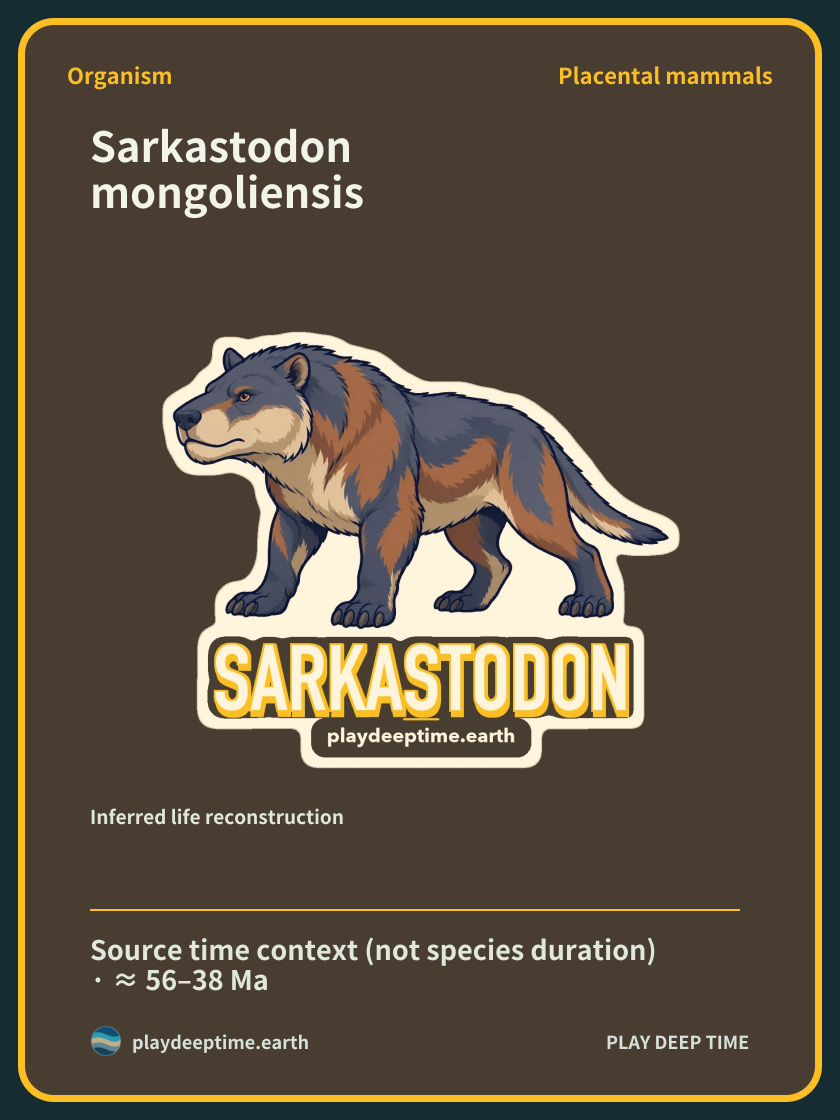
Organism · Placental mammals
Sarkastodon mongoliensis
Source time context (not species duration) · ≈ 56–38 Ma
Inferred life reconstruction
Sarkastodon mongoliensis
Overview
Sarkastodon mongoliensis is an ancient mammal from Eocene Asia. Its name became known through a 1938 study introducing a large oxyaenid. Its story extends beyond the fossil itself to the position of the strata in which it was buried.[1][2]
Loading illustration…
Key facts
Fossils from the same hill do not all come from the same layer. One Sarkastodon specimen was recorded from strata below a famous collecting site. A small field number beside the fossil’s name helped distinguish intervals of ancient time.[2]
Time and place
This is an Asian mammal from the Eocene, approximately 56–34 million years ago. Researchers study a specimen from Wulanhuxiu in the Erlian Basin of present-day Inner Mongolia, China, at a place an earlier expedition called Chimney Butte. Connecting old locality names with modern maps is also part of research.[2]
The time range describes source context, not the complete duration of this species.
Size, form and skeleton
The genus Sarkastodon is compared through a shortened snout and lower jaw and reduced anterior premolars. A 2018 dental study described these structures as a type of bone-crushing dentition. This compares how jaws and teeth processed food together.[3]
A dental-data-based model in the 2021 CarniFOSS study estimated a body mass of approximately 1,100 kg.[9]
Loading illustration…
Habitat and reproduction
Sarkastodon fossils can be examined alongside records of terrestrial strata yielding several ancient mammals. The region contains gray clay, sand, and gravel layers as well as red clay. Comparing animals with strata helps explore the terrestrial environment of the time.[2][3]
Fossil discovery
Old expedition evidence continued to be reexamined after Granger’s 1938 paper. A 2018 study linked Sarkastodon field number 641 with the twelfth stratigraphic layer. Matching museum specimens with old field notes thus became a new discovery.[1][2]
References
- Granger1938 — A giant oxyaenid from the Upper Eocene of Mongolia
- Bai et al.2018 — Age and distribution of mammals in the Erlian Basin
- Morales & Pickford2018 — Comparison of jaws and teeth of ancient carnivorous mammals
- Schoch & Lucas1985 — The phylogeny and classification of the Dinocerata
- 2006 IVPP — Dinocerate jaws from the Erlian Basin
- Osborn, H. F. & Granger, W. (1932), Coryphodonts and uintatheres from the Mongolian expedition of 1930. American Museum Novitates 552:1–16.
- Bai et al.2018 — Age and distribution of mammals in the Erlian Basin
- Granger1938 — A giant oxyaenid from the Upper Eocene of Mongolia
- Faurby·Morlo·Werdelin(2021) — CarniFOSS fossil carnivorous mammal body-mass data
Research questions
How do locality names in old papers connect with modern stratigraphic names? Researchers compare expedition routes, stratigraphic sketches, and specimen numbers together. Retracing discovery records is an important fossil story alongside animal evolution.[2]
Observation
After examining the head and jaws, imagine the several layers in the hill where the fossil was found. One specimen connects the story of a body with the chronology of its discovery site.[3][2]
Related organisms
 Gobiatherium mirificumMammalsSource time context (not species duration) · ≈ 56–38 Ma
Mammal stories from the Eocene Erlian Basin
Gobiatherium and Sarkastodon material connects to the Eocene Erlian Basin in present-day Inner Mongolia, China. Follow different strata and localities to read Gobiatherium cranial material alongside the discovery story of Sarkastodon.