Organism · Dinosaurs
Scansoriopteryx heilmanni
Source time context (not species duration) · ≈ 130–120 Ma
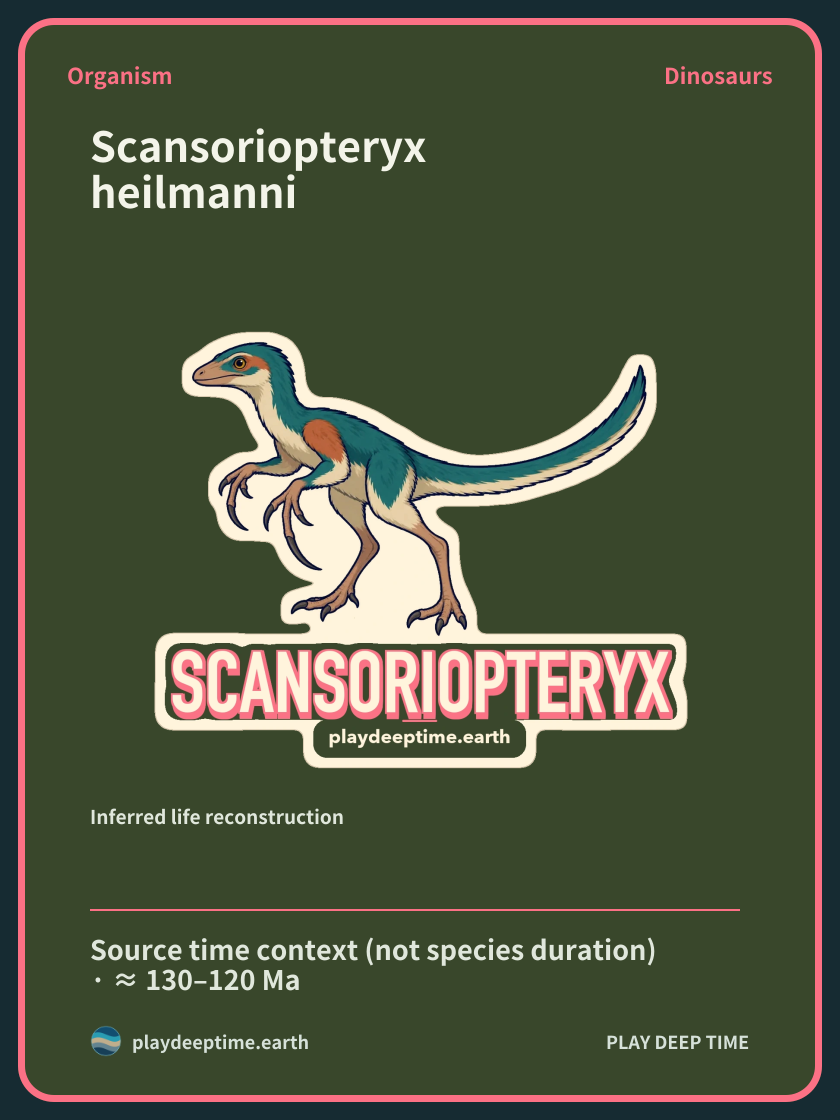
Inferred life reconstruction
Scansoriopteryx heilmanni
Overview
Scansoriopteryx heilmanni is a small dinosaur relative with an exceptionally long third finger. It is studied from an articulated juvenile skeleton and partial traces of downy covering. The distinctive shape of a small hand raises questions about the life of the whole animal.[1]
Loading illustration…
Key facts
The third finger extends farther than the other fingers. This unusual hand structure could be examined even in a juvenile. A small part of the body became an important feature for comparison with other theropods.[1]
Time and place
The 2002 description addresses a fossil from northeastern China. This organism can be considered as material from the Mesozoic, when dinosaurs flourished. The Mesozoic is a broad span roughly 250–66 million years ago.[1][2]
The time range describes source context, not the complete duration of this species.
Size, form and skeleton
It is studied from a juvenile skeleton with the head, hands, trunk, tail, pelvis, and feet articulated. The exceptionally long third finger and partially preserved down-like traces catch the eye. Its small body allows examination of the construction of the hands and tail.[1]
Of the two known juvenile specimens of Scansoriopteryx heilmanni, the larger was estimated in the literature to have weighed about 7g. This is an estimate for a still-young individual, not an adult dinosaur, and offers a glimpse of an early growth stage of this small, long-fingered animal.[3]
Loading illustration…
Habitat and reproduction
The structures of the long fingers, feet, and shoulder raise questions about how this animal used its body in its surroundings. The researchers in 2002 compared its form in relation to life in trees. The unusual construction of a single hand broadens into a question about lifestyle.[1]
Fossil discovery
The 2002 description introduced the juvenile skeleton from northeastern China as a new animal. An abridged paper made public by the museum describes not only the hands and head but also the tail, pelvis, shoulder, and feet. One young body provided evidence for comparisons of many regions.[1]
References
- Czerkas & Yuan (2002) — Scansoriopteryx from northeastern China
- International Commission on Stratigraphy (2024) — Geological time chart
- Sorkin (2021; online 2020) — Scansorial and aerial ability in Scansoriopterygidae and basal Oviraptorosauria
- Han et al. (2015) — Skull structure of Yinlong
- Xu et al. (2006) — Early ceratopsians from the Late Jurassic
Research questions
What function might the exceptionally long finger have served? The hands, feet, and shoulder can be compared alongside those of other small theropods. Examining the features of a growing skeleton allows us to explore the relationship between body and life.[1]
Observation
First look at the long extension of the third finger. Then move your gaze to the small head and trunk, the long tail, and the feet to reveal the construction of one young body.[1]
Related organisms
 Yinlong downsiDinosaursSource time context (not species duration) · ≈ 201–143 Ma
Different bodies among dinosaurs
Explore the bodies and living backgrounds of Scansoriopteryx heilmanni and Yinlong downsi together. Scansoriopteryx heilmanni: Scansoriopteryx heilmanni is a small dinosaur relative with an exceptionally long third finger. It is studied from an articulated juvenile skeleton and partial traces of downy covering. Yinlong downsi: Yinlong downsi is an early ceratopsian with a short frill behind its head. Its low triangular head narrows toward the front and widens at the cheeks.