Organism · Placental mammals
Scarrittia canquelensis
Source time context (not species duration) · ≈ 29–21 Ma
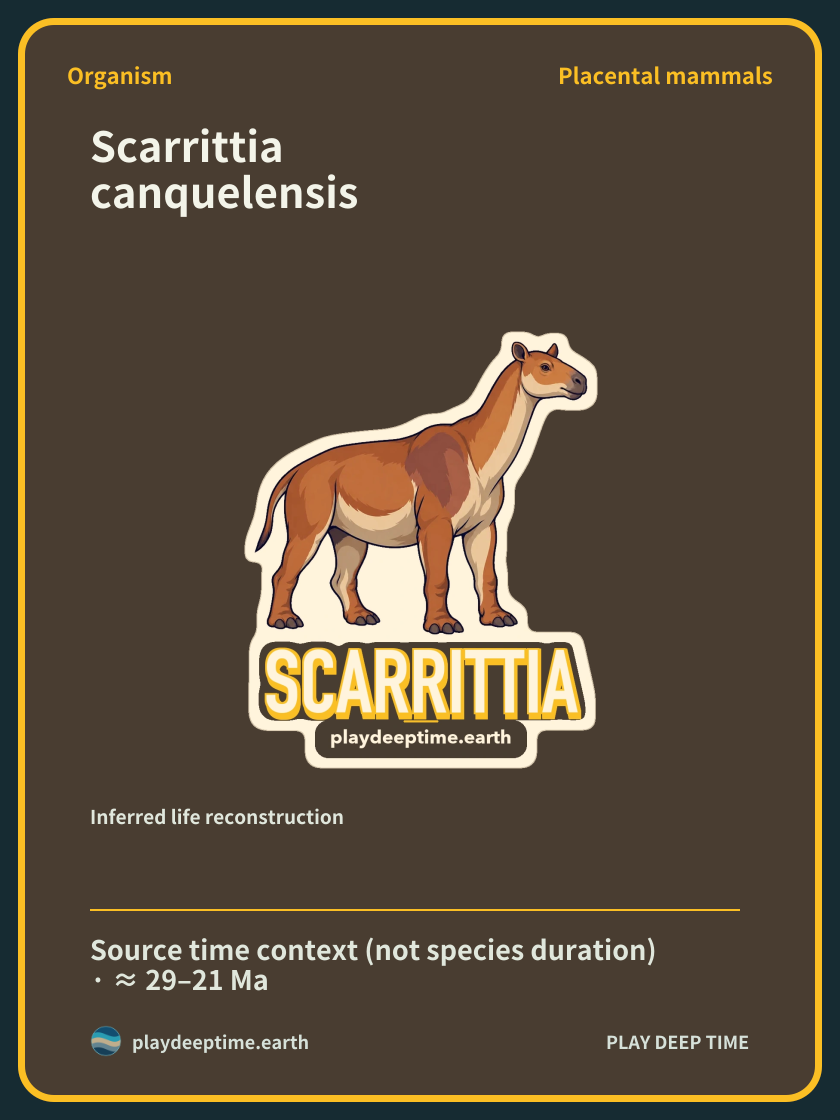
Inferred life reconstruction
Scarrittia canquelensis
Overview
Scarrittia canquelensis is an extinct mammal studied by comparing skulls, teeth, and several skeletal materials. A short lower jaw and narrow anterior jaw junction are described as genus features. Small facial structures can be explored alongside the broad arrangement of neck and limbs.[2][3]
Loading illustration…
Key facts
The point where the two halves of the lower jaw meet at the front is an important comparison region. Scarrittia is described as having a narrow junction. Beyond overall head length, where and how bones meet provides distinguishing clues.[2]
Time and place
Institutional collection records place its fossil locality in Patagonia, present-day Argentina. Fossil-database occurrence strata are summarized as spanning the Oligocene and Miocene, approximately 29–21 million years ago. Head and body skeletal material can be explored within this time and locality context.[4][2][1]
The time range describes source context, not the complete duration of this species.
Size, form and skeleton
The head is described as having a short lower jaw and narrow anterior junction. Comparative research also addresses the long neck and limbs of Scarrittia.[2][3]
A 2023 body-mass study estimated this species at approximately 450–550 kg. This range was inferred from fossil bone measurements.[5]
Loading illustration…
Habitat and reproduction
A 2012 study discussed the long neck and limb-support arrangement of Scarrittia. Interpretations of an upright supporting posture and foot pads were also proposed. Comparing bones with several related groups helped investigate how the body was used.[3]
Fossil discovery
The literature records the reference specimen and several subsequently assigned specimens separately. It explains that the original reference material was not collected and is now difficult to verify. Distinguishing and comparing later skull and skeletal material provides clues to this animal.[2][1]
References
- Smithsonian — Scarrittia canquelensis. Record nmnhpaleobiology_3456940
- Revised diagnosis of the head and teeth of Scarrittia
- 2012 study — Body and limb comparisons of leontiniids
- Paleobiology Database — Stratigraphic records of Scarrittia fossils
- 2023 study — Estimating body mass in South American native ungulates
- Billet et al. (2009) — Skulls and teeth of South American archaeohyracids
Research questions
How do small jaw features connect with large limb structures? Taxonomic research on skulls and teeth can be read alongside comparisons of body support. This understands the same organism through different body regions.[2][3]
Observation
Move your gaze from the front of the lower jaw to the neck, trunk, and limbs. Examining the short head outline separately from broad body connections helps compare the features revealed by each kind of evidence.[2][3]
Related organisms
 Archaeohyrax patagonicusPlacental mammalsSource time context (not species duration) · ≈ 33.9–23 Ma
Different bodies among mammals
Explore the bodies and backgrounds of Scarrittia canquelensis and Archaeohyrax patagonicus together. Scarrittia canquelensis is an extinct mammal studied by comparing skulls, teeth, and several skeletal materials. A short lower jaw and narrow anterior jaw junction are described as genus features. Archaeohyrax patagonicus is an extinct mammal from Late Oligocene South America. Its reference specimen, with skull and lower jaw articulated, is important research material.