Organism · Tetrapod lineage
Sclerocephalus haeuseri
Fossil record age bounds · ≈ 299–283 Ma
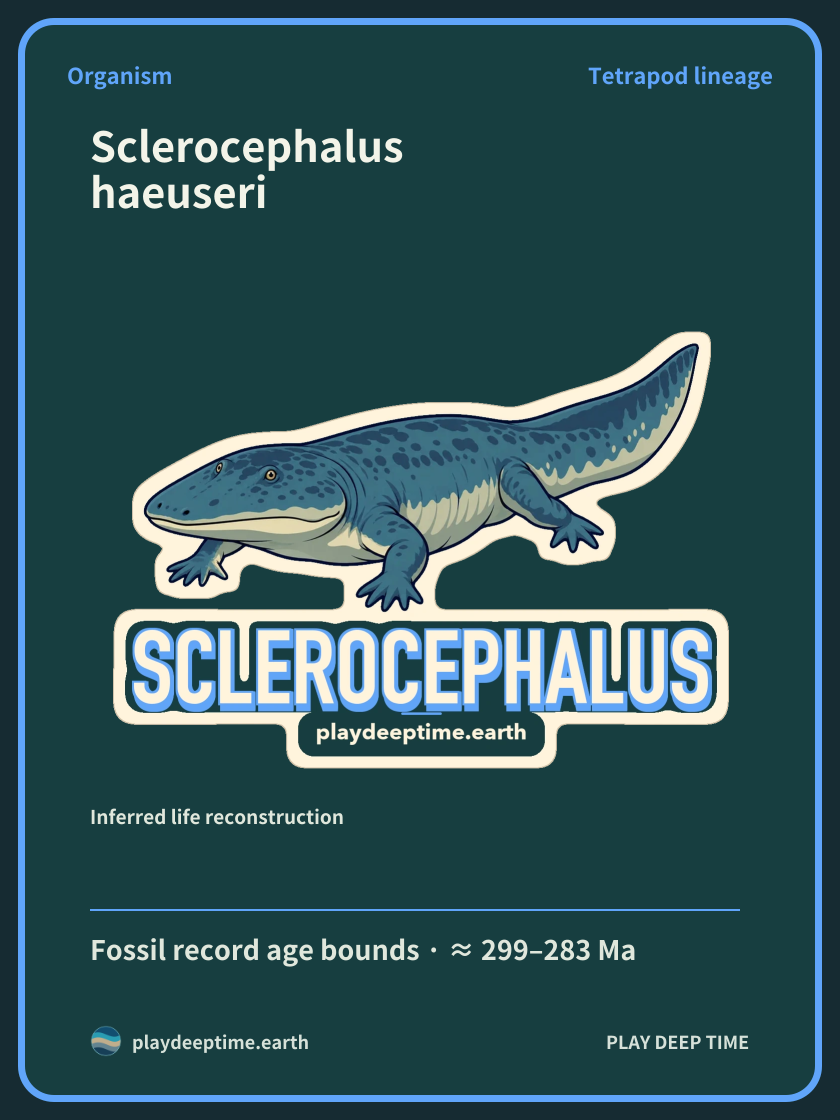
Inferred life reconstruction
Sclerocephalus haeuseri
Overview
Sclerocephalus haeuseri is a Paleozoic temnospondyl known for robust postcranial bones. Studies of adult Sclerocephalus describe a long trunk and a laterally flattened tail. This ancient tetrapod leads from the appearance of its head to the skeleton of the whole body.[1]
Loading illustration…
Key facts
The original reference specimen, long thought lost, was identified again in a museum collection. It was a partial skull held at the University of Lyon in France. This discovery came from reexamining an old collection rather than a new excavation.[2]
Time and place
It is known from Lower Rotliegend material in the Saar–Nahe Basin of present-day southwestern Germany. Research on this genus concerns the world around 300 million years ago, from the latest Carboniferous to the earliest Permian. Germany, where the fossil originated, and France, where the original reference specimen was stored, are different places.[1][2]
The time range describes source context, not the complete duration of this species.
Size, form and skeleton
A 2009 study examined the robust postcranial bones of haeuseri. Adult comparisons at genus level describe a long trunk and a laterally flattened tail. Examining head, trunk, and tail separately helps compare the organization of an ancient tetrapod.[1]
The skull length of the not yet fully grown specimen SMNS90517 is described as approximately 120 mm.[3]
Loading illustration…
Habitat and reproduction
Researchers proposed an aquatic lifestyle by considering the long adult trunk, flattened tail, and lateral-line grooves preserved in some individuals together. Different body regions thus informed the interpretation of its habitat. This research combines several clues rather than relying on one feature.[1]
Fossil discovery
Because the original reference specimen was thought lost, a new one was once designated. When a 2019 study identified the original partial skull again, its reference status was restored. Recovering the location of a fossil thus changed the reference for its scientific name.[2]
References
Research questions
How can a fossil in a collection be identified as the very specimen illustrated long ago? The rediscovery study compared the original description with features of the surviving skull. This brings the history of science together with the study of biological form.[2]
Observation
Move your gaze from the head to the long trunk and laterally flattened tail. Examining the outline of each region separately helps explain how researchers connect body structure with lifestyle.[1]
Related organisms
 Balanerpeton woodiTetrapod lineageSource time context (not species duration) · ≈ 359–299 Ma
Different bodies among amphibians
Explore the bodies and backgrounds of Sclerocephalus haeuseri and Balanerpeton woodi together. Sclerocephalus haeuseri is a Paleozoic temnospondyl known for robust postcranial bones. Studies of adult Sclerocephalus describe a long trunk and a laterally flattened tail. Balanerpeton woodi is an Early Carboniferous amphibian known for a broad, low head and four limbs. A skeletal diagram in the research shows the connections between the trunk, pelvis, and front of the tail.